
24 Feb 2026
- 12 Comments
When you pick up a prescription at the pharmacy, you might not think about why your insurer covers one generic drug but not another-even if they do the same thing. The truth is, insurers don’t just pick generics at random. There’s a detailed, systematic process behind it, and it’s designed to save money without sacrificing care. This is how they decide.
It Starts with the FDA
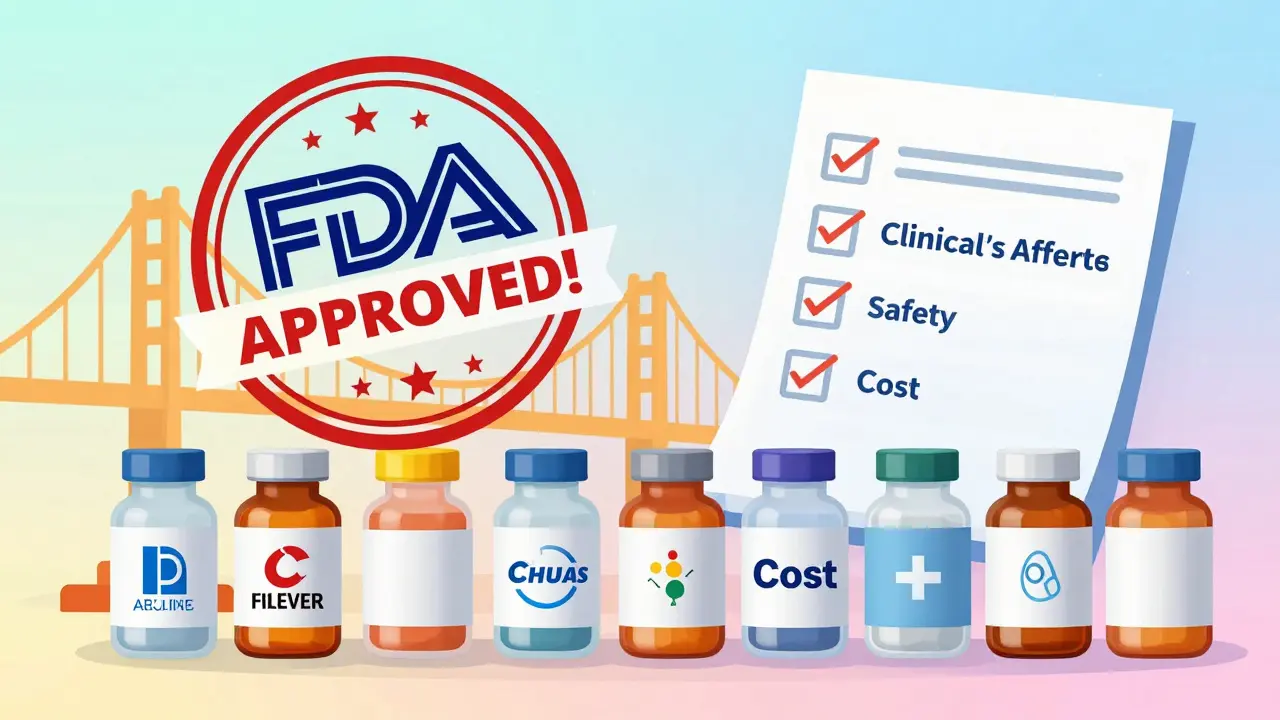
Before any insurer even looks at a generic drug, the FDA has already approved it. That’s the first gate. To be considered, a generic must contain the exact same active ingredient as the brand-name version, work the same way in the body, and meet the same quality standards. The FDA calls this "therapeutic equivalence." If a drug doesn’t have that label, insurers won’t even consider it for coverage.But here’s the catch: not all generics are created equal in practice. Some are made by manufacturers with better consistency, while others might have slight differences in inactive ingredients that affect how they’re absorbed. Insurers rely on the FDA’s rating system to know which ones are truly interchangeable.
The Role of Pharmacy & Therapeutics (P&T) Committees
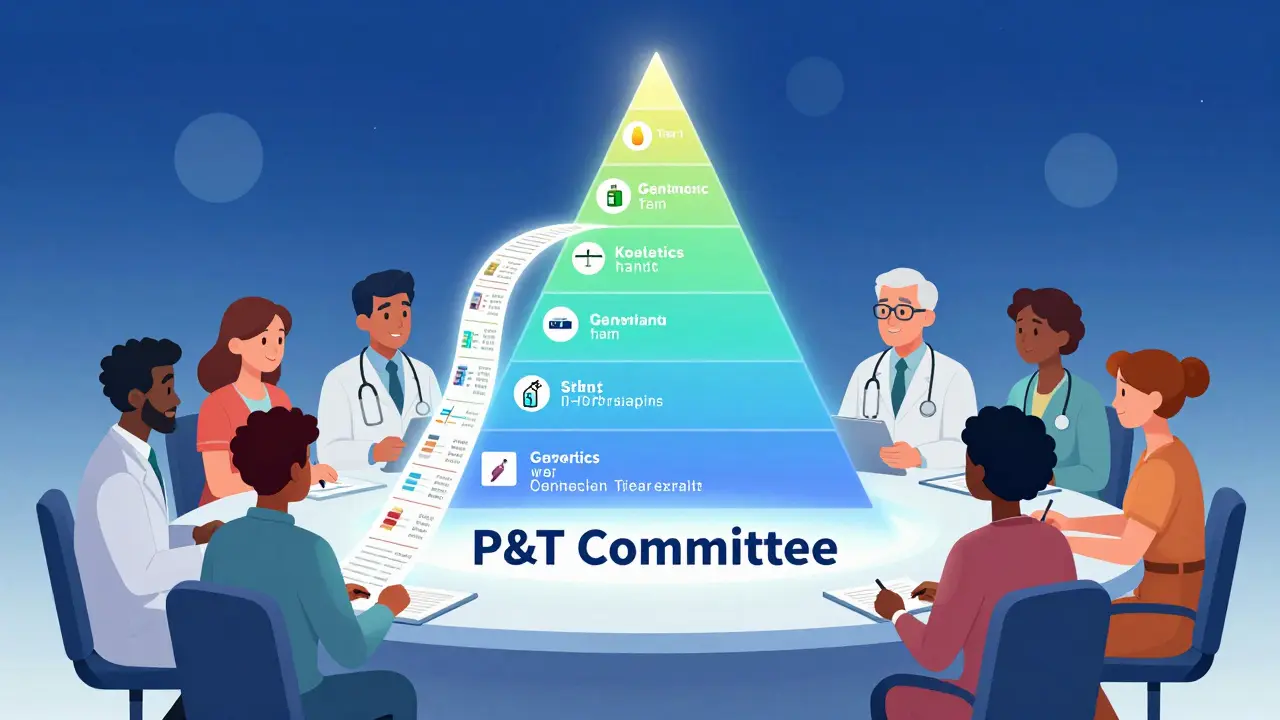
Every major insurer-whether it’s Medicare, UnitedHealthcare, or a local Blue Cross plan-has a Pharmacy & Therapeutics committee. These are groups of doctors, pharmacists, and sometimes patient advocates who meet regularly to review which drugs get covered. They don’t make decisions based on price alone. They look at three things:- Clinical effectiveness: Does the drug actually work? Are there studies showing it helps patients live longer, feel better, or avoid hospital visits?
- Safety: Does it have fewer side effects than other options? Are there known risks for older adults, people with kidney issues, or pregnant patients?
- Cost-effectiveness: If two drugs work just as well, but one costs 80% less, the cheaper one usually wins.
These committees don’t just look at clinical trials. Increasingly, they’re using real-world data-like how patients actually respond after the drug is on the market. Dr. Richard Baron, a leading voice in healthcare quality, says insurers now track outcomes from millions of prescriptions to see which generics deliver the best results in everyday use.
Tiered Formularies: Where Generics Always Win
Insurers organize their drug lists into tiers. Think of them like pricing levels. The lower the tier, the less you pay at the pharmacy.Generics almost always land in Tier 1. In fact, according to CMS data from 2023, 92% of Medicare Part D plans use a structure where only generics are in Tier 1. That means:
- Most people pay $0 to $15 for a 30-day supply of a generic
- Brand-name drugs often cost $40 to $100+
- Specialty drugs (like those for cancer or MS) can run over $500
Why? Because generics save money. Since 2007, Medicare Part D plans alone have saved over $1.6 trillion by using generics. In 2019, that number hit $141 billion in a single year. Those savings help keep premiums lower for everyone.
Why Some Generics Are Still Not Covered
Even if a drug is FDA-approved and cheap, it might not be on your plan’s list. Here’s why:- Too many similar options: If there are five equally effective generics for high blood pressure, insurers may only cover two-the cheapest and the one with the best safety record.
- Manufacturer deals: Some drugmakers pay insurers to prioritize their product. This isn’t illegal, but it can influence which generics make the cut.
- Formulary gaps: New generics can take months to get added. If a drug just came out last year, your insurer might still be reviewing it.
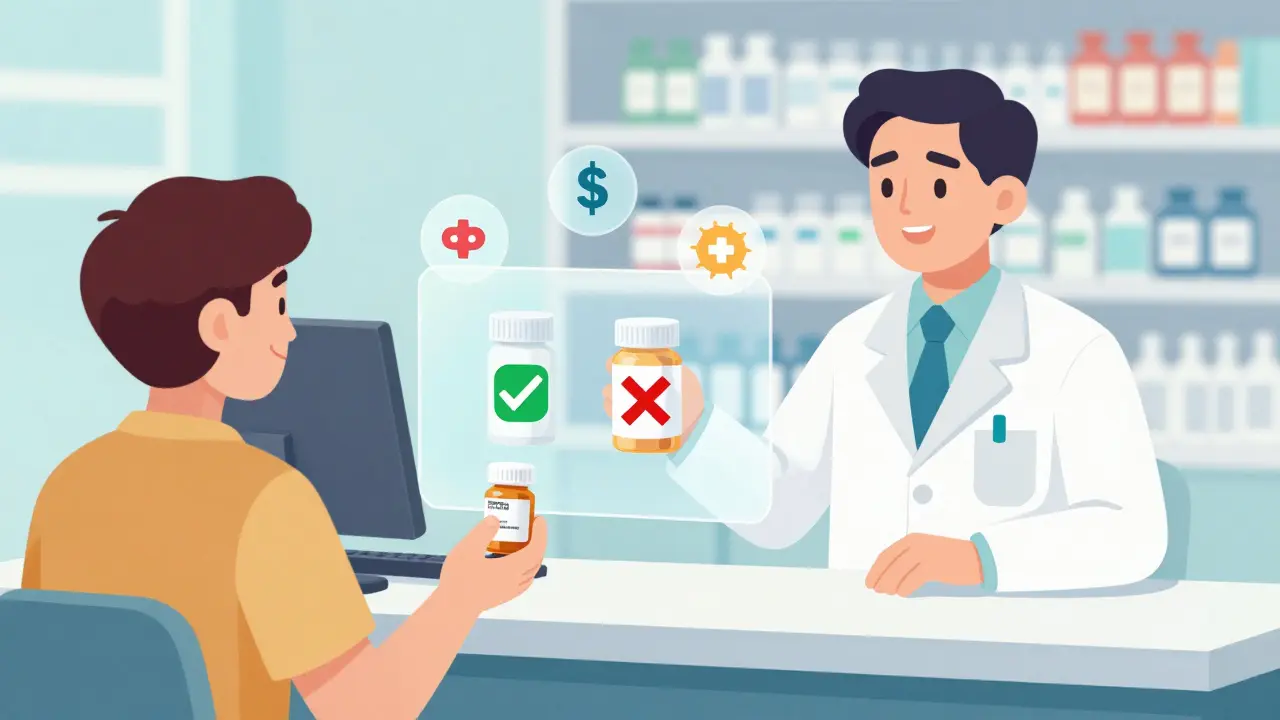
There’s also a hidden layer: therapeutic substitution. Some plans automatically swap your brand-name drug for a generic-even if your doctor didn’t prescribe it. In 78% of commercial plans, pharmacists can make this switch at the counter. But that doesn’t always go smoothly. A 2023 survey found 31% of patients reported side effects after switching to a substituted generic they hadn’t tried before.
What Happens When Your Drug Isn’t Covered?
If your prescription isn’t on the formulary, you’re not stuck. You can request an exception. This isn’t a long, complicated process. You or your doctor just need to submit a short form explaining why:- The covered generic caused bad side effects
- You tried it and it didn’t work
- You need a higher dose than the insurer allows
Insurers are required to respond within three business days. For urgent cases (like cancer or heart conditions), they must respond in one day. If they don’t respond? The request is automatically approved. The Patient Advocate Foundation found that 78% of people who appealed a denial eventually got coverage.
The Bigger Picture: Costs, Shortages, and Future Changes
The U.S. generic drug market was worth $81.8 billion in 2022 and is expected to hit $112.6 billion by 2027. Five companies-Teva, Sandoz, Mylan, Apotex, and Sun Pharma-control nearly half of it. Their production choices directly affect what’s available on formularies.But there’s a growing problem: drug shortages. As of October 2023, the FDA listed 372 active shortages, and 78% of them were generics. When a popular generic runs out, insurers scramble to find replacements. Sometimes, they switch to a different manufacturer. Other times, they temporarily lift restrictions on a brand-name drug.
Looking ahead, two big changes are coming:
- The Inflation Reduction Act: Starting in 2025, Medicare Part D beneficiaries won’t pay more than $2,000 out of pocket for drugs in a year. This pushes insurers to focus even more on low-cost generics to keep total spending down.
- Complex generics: The FDA is speeding up approval for hard-to-make generics like inhalers and insulins. That means more options could hit formularies soon.
Still, uncertainty remains. P&T committees are starting to see AI-driven personalized generics in development-drugs tailored to a patient’s genes or health history. But how do you price or compare those? No one has a clear answer yet.
What Patients Should Know
You don’t need to be an expert to navigate this system. Here’s what actually helps:- Ask your pharmacist: "Is this generic covered? If not, what’s the next option?"
- Check your plan’s formulary online. Most insurers list them in the member portal.
- If a drug isn’t covered, ask your doctor to file an exception. It’s easier than you think.
- Don’t assume all generics are the same. If you had a bad reaction to one, tell your doctor-it might be the manufacturer, not the drug.
The system isn’t perfect. Transparency is still low-only 37% of insurers publicly share their full decision criteria. But it works. Eighty-seven percent of all prescriptions filled in the U.S. are generics. That’s because insurers have built a system that rewards value: safe, effective, and affordable.
Why do some generic drugs cost more than others?
Even though all generics have the same active ingredient, manufacturers can charge different prices. Insurers negotiate discounts with drugmakers. The ones that offer the biggest price break usually get placed in the lowest tier. A generic made by a smaller company might cost more simply because it hasn’t struck a deal with your insurer.
Can my pharmacy switch my generic without telling me?
Yes, in many cases. If your plan allows therapeutic substitution, the pharmacist can swap one generic for another-even if your doctor prescribed a specific brand. They’re required to notify you if the change affects your cost or dosage. If you’re unhappy, ask for the original product or ask your doctor to write "Do Not Substitute" on the prescription.
Do Medicare and private insurers use the same formulary rules?
They follow very similar patterns. Both place generics in Tier 1 and use P&T committees to make decisions. But private insurers often have more flexibility. For example, Medicare must cover all FDA-approved drugs in certain categories, while private plans can exclude some. Also, 78% of commercial plans automatically substitute generics at the pharmacy-only 52% of Medicare Advantage plans do.
Why do some generics take so long to get covered?
Insurers review new drugs quarterly or semi-annually. Even if a generic is FDA-approved, it can take 6 to 12 months to get added to a formulary. This is because committees need time to review safety data, compare it to existing options, and negotiate pricing. Newer generics are often excluded until they’ve been on the market long enough to show real-world performance.
What’s the difference between a preferred and non-preferred generic?
Preferred generics are the ones insurers have negotiated the best price with. They’re usually cheaper and placed in Tier 1. Non-preferred generics are still covered but may cost more-sometimes as much as a brand-name drug. You’ll pay less if you use the preferred version. Your pharmacy can tell you which is which when you pick up your prescription.
Christina VanOsdol
February 26, 2026Wow. So insurers are basically playing chess with our prescriptions? 🤯 I just thought generics were generics. Turns out there’s a whole corporate game of ‘who gave the best discount’ behind that $3 pill. And don’t even get me started on the 31% of people who got weird side effects after a swap. That’s not healthcare. That’s a roulette wheel with your health on the line.
Alfred Noble
February 26, 2026i read this and thought 'finally someone explains why my blood pressure med keeps changing' lol. yeah, i got switched from one generic to another last month and i swear i felt like i was in a zombie movie for a week. pharmacist said 'it's the same drug' but nope. body knows. always ask for the brand name if it's not working. they can't say no forever.
Brooke Exley
February 28, 2026You know what? This is actually kind of beautiful. 🌱 Insurers aren’t just trying to save money-they’re trying to save *you*. By prioritizing generics that have real-world data backing them up, they’re cutting out the noise and giving you what works. And yes, the system’s flawed-but 87% of prescriptions being generics? That’s a win for accessibility. Keep pushing for exceptions. Your voice matters. You’re not just a number.
Matthew Brooker
March 1, 2026I’ve been a pharmacist for 14 years and let me tell you this: the real hero here is the P&T committee. Not the insurance execs. Not the drug reps. The doctors and pharmacists who sit in rooms for hours, sifting through data, trying to balance science and cost. They’re the ones saying ‘no’ to the flashy new generic that’s 20% cheaper but has 3x the hospitalization rates. We don’t talk about them enough.
Emily Wolff
March 1, 2026This is why people hate the system. It’s not about health. It’s about profit. The FDA approves. The P&T committee rubber-stamps. The insurer negotiates. And you? You’re the one who ends up with a pill you’ve never taken before and a $400 bill. It’s not a system. It’s a shell game.
Khaya Street
March 2, 2026I appreciate the clarity in this piece. The tiered formulary explanation alone is worth the read. It’s easy to assume insurers are arbitrary, but when you see the structured, evidence-based logic behind their choices, it’s hard to dismiss them as purely profit-driven. The real issue? Lack of transparency. If patients could see the criteria, we’d have fewer angry calls to customer service.
Nick Hamby
March 3, 2026There’s a philosophical layer here that few acknowledge: healthcare is not a market. It is a covenant. When we allow cost-effectiveness to override patient experience-when we treat a human body like a spreadsheet cell-we erode the very foundation of care. Generics save money. But if a patient’s body rejects a substitution because of an inactive ingredient, is that savings? Or is it a betrayal of trust? We must ask not just ‘what is cheaper?’ but ‘what is humane?’
Haley Gumm
March 4, 2026I work in a clinic. Last week, a 72-year-old came in crying because her new generic made her dizzy. She’d been on the brand for 8 years. The pharmacist swapped it. No warning. No consent. She’s not dumb. She’s scared. This isn’t innovation. It’s negligence dressed up as efficiency.
Joseph Cantu
March 5, 2026Let’s be real. The real reason some generics aren’t covered? Big Pharma pays off the P&T committees. It’s not about safety. It’s not about data. It’s about who bribed who. The FDA? A joke. The Inflation Reduction Act? A PR stunt. And don’t even mention those ‘real-world data’ studies-they’re all funded by the same 5 companies that control 50% of the market. This isn’t healthcare. It’s a cartel.
Jacob Carthy
March 6, 2026America’s healthcare is a mess but at least we got generics. In other countries? You wait 6 months for a prescription. Here? You get 15 options. If one makes you feel weird? Ask for another. The system works. Stop whining. People in other countries would kill for this level of access. We got problems? Fine. But we got solutions too. Quit being so dramatic.
Lisandra Lautert
March 7, 2026I’ve been on 7 different generics for my thyroid in 3 years. Each one ‘works.’ Each one also made me feel like I was slowly dissolving. My doctor says ‘it’s the same drug.’ But my body says otherwise. And now I’m being told to ‘just accept it’ because the insurer says it’s cost-effective. I’m not a cost. I’m a person.
kirti juneja
March 9, 2026As someone from India where generics are the ONLY option, this article hit different. We don’t have brand-name drugs here. We have generics. And we know which ones work. We know which manufacturers are trustworthy. We don’t need a P&T committee. We need transparency. And maybe, just maybe, if the U.S. started listening to patients like we do, fewer people would feel like guinea pigs.