
16 Jan 2026
- 15 Comments
Medication Guide Checker
Check Your Prescription Drug
Find out if your medication requires a federally mandated Medication Guide and understand your rights.
Results
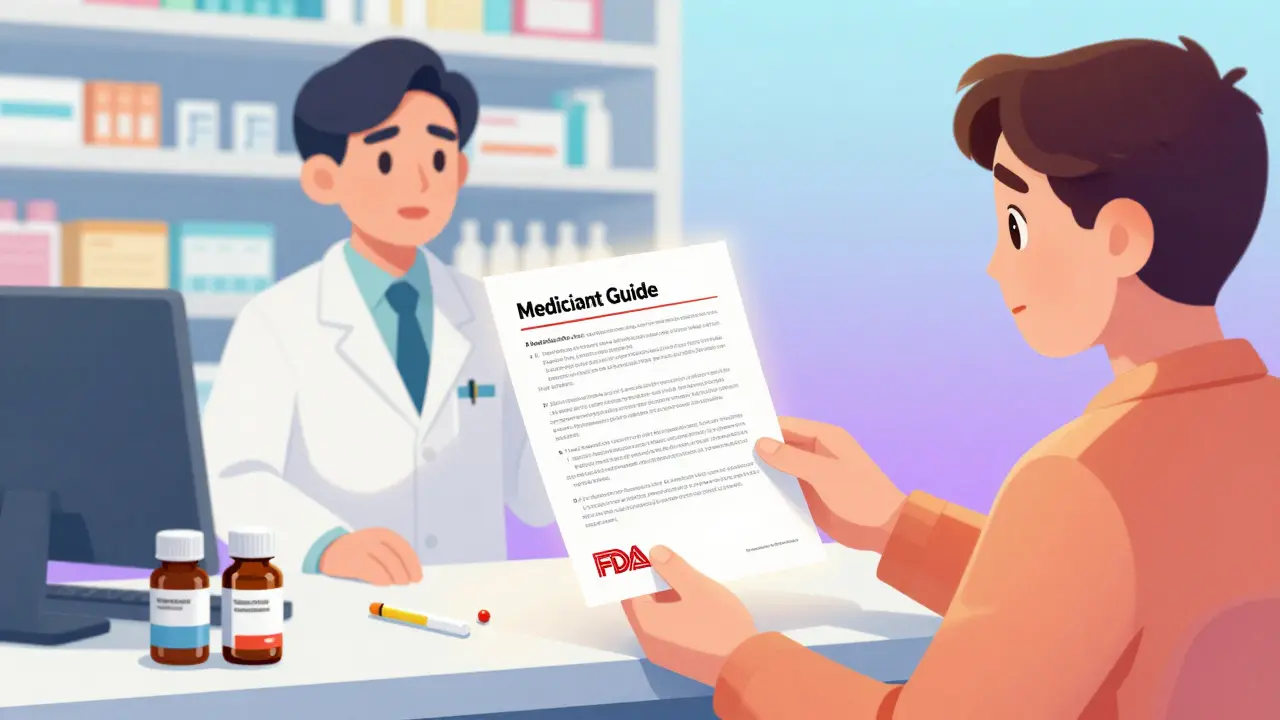
When you pick up a prescription, you might not think to ask for a Medication Guide. But if your drug requires one, you have a legal right to receive it - in paper form - every single time. And if you’d rather get it electronically, you can ask for that too. Pharmacies don’t get to decide whether you get it. The FDA says you must.
What Exactly Is a Medication Guide?
A Medication Guide is not just a small leaflet tucked into your pill bottle. It’s a federally approved, legally required document that explains serious risks of certain prescription drugs in plain language. The FDA started requiring these in 1998 because too many people were ending up in the hospital from side effects they never knew about.
These guides aren’t for every drug. Only about 5% of prescription medications need them - around 150 drugs as of 2023. These are the ones with serious risks: things like liver damage, dangerous interactions, or side effects that could be fatal if you don’t follow instructions exactly. Think blood thinners, certain antidepressants, diabetes drugs with high hypoglycemia risk, or medicines that can cause birth defects.
The FDA makes sure these guides follow strict rules. They must be written in simple English - no medical jargon. The font can’t be smaller than 10-point. The words “Medication Guide” must be at the top, followed by the brand name and generic name of the drug. And right at the bottom, it must say: “This Medication Guide has been approved by the U.S. Food and Drug Administration.” No exceptions.
You Have the Right to a Printed Copy - Every Time
Under 21 CFR §208.24, pharmacies are required to give you a printed Medication Guide when you pick up your prescription. Not when you ask. Not if you seem like you “might want it.” Right then. At the counter. With your meds.
Pharmacists can’t say, “We’re out,” or “It’s on the shelf over there,” or “We’ll email it later.” That’s not enough. The law says they must hand it to you at the time of dispensing. If they don’t, they’re breaking federal regulations.
Some pharmacies skip this step because they’re busy. A 2022 audit by the Department of Health and Human Services found that 31% of pharmacy sites had problems tracking or distributing Medication Guides. Independent pharmacies were more likely to miss it than big chains. But that doesn’t make it okay. You’re not asking for a favor. You’re exercising a right.
But What If You Don’t Want Paper? You Can Ask for Electronic
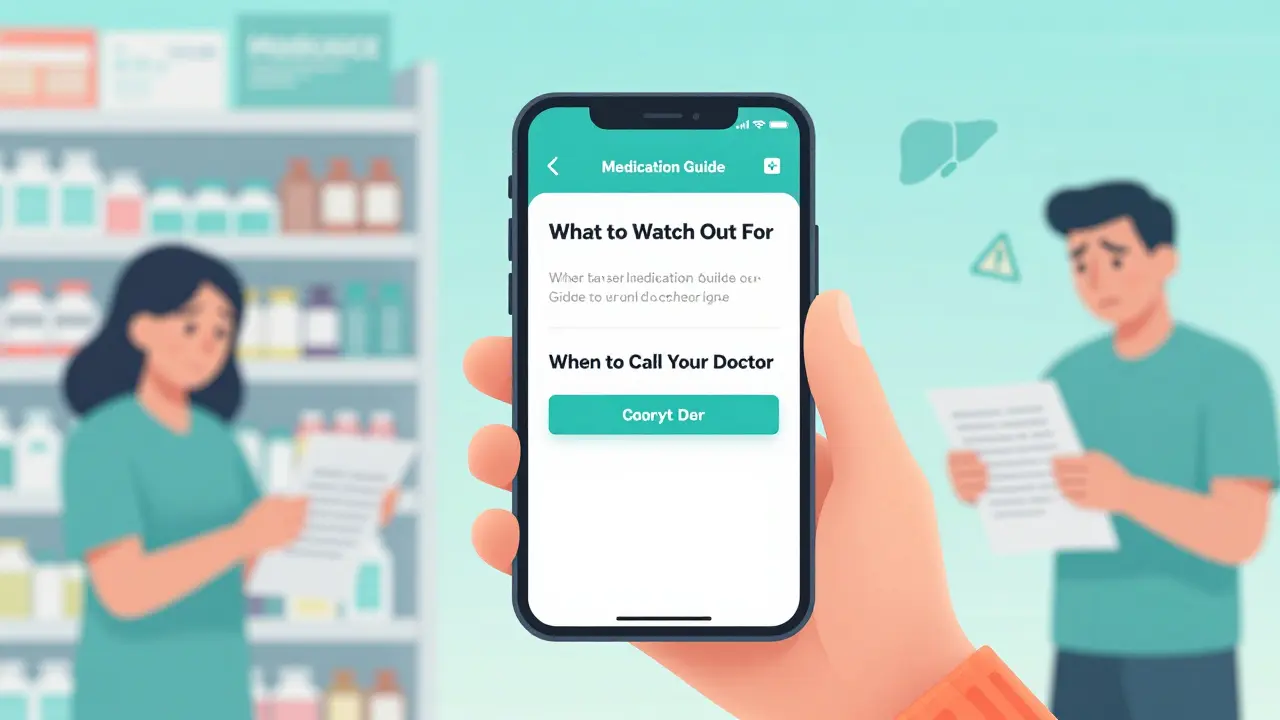
In May 2023, the FDA updated its rules to say: if you prefer to get your Medication Guide on your phone or tablet, the pharmacy must give it to you that way. No pressure. No extra fees. Just a simple request.
You can say: “I’d rather get this guide electronically. Can you text me the link or email it?” The pharmacy has to comply. They can’t refuse just because they’ve always done it the old way. They need to have systems in place to provide electronic versions - and many chains already do.
This change was made because most people carry smartphones. Paper guides get lost, crumpled, or thrown away. Digital ones stay accessible. You can read them at home, share them with family, or show them to your doctor later.
Why Do So Many People Never Get Them?
Despite the rules, a 2022 survey by the National Consumers League found that 43% of patients never received a Medication Guide when they should have. Why?
- Pharmacists are overwhelmed. It takes 15-20 seconds per prescription to verify, pull, and hand out the guide. During rush hours, that’s time they don’t have.
- Some pharmacies don’t stock enough copies. If the manufacturer doesn’t send enough, and the pharmacy doesn’t have a printer, they’re stuck.
- Many patients don’t know they’re entitled to it. So they don’t ask.
- Some guides are hard to read. A 2023 analysis by ASHP found 68% of guides are written at an 11th-grade reading level or higher - way above the recommended 6th-grade level for patient materials.
One patient in Bristol told me she filled a prescription for a blood thinner and didn’t get a guide. A week later, she started feeling dizzy. She looked up the drug online and found the guide - it warned about dizziness and avoiding alcohol. She called her pharmacist. They admitted they’d forgotten. She filed a complaint with the FDA. They responded within two weeks.
What to Do If You Don’t Get Your Guide
If you’re not given a Medication Guide when you should be, here’s what to do:
- Ask clearly: “Is there a Medication Guide for this drug? I’m entitled to one by law.”
- If they say no, ask: “Can you print it right now?” or “Can you email it to me?”
- If they still refuse, ask for the pharmacy manager. Say: “I’m requesting my FDA-mandated Medication Guide. If you can’t provide it, I’ll need to file a complaint.”
- If nothing works, report it to the FDA through their MedWatch portal. You don’t need to know the drug’s name - just describe the situation.
Don’t wait. These guides have saved lives. A 2022 survey by Patients for Safer Drugs found that 22.5% of people who received the guide said it helped them avoid a dangerous reaction - like stopping a drug before it caused liver damage or realizing they couldn’t take it with their other meds.
The Big Change Coming: Patient Medication Information (PMI)
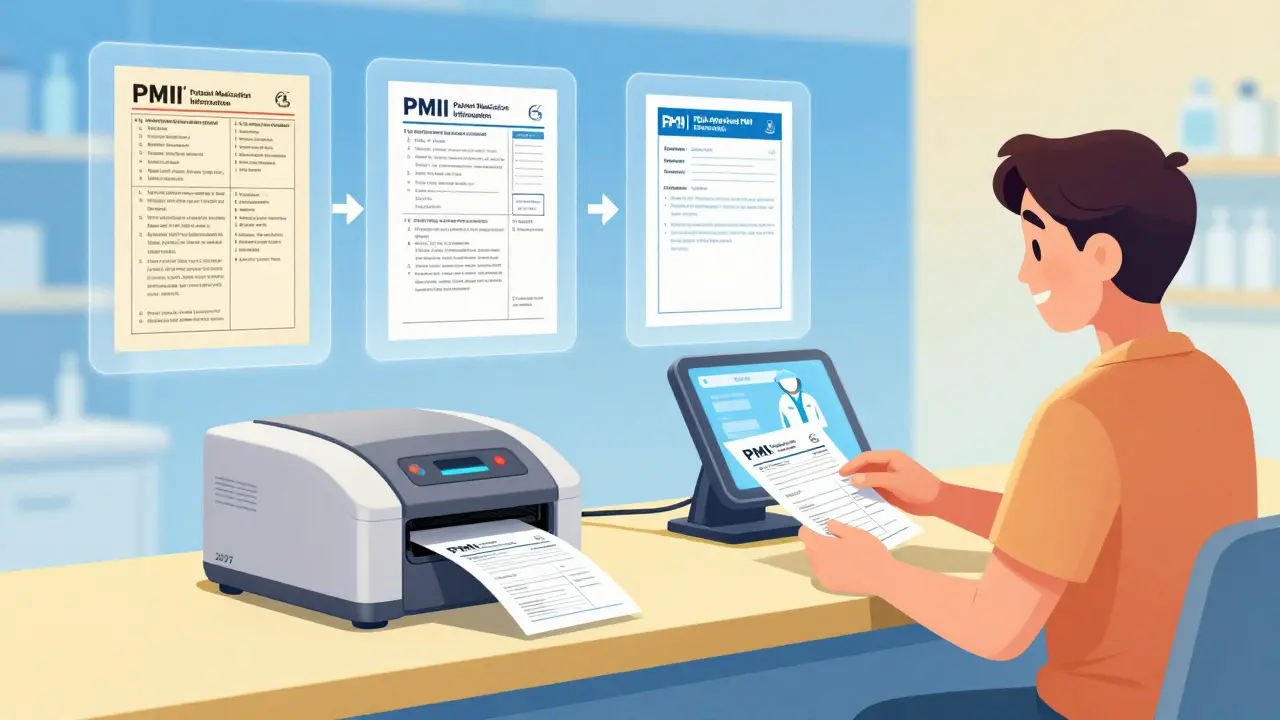
The FDA isn’t stopping here. By 2027, they plan to replace all current Medication Guides with something new: Patient Medication Information, or PMI.
PMI will be a single, standardized one-page format for every drug. No more 12-page booklets with tiny fonts. No more inconsistent layouts. Just clear headings: What this medicine is, Why you’re taking it, What to watch out for, What to avoid, What to do if you miss a dose, and When to call your doctor.
The FDA tested PMI prototypes and found patients understood them 37% better than current guides. That’s huge. It means fewer mistakes. Fewer ER visits. More people staying safe.
But here’s the catch: pharmacies will need new printers, software, and training. The cost could hit $600 million industry-wide. Independent pharmacies might spend $2,500 to upgrade. Chains, up to $15,000. It’s a big shift. But the goal is simple: make sure every patient gets information they can actually use.
Bottom Line: Know Your Rights, Speak Up
You don’t need to be a medical expert to protect yourself. You just need to know your rights. If your prescription requires a Medication Guide, you’re entitled to it - printed or digital. No excuses. No delays. No “we’re out.”
Next time you pick up a prescription, check the bottle. If it’s one of the drugs that needs a guide (you can look up the list on the FDA website), don’t leave without it. Ask. If they say no, ask again. And if they still say no - file a complaint. Your life might depend on it.
Do I have to pay for a Medication Guide?
No. Medication Guides are provided at no extra cost. They’re part of the prescription service, paid for by the drug manufacturer under FDA rules. Pharmacies can’t charge you for them - not even a small fee.
What if I lose my printed Medication Guide?
You can ask the pharmacy for another copy. They’re required to have them on hand or be able to print them. You can also request an electronic version via email or text. Many drug manufacturers also post PDFs of their guides on their official websites.
Are Medication Guides the same as the leaflets inside the pill bottle?
No. The small leaflet inside your bottle is usually a patient information sheet created by the pharmacy or manufacturer, but it’s not FDA-approved. Only the official Medication Guide - with the FDA approval statement at the bottom - meets federal requirements. Don’t confuse the two.
Can I get a Medication Guide for over-the-counter (OTC) drugs?
No. Medication Guides only apply to prescription drugs that the FDA has specifically flagged for serious safety concerns. OTC drugs have different labeling rules and don’t require these guides.
How do I know if my drug needs a Medication Guide?
You can search the FDA’s list of drugs requiring Medication Guides on their website. Or, when you pick up your prescription, ask the pharmacist: “Does this drug require a Medication Guide?” If they hesitate or say no, you have the right to ask for proof - the FDA’s official list is public and available to anyone.
Andrew Qu
January 17, 2026I’ve been a pharmacist for 12 years, and I can tell you-most of us *want* to give out the guides. But we’re running on fumes during lunch rush. One guy with 12 scripts, 3 of them needing guides, and the printer jammed? Yeah, it happens. We’re not trying to hide anything. We’re just drowning.
That said, if you ask clearly, we’ll drop everything. Seriously. I’ve printed guides while the next customer waited. No one’s ever complained about the delay when they realized why it mattered.
Andrew Short
January 18, 2026Oh please. Another ‘you have a right’ lecture. You don’t have a right to waste my time. If you can’t read the tiny print on the bottle, maybe you shouldn’t be taking pills. The FDA doesn’t run your life. Stop treating pharmacies like customer service desks.
And don’t even get me started on ‘electronic versions.’ Next you’ll want them to text you a video tutorial with interpretive dance.
christian Espinola
January 19, 2026Let’s be real: this whole Medication Guide thing is a government overreach disguised as ‘patient safety.’ Who decided you need a 12-page pamphlet to understand that blood thinners can kill you? You’re an adult. Read the label. If you can’t, maybe you’re not fit to manage your own meds.
And don’t tell me about the ‘FDA approval’ stamp-that’s just bureaucratic theater. The same agency that approved Vioxx and OxyContin is now your medical conscience? LOL. This is about liability, not safety.
Also, 68% of guides are written at 11th-grade level? That’s not a flaw-it’s a feature. If you can’t read above 6th grade, you shouldn’t be on prescription meds. Period.
Chuck Dickson
January 21, 2026Hey, if you’re reading this-you’re already ahead of the game. Seriously. Most people just grab their pills and walk out. But you? You care. That’s huge.
Next time you’re at the pharmacy, just say, ‘Hey, can I get the Medication Guide for this?’ with a smile. Most pharmacists will be so relieved you asked they’ll hand it over like it’s a free coffee.
And if they don’t? Don’t rage. Just say, ‘No worries-I’ll check the FDA site.’ Then do it. You’re not being annoying. You’re helping make the system better-for everyone.
Also, if you get the guide and it helps you avoid a bad reaction? Tell your pharmacist. They’ll remember you. And next time? They’ll be ready.
You’re not just a patient. You’re a partner in your health. Keep showing up.
Robert Cassidy
January 22, 2026This is all part of the pharmaceutical-industrial complex’s control agenda. They want you dependent. They want you confused. They want you reading 12-page PDFs so you feel too overwhelmed to question the drug’s real purpose.
Why do you think they only make these guides for 5% of drugs? Because the other 95%? Those are the ones that *really* mess you up-and they don’t want you to know.
And don’t tell me about ‘FDA approval.’ The FDA is a revolving door between Big Pharma and government. They’re not your friends. They’re your jailers.
Next time you get a prescription, ask for the guide. Then burn it. And call your congressperson. This isn’t about safety-it’s about conditioning.
Naomi Keyes
January 23, 2026Actually, the FDA’s 2023 update to electronic delivery does NOT override the requirement for printed copies at the time of dispensing-per 21 CFR §208.24(a)(1), which states: ‘The pharmacist shall provide the Medication Guide to the patient at the time of dispensing.’
Furthermore, the ‘electronic option’ is an *alternative*, not a substitution, unless the patient affirmatively consents in writing-or via a documented electronic acknowledgment-under §208.24(c)(2).
Also, the 2022 HHS audit found 31% of pharmacies had ‘deficiencies,’ but only 12% were cited for actual violations. Many were ‘minor documentation lapses.’
And the 11th-grade reading level? That’s because the content is derived from clinical trial data, not consumer marketing copy. Simplifying it too much risks misrepresentation.
Finally, the FDA’s MedWatch portal does not accept anonymous complaints without the drug’s NDC number-so your ‘describe the situation’ advice is misleading.
Dayanara Villafuerte
January 23, 2026Okay but imagine if your doctor gave you a pill and said ‘here’s your heart medication’ and walked away 😭
That’s what happens when you don’t get the guide. I got one for my mom’s diabetes med last year-read it on the bus. Turns out she was supposed to take it *after* food, not before. She almost passed out. 🥲
So yeah, ask for it. Even if you think you know what you’re doing. You don’t. None of us do. 🤷♀️💊
Also-pharmacies? They’re tired. Be nice. Ask like you mean it. Not like you’re filing a complaint. Just say ‘Hey, can I get the guide for this?’ and smile. It’s 10 seconds. It saves lives.
rachel bellet
January 25, 2026The entire framework is structurally flawed. Medication Guides are not evidence-based patient education-they’re risk mitigation artifacts designed to satisfy regulatory compliance metrics, not improve outcomes.
Furthermore, the 6th-grade reading level recommendation is rooted in a 1990s literacy model that ignores cognitive load theory and health literacy as a dynamic, context-dependent construct.
And the digital transition? It’s a performative gesture. Most elderly patients don’t have smartphones. And those who do? They’re not downloading PDFs from pharmacy portals-they’re Googling symptoms.
The real problem? No one’s auditing whether patients *understand* the guides. Just whether they were *distributed*.
kenneth pillet
January 26, 2026Got my guide for my blood thinner last week. Pharmacist forgot. Asked again. Got it. Didn’t make a fuss. Just said ‘thanks.’
Worth it. I read it at home. Found out I can’t drink grapefruit juice. Didn’t know that.
Pharmacists are busy. Be cool. Ask nicely. They’ll help.
Jodi Harding
January 28, 2026They don’t give you the guide because they don’t want you to think.
Think about it.
If you knew what the drug *really* did, would you still take it?
They need you silent. Compliant. Unquestioning.
Asking for the guide? That’s rebellion.
And you’re winning.
Danny Gray
January 30, 2026But what if the guide is wrong? What if it’s outdated? What if the FDA approved it based on a study funded by the manufacturer? What if the real risk isn’t listed because it’s too expensive to fix?
Isn’t the real issue that we’ve outsourced our health to systems that profit from our ignorance?
Maybe we shouldn’t be asking for guides.
Maybe we should be asking why they exist at all.
Tyler Myers
February 1, 2026They’re lying. The FDA doesn’t require this. It’s a myth. I checked. There’s no law. It’s just a recommendation. Pharmacies don’t have to give it. They just do it because they’re scared of lawsuits.
And the ‘electronic option’? That’s just a way for them to stop printing. They’re cutting costs. You’re being manipulated.
Don’t trust the FDA. Don’t trust the pharmacy. Trust yourself. Or don’t take the pill.
Zoe Brooks
February 2, 2026I used to ignore these guides too. Then I got one for my antidepressant. It said ‘don’t stop suddenly’-I didn’t know that. I almost went into withdrawal because my doctor assumed I’d read it.
Now I always ask. Even if I think I know the drug.
It’s not about being scared. It’s about being smart.
And if the pharmacist looks annoyed? Just say ‘I appreciate you helping me stay safe.’
They’ll smile. I promise.
Kristin Dailey
February 3, 2026USA first. If you want a guide, go to Canada. They don’t waste time on paper. They trust people to read the label. We’re too soft here.
Andrew McLarren
February 3, 2026Thank you for this comprehensive and well-referenced summary. The legal and practical dimensions you’ve outlined are critical for patient autonomy.
I would only add that while the FDA’s mandate is clear, implementation varies significantly due to systemic under-resourcing in community pharmacy settings.
It is neither the fault of individual pharmacists nor the intent of the regulation that these guides are inconsistently distributed.
Advocacy, as you’ve described, remains the most effective bridge between policy and practice.
Well done.