
16 Mar 2026
- 10 Comments
When you pick up a generic pill from the pharmacy, you expect it to work just like the brand-name version. But what if that pill is cracked, discolored, or contains too little-or too much-of the active ingredient? These aren’t rare glitches. They’re common manufacturing defects that happen more often in generics than you might think. And they’re putting patients at risk.
What Goes Wrong in Generic Drug Manufacturing?
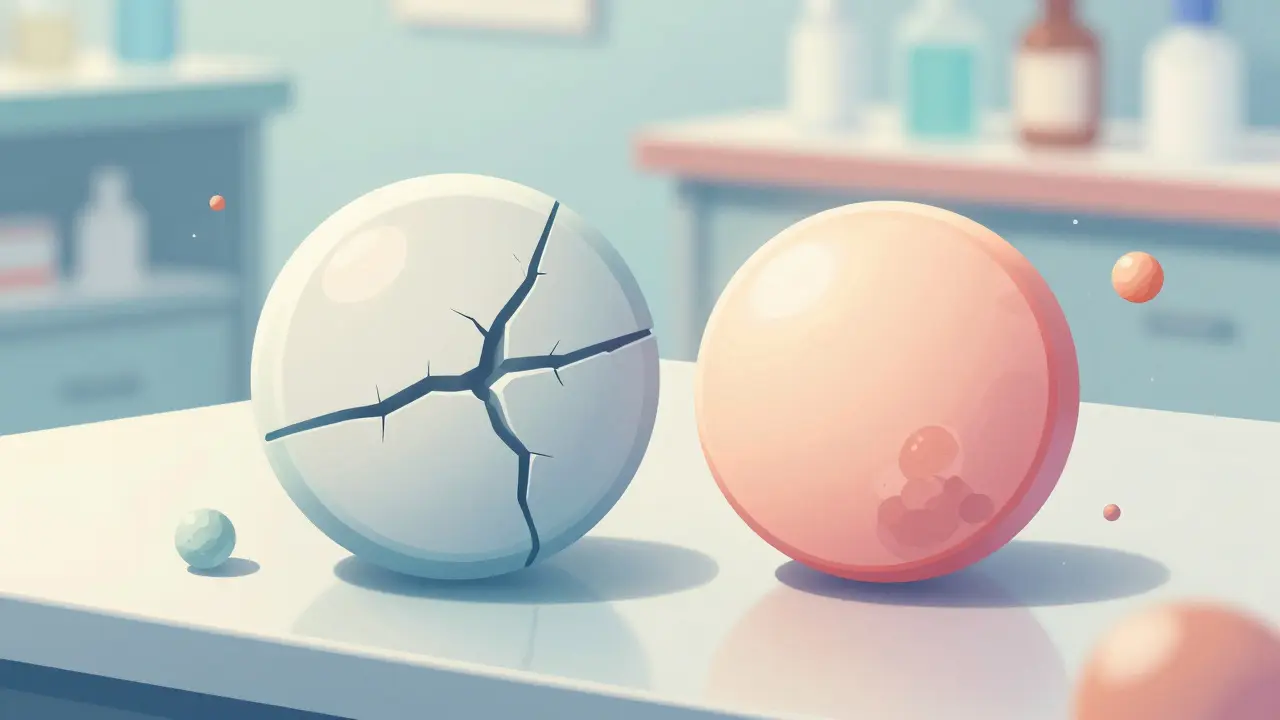
Generic drugs are supposed to be exact copies of brand-name drugs. But copying a pill isn’t as simple as making a photocopy. The process involves precise chemistry, controlled environments, and high-speed machinery. When any part of that system slips, defects appear. The most frequent problems show up in oral solid tablets. Look at the surface: if it’s splitting horizontally, that’s capping. If layers peel apart, that’s lamination. If the tablet sticks to the machine’s punch and comes out misshapen, that’s sticking. And if the color looks patchy or blotchy, that’s mottling. These aren’t just cosmetic issues. Each one signals a deeper problem in the manufacturing process. Capping happens when compression force goes over 15 kN and the tablet’s moisture content drops below 2%. That’s common in hydrophobic drugs like some blood pressure medications. Lamination occurs when tablet presses run faster than 40 rotations per minute and pre-compression isn’t strong enough. Sticking? That’s often tied to active ingredients with melting points under 120°C-like some antidepressants-when humidity rises above 4% during long production runs. These aren’t guesses. These are measurable, documented thresholds backed by decades of pharmaceutical engineering.Why Are Generics More Prone to Defects?
Branded drug companies spend 15-18% of their production budget on quality control. Generic manufacturers? They average 8-10%. Why? Price pressure. Generics make up 90% of U.S. prescriptions but only 23% of total drug spending. That means every penny counts. And quality often gets cut. Many generic manufacturers share facilities. One line might make a blood thinner, the next a diabetes pill. Cross-contamination is a real risk. Older equipment, not designed for modern standards, is still in use. The FDA found that 57% of generic manufacturing sites failed inspections in recent years, compared to just 28% of branded sites. That’s not coincidence-it’s systemic. The numbers don’t lie. Generics face 3.2 times more quality issues than branded drugs. And it’s not just about looks. The FDA’s Product Quality Defect system classifies defects by risk. Critical defects affect dose accuracy-like weight variation over 5%. Major defects hurt patient trust, like severe mottling. Minor ones? Those are often accepted with paperwork. But in practice, even minor defects can lead to bigger problems down the line.Defects by Drug Type: Some Generics Are Riskier Than Others
Not all generics are created equal. Simple immediate-release tablets-like basic ibuprofen or metformin-have a defect rate of about 9.3%. But when you get into complex formulations, the numbers climb fast. Modified-release tablets? That’s 14.7%. These are designed to release medicine slowly over hours. If the coating is uneven or the granules don’t flow right, the drug hits too fast or too slow. Patients report side effects or no relief-both are signs of manufacturing failure. Inhalers? 18.2% defect rate. That’s because they require precise particle size, consistent metering, and perfect valve function. A single flawed unit can mean a patient doesn’t get the dose they need during an asthma attack. Sterile injectables? 8.7% defect rate. These are made in clean rooms, but contamination still happens. Particles in IV bags? That’s not just a quality issue-it’s a life-threatening one. The FDA has issued dozens of recalls over the past five years for injectables with visible particles or microbial contamination.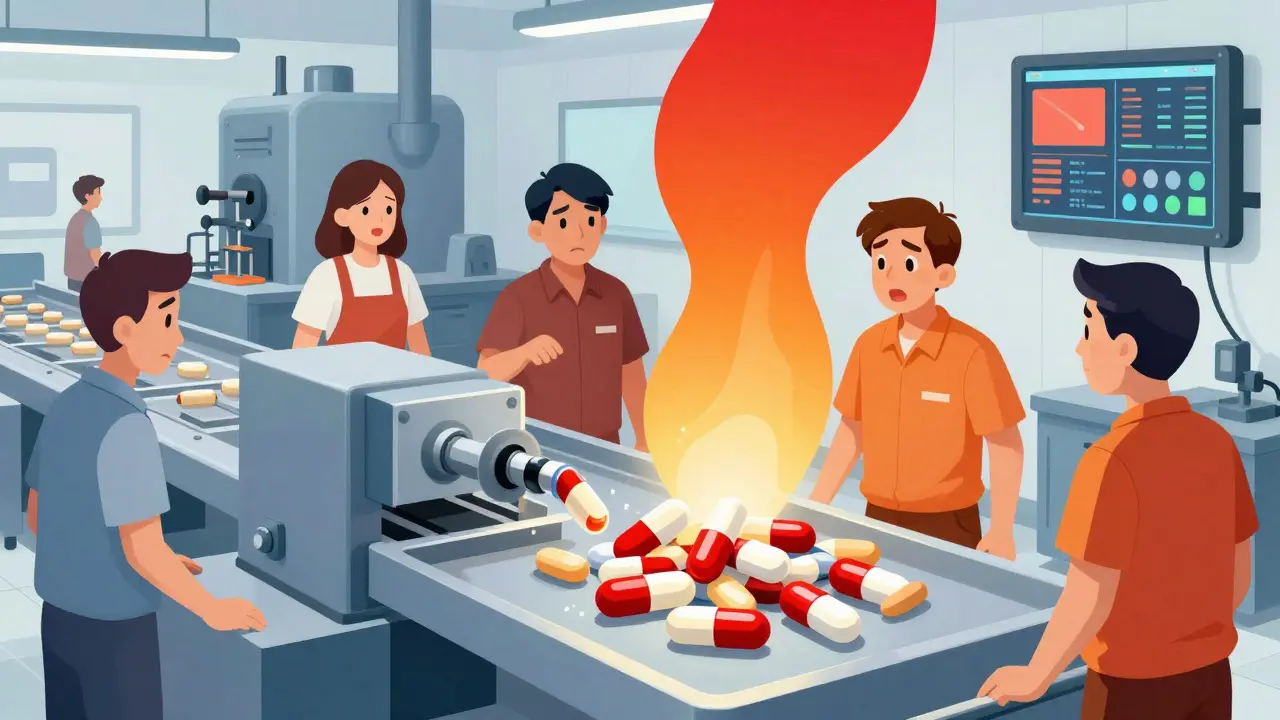
Real-World Impact: What Pharmacists and Patients Are Seeing
A 2023 survey of 1,247 U.S. pharmacists found that 68% had encountered a quality issue with a generic drug in the past year. Forty-two percent said patients complained about tablets crumbling, chipping, or looking wrong. Twenty-nine percent reported cases where patients said a generic didn’t work like the brand version-even though they were supposed to be identical. Reddit threads from pharmacy workers are full of stories: “Received a batch of metformin ER that turned to powder in the bottle.” “Three patients on the same levothyroxine generic had wildly different thyroid levels.” These aren’t outliers. They’re patterns. The FDA’s MedWatch system logged 1,842 adverse events in 2023 directly tied to generic drug appearance or performance. 327 of those involved visible defects-cracks, discoloration, uneven surfaces. That’s not paranoia. That’s data. Hospital formulary committees in 2023 saw 17.3% of generic substitution requests come with quality concerns. Nearly 10% of those led to permanent switches back to brand-name drugs. Why? Because safety trumps cost.How Manufacturers Are Trying to Fix This
It’s not all bad news. Some companies are stepping up. The FDA’s Emerging Technology Program has helped 47 generic manufacturers switch from batch processing to continuous manufacturing. That alone cuts defect rates by 65%. Why? Because continuous systems monitor every step in real time. No batch is too big to miss a flaw. Advanced visual inspection systems now scan tablets at 600 per minute, spotting defects as small as 0.1 mm. Human inspectors miss 30% of problems. Machines miss less than 2%. That’s a game-changer. In-line weight monitoring systems reject tablets outside ±5% of target weight-faster than a human can react. Training programs now require 40+ hours of GMP instruction per year. And AI is starting to help. Pilot programs at Sandoz and Dr. Reddy’s are using machine learning to predict defects before they happen. Accuracy? 92%. But these upgrades cost money. The Generic Pharmaceutical Association estimates it would take $28.7 billion to bring all U.S. generic facilities up to modern standards. Right now, annual investment is only $1.2 billion. That gap isn’t closing.
Paul Ratliff
March 17, 2026just got a new batch of generic lisinopril and it's falling apart in my hand. like, seriously? i'm not even kidding. this is scary.
SNEHA GUPTA
March 18, 2026The systemic underinvestment in generic manufacturing is not a failure of ethics-it's a failure of economic logic. When profit margins are squeezed to the point where quality control becomes a line item to be cut, the human cost becomes an externality. We've normalized this because we've forgotten that medicine is not a commodity.
Gaurav Kumar
March 18, 2026India produces 60% of the world's generics. You think we don't know quality? We built this industry on precision, not shortcuts. The real problem? American pharmacies buying the cheapest product without oversight. Stop blaming us and start holding your regulators accountable.
David Robinson
March 20, 2026Look, I work in pharma logistics. I've seen warehouses where generic tablets are stored next to cleaning supplies. I've seen labels printed on thermal paper that fades in 3 weeks. I've seen inspectors who sign off on batches with 12% weight variation because 'it's within tolerance.' The system is broken. And no, the FDA isn't going to fix it. They're understaffed, underfunded, and too cozy with Big Pharma. The only thing that changes anything? Lawsuits. And we're not even close to having enough.
Jeremy Van Veelen
March 21, 2026I read this like a eulogy for American healthcare. A pill isn't just a pill. It's a promise. And we've turned that promise into a lottery ticket. One day you get relief. The next day, you get a powder that tastes like chalk and doesn't do a damn thing. And they wonder why people are dying from 'noncompliance.' It's not noncompliance-it's negligence dressed up as savings.
MALYN RICABLANCA
March 22, 2026I'm a pharmacist. Last week, a patient came in crying because her generic levothyroxine made her heart race like she'd downed three energy drinks. We switched her back to Synthroid. The generic? The tablets were a weird grayish-brown. Not just off-color-like, *visibly* contaminated. I filed a MedWatch report. Got a form letter back. No follow-up. This isn't a 'quality issue.' It's a public health emergency. And nobody's listening.
gemeika hernandez
March 23, 2026I’ve been on generic blood pressure meds for years. Last month, my pills looked different. I didn’t say anything. Then I passed out at work. Turned out the dose was way off. I’m lucky I didn’t die. Now I only take brand. My insurance hates me. I don’t care.
Nicole Blain
March 23, 2026i just saw a video of a generic inhaler that shot out a chunk of powder instead of mist. 🤢 like… how? how does this happen? i’m not even mad. i’m just… sad. 🥲
Kathy Underhill
March 24, 2026The science is clear: bioequivalence doesn't guarantee therapeutic equivalence when manufacturing controls fail. The FDA's current standards are based on 1980s technology. We need real-time, continuous process verification. Not batch sampling. Not 10% inspections. Every tablet, every dose, every unit. That's not expensive. That's responsible.
Melissa Stansbury
March 26, 2026I read your post and then I checked my last prescription. The tablets were cracked. I thought it was just bad luck. Now I know it's not. I'm switching back to brand. Even if it costs me $50 more a month. I'd rather pay than end up in the ER.