
23 Jan 2026
- 11 Comments
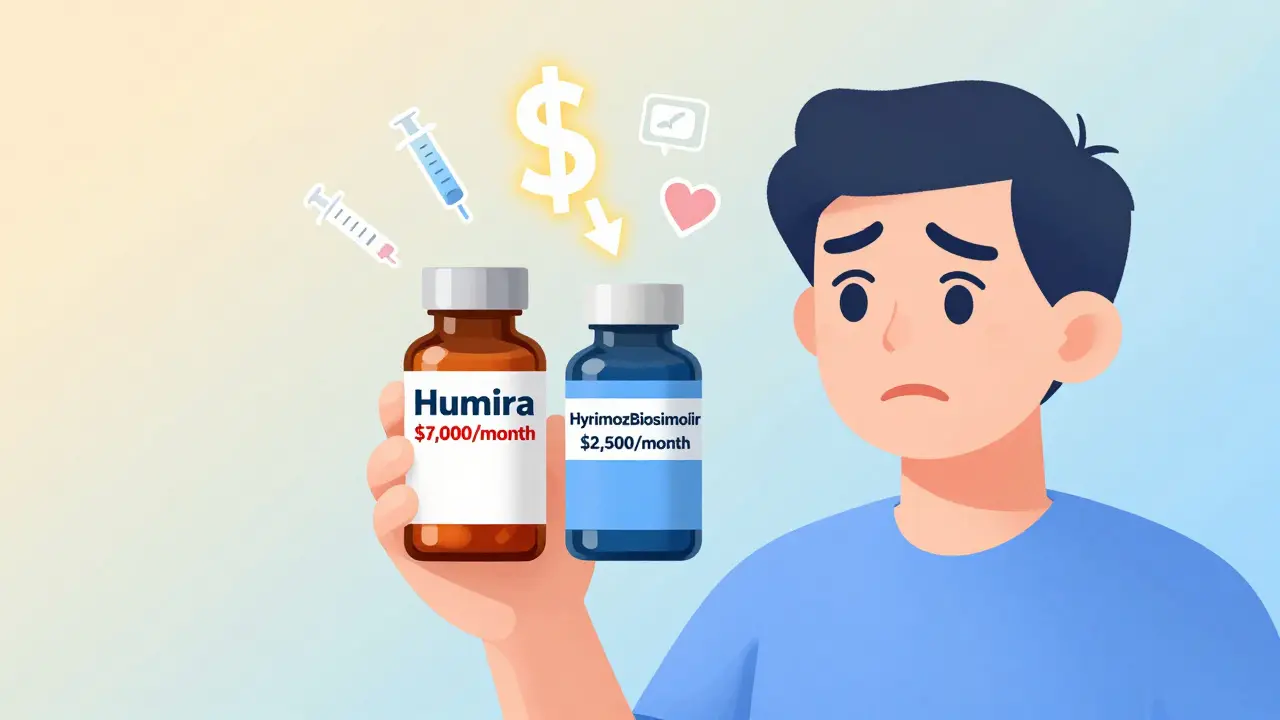
When you’re prescribed a biologic drug like Humira, Enbrel, or Humira, you’re looking at a monthly bill that can easily hit $7,000 or more. That’s not a typo. For many people with rheumatoid arthritis, Crohn’s disease, or psoriasis, these drugs are life-changing - but they’re also financially crushing. Enter biosimilars: cheaper, equally safe, and just as effective alternatives. Yet most patients still pay full price for the brand name, even when a biosimilar is available. Why? And how much can you actually save?
What’s the real cost difference?
In 2025, the average 30-day supply of a brand-name biologic cost $2,104. The biosimilar version? $919. That’s a 56% drop - over $1,200 a month saved. For someone on a chronic treatment plan, that’s more than $14,000 a year. And it’s not just the list price. Out-of-pocket costs for patients using biosimilars are 23% lower than for brand biologics. If your copay was $500 before, it’s now around $385. That’s the difference between paying for treatment and skipping doses because you can’t afford it.Why are biosimilars so much cheaper?
Biosimilars aren’t like regular generics. You can’t just copy a chemical formula and call it the same. Biologics are made from living cells - think proteins, antibodies, complex molecules grown in labs. That means you can’t replicate them exactly. But you can get extremely close. The FDA requires biosimilars to prove they work the same way, have the same safety profile, and cause the same side effects as the original. No extra trials needed. No need to prove they’re better - just that they’re not worse. Because biosimilar makers don’t have to start from scratch, their development costs are lower. They skip the massive clinical trials that brand companies ran to get FDA approval. That’s why a biosimilar can launch at 40-80% off the brand price. Sandoz’s Hyrimoz, a biosimilar to Humira, entered the market at an 80% discount. In just two years, it captured 14% of the U.S. market. That’s not just a discount - it’s a market shift.How much have biosimilars saved the system?
Since 2015, biosimilars have saved the U.S. healthcare system between $36 billion and $56 billion, depending on who’s counting. The biggest savings came in 2024 alone - $20 billion. That’s enough to cover free insulin for millions of people or fund thousands of cancer screenings. But here’s the kicker: those savings are still just the tip of the iceberg. Humira, the top-selling drug in history, brought in $21.2 billion in global sales in 2022. After its patent expired in 2023, biosimilars flooded in. Within 18 months, they took over 65% of the U.S. market. The brand price didn’t just drop - it collapsed. The original manufacturer, AbbVie, slashed its list price by 33% just to stay competitive. That’s the power of competition.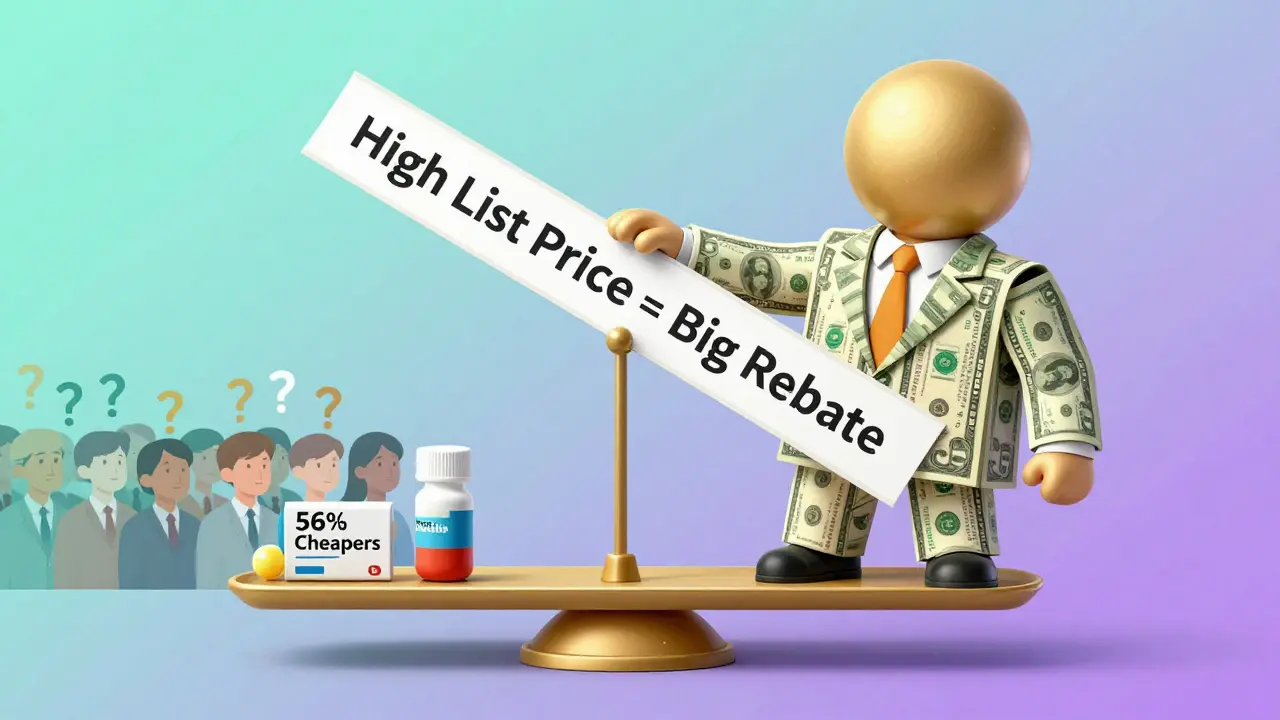
Why aren’t more people using them?
If biosimilars are cheaper and just as good, why are so many patients still on the brand? The answer isn’t science - it’s money. Pharmacy Benefit Managers (PBMs), the middlemen who negotiate drug prices for insurers, have a strange incentive: they get bigger rebates from brand-name companies. The higher the drug’s list price, the bigger the rebate. So even if a biosimilar costs half as much, the PBM might still push the brand because it pockets more cash. That’s called a rebate wall. Then there’s the patent game. Brand companies file dozens of secondary patents - on packaging, delivery devices, dosing schedules - just to delay biosimilar entry. It’s legal, but it’s designed to block competition. One drug can have over 100 patents. That’s not innovation. That’s a tactic. Doctors and patients also get confused. Many still think biosimilars are “weaker” or “experimental.” But the FDA says they’re as safe and effective as the original. In Europe, where biosimilars have been used for over 15 years, adoption rates are over 70%. In the U.S., it’s still under 20%. That gap isn’t about science. It’s about inertia and profit.What’s changing in 2026?
The FDA just released new draft guidance to make biosimilar development faster and cheaper. They’re cutting unnecessary clinical trials and allowing more data from overseas studies. That means more biosimilars will hit the market sooner. By 2030, analysts expect biosimilar use to jump from 20% to 40% of the biologic market. That could mean an extra $125 billion in annual savings. The Biden administration’s Biosimilars Action Plan is pushing insurers to prioritize biosimilars in their formularies. Some states are starting to require pharmacists to switch patients to biosimilars unless the doctor says no. That’s a big deal. Right now, many patients don’t even know they have a cheaper option.
What does this mean for you?
If you’re on a brand biologic, ask your doctor or pharmacist: “Is there a biosimilar for this?” Don’t assume your insurance automatically covers the cheaper version. Check your formulary. Call your insurer. Ask if switching will affect your coverage or copay. If your drug is Humira, Enbrel, Remicade, or Rituxan - there’s likely a biosimilar available. You might be surprised. A patient on a $7,000/month drug could drop to $2,500 with a biosimilar. That’s $54,000 a year saved. That’s a mortgage payment. A car. A year of therapy. A trip to see family.What’s next?
More biologics are losing patents in the next five years. Drugs for cancer, diabetes, multiple sclerosis - all of them will have biosimilar options. The technology is ready. The science is proven. The savings are real. What’s missing is awareness and policy change. If you’re paying full price for a biologic, you’re not just paying for medicine. You’re paying for a broken system. But you don’t have to. Ask. Advocate. Switch. The cheaper, equally effective option is already there.Are biosimilars as safe as brand biologics?
Yes. The FDA requires biosimilars to prove they have no clinically meaningful differences in safety, purity, or potency compared to the original biologic. They’re tested in the same rigorous way, with thousands of patients across multiple studies. Over 15 years of real-world use in Europe shows no increased risk. The FDA calls them "as safe and effective as the branded drugs."
Can I switch from a brand biologic to a biosimilar?
In most cases, yes. Many doctors now prescribe biosimilars as the first option. If you’re already on a brand biologic, talk to your doctor about switching. It’s not a gamble - it’s a well-studied transition. Some insurers even require you to try the biosimilar first. If your doctor is hesitant, ask them to review the FDA’s biosimilar approval data - it’s publicly available and overwhelmingly supportive.
Why does my insurance still cover the brand name if the biosimilar is cheaper?
Because of how rebates work. Pharmacy Benefit Managers (PBMs) get paid more from the brand-name company if the drug’s list price is higher. Even if the biosimilar costs half as much, the PBM might make more money by keeping you on the brand. That’s why you might see the biosimilar listed as "not preferred" on your formulary - not because it’s worse, but because the system is rigged to favor high prices.
How do I find out if a biosimilar is available for my drug?
Start by checking the FDA’s biosimilar product list - it’s updated monthly and free to access. Then call your pharmacy or insurer and ask: "Is there an FDA-approved biosimilar for [drug name]? Is it covered under my plan?" If you’re on Medicare Part D, ask if switching will trigger a coverage gap. Most biosimilars are tier 2 or 3, meaning lower copays than brand biologics, which are often tier 4 or 5.
Will switching to a biosimilar affect my treatment results?
No. Multiple large studies, including ones from the CDC and the European Medicines Agency, show no difference in effectiveness or side effects when patients switch from a brand biologic to its biosimilar. In fact, some patients report better outcomes because they’re finally able to take their medication consistently - something they couldn’t do when the brand was too expensive.
Are biosimilars covered by Medicare and Medicaid?
Yes. Both Medicare Part D and Medicaid cover FDA-approved biosimilars. In fact, many state Medicaid programs now require biosimilar use for certain drugs. Medicare Advantage plans vary, but most have lower copays for biosimilars. Check your plan’s formulary or call customer service. You’re not risking coverage by switching - you’re saving money.
Juan Reibelo
January 23, 2026Wow. I had no idea biosimilars could save you over $14k a year. I’m on Humira, and my copay’s been $450 since 2022. Just called my pharmacy-they said Hyrimoz is covered at $180. I’m switching next week. Thank you for this.
Dolores Rider
January 25, 2026PBMs are literally stealing from us. 😡 They get rich off our suffering. I bet the CEO of CVS Caremark owns 3 vacation homes. And you think this is healthcare? Nah. It’s a rigged casino. 💸
Vatsal Patel
January 25, 2026Let me ask you this: if a drug made from living cells is so complex, how can a ‘biosimilar’ be ‘equally effective’? Are we really just playing God with protein folding? Or is this just capitalism repackaged as science? 🤔
They say ‘no clinically meaningful difference’-but who defines ‘meaningful’? The FDA? Or the shareholders who need quarterly profits? We’ve been conditioned to believe cheaper = worse. But what if the truth is: cheaper = honest?
Sharon Biggins
January 26, 2026Yesss!! I switched to the biosimilar for my Enbrel last year and my copay dropped from $520 to $310!! I was scared at first but my rheumatologist said it’s been proven safe for years in Europe. Seriously, if you’re on a brand biologic-ask!! You’ve got nothing to lose and thousands to gain 💪❤️
John McGuirk
January 27, 2026They’re lying. All of it. The FDA? PBMs? Doctors? It’s all a front. The real reason biosimilars are cheaper is because they’re made in China. You think they test them like we do? Nah. They use recycled lab equipment and skip the stability studies. You think your immune system won’t notice? It will. And when it does… who gets blamed? You.
lorraine england
January 28, 2026My sister’s on a biosimilar for Crohn’s now-she’s been symptom-free for 11 months. I used to think ‘biosimilar’ meant ‘second-rate.’ Turns out, it just means ‘not overpriced.’ So glad I didn’t listen to the fear-mongering. You guys are doing the right thing by asking questions. Keep going!
Himanshu Singh
January 29, 2026Life is about balance, right? We want cheap medicine, but we also want safety. Biosimilars strike that balance. They’re not perfect, but they’re not evil either. The system is broken-not the science. Maybe the real question is: why do we let profit decide who gets to live?
Helen Leite
January 30, 2026OMG I JUST REALIZED MY INSURANCE IS SCAMMING ME 😭 I’M PAYING $7K A MONTH FOR HUMIRA AND THERE’S A $2.5K ALTERNATIVE?! I’M CALLING THEM RIGHT NOW. THANK YOU. I’M CRYING. 🤍
Marlon Mentolaroc
January 30, 2026Let’s not romanticize this. Biosimilars aren’t magic. They’re just cheaper versions of drugs that were overpriced to begin with. The real villain? The patent system. 100 patents on a single drug? That’s not innovation. That’s legal extortion. And the FDA? They’re just the janitor cleaning up after the party.
Gina Beard
February 1, 2026It’s not about cost. It’s about control.
siva lingam
February 2, 2026So… biosimilars save money. Who cares. We’re all gonna die anyway.