

21 Jan 2026
- 12 Comments
After losing 50 pounds, Sarah thought she’d finally won. She’d stuck to her low-calorie plan for eight months, hit her goal, and even started enjoying meals again. But then, the scale stopped moving. No matter how little she ate, she couldn’t lose another pound. Worse-she was constantly tired, hungrier than ever, and her workouts felt pointless. She wasn’t lazy. She wasn’t failing. Her body had simply adapted.
What Is Adaptive Thermogenesis?
Adaptive thermogenesis is your body’s biological defense system against weight loss. It’s not a glitch. It’s a survival mechanism. When you cut calories, your body doesn’t just burn less fat-it actively slows down your metabolism beyond what you’d expect based on how much weight you’ve lost. This isn’t about willpower. It’s about hormones, nerves, and energy conservation. Research from Columbia University shows this happens in both lean and obese people trying to keep weight off. After losing weight, your resting metabolic rate (RMR) drops more than it should. For example, if you lose 20 pounds, your body might burn 200 fewer calories per day than predicted just from your new size. That’s like eating a whole extra banana every day without gaining weight-except you’re not. You’re stuck. This isn’t temporary. A 2017 study followed people for a full year after a rapid weight-loss diet. Even after 44 weeks of maintaining their new weight, their metabolism stayed suppressed. The same thing happened to contestants on The Biggest Loser. Six years later, most had regained nearly all their weight-and their metabolisms were still running 500 calories slower than expected. The culprit? Hormones. Leptin, insulin, thyroid hormones, and stress chemicals like cortisol all shift when you’re in a calorie deficit. Your body thinks it’s starving. It reduces energy spent on non-essential functions: digestion, movement, even body heat. Brown fat, the kind that burns calories to make heat, becomes less active. Your sympathetic nervous system quiets down. Your body is doing everything it can to hold onto fat.Why Reverse Dieting Isn’t Just “Eating More”
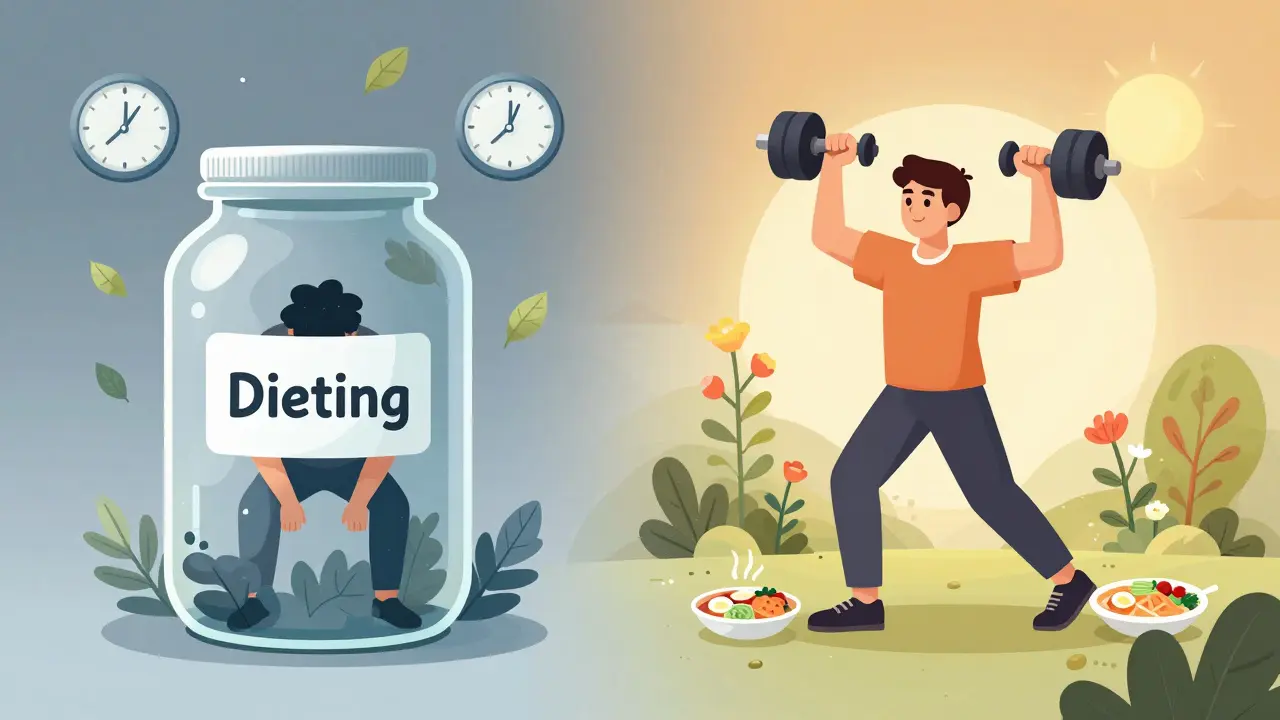
Reverse dieting isn’t about going back to your old eating habits. It’s not a cheat phase. It’s a strategic, slow rebuild of your metabolism after a long period of dieting. The idea is simple: after you’ve lost weight, you don’t jump back to maintenance calories. You add them back-gradually. Usually 50 to 100 calories per week. You track your weight, hunger, energy, and sleep. If your weight stays stable, you keep going. If you gain more than 0.5 pounds in a week, you pause and hold at that level for another week. Why does this work? Because your body needs time to adjust. If you suddenly eat 2,000 calories after living on 1,200 for months, your body doesn’t know how to handle it. It assumes you’re in a feast-or-famine cycle and stores more fat. But if you increase slowly, your body has a chance to relearn how to burn those calories. Hormones like leptin slowly rise. Thyroid output improves. Your metabolism starts to tick back up. A 2022 survey of over 1,200 people using MyFitnessPal found that 68% felt their metabolism slowed after dieting. Of those who tried reverse dieting, 73% reported better energy. 65% said hunger decreased. And 31% successfully maintained their weight without regain. But reverse dieting isn’t magic. It takes patience. Most people need 3 to 6 months to complete the process. And it only works if you do it right.What Happens If You Don’t Reverse Diet?
Skipping reverse dieting is like driving a car with the brakes on. You might not notice it at first, but over time, it wears you down. Without rebuilding your metabolism, you’re stuck in what experts call the “weight loss trap.” You can’t eat normally without gaining weight. You feel hungry all the time. Your workouts feel harder. You get frustrated. Many people give up, regain the weight, and then start the cycle again. And here’s the kicker: each time you lose and regain weight, your metabolism gets slower. Research shows even one cycle of weight cycling-yo-yo dieting-can permanently lower your resting metabolic rate. Your body learns to expect famine. It becomes more efficient at storing fat. The next time you diet, it’s even harder to lose weight. This is why so many people who lose weight end up heavier than before. It’s not because they lack discipline. It’s because their biology changed.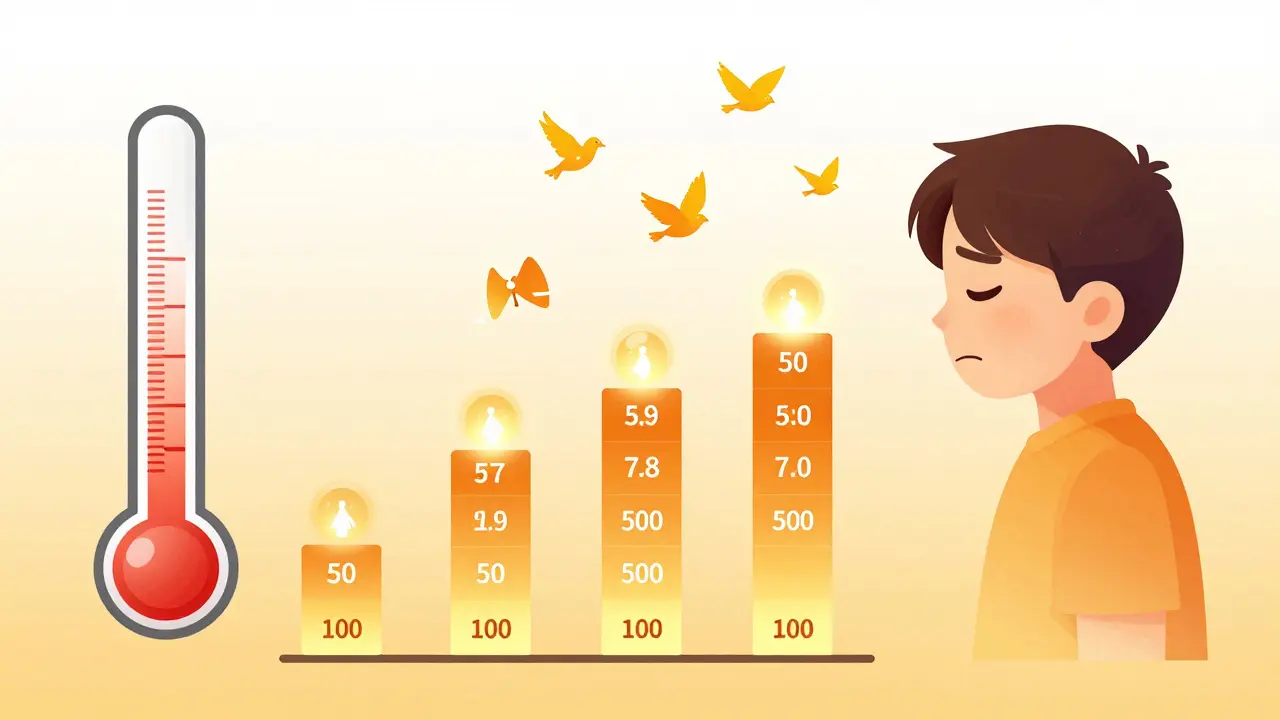
How to Do Reverse Dieting Right
There’s no one-size-fits-all plan, but here’s what works based on real studies and expert practice:- Start slow. Add 50-100 calories per week. Use a food tracking app to be precise. Don’t guess.
- Focus on protein. Aim for 1.6 to 2.2 grams of protein per kilogram of body weight. This protects muscle, which keeps your metabolism higher.
- Strength train 2-3 times a week. Muscle burns more calories at rest than fat. Preserving or building muscle during reverse dieting can reduce metabolic adaptation by up to 15%.
- Monitor your body. Track your weight weekly, but don’t obsess over daily numbers. Look at trends. Also note energy levels, sleep quality, and hunger. If you’re sleeping better and feeling less ravenous, that’s progress.
- Don’t rush. Increasing calories too fast (more than 150 per week) often leads to fat gain. Slow is sustainable.
- Be patient. It can take months to see your metabolism bounce back. Don’t expect results in 2 weeks.
What Doesn’t Work
There are a lot of myths floating around. Let’s clear them up.- “I just need to eat less.” If you’ve already been dieting for months, eating less will only make your metabolism slower. You’re not broken-you’re adapted.
- “Detox teas” or “metabolism pills.” No supplement can reverse adaptive thermogenesis. The only thing that works is time, protein, strength training, and gradual calorie increases.
- “I’ll just do intermittent fasting.” Fasting after dieting can make your body think you’re still in survival mode. It won’t fix your metabolism-it might make it worse.
- “I’ll bulk up first.” Trying to gain muscle immediately after a long diet often leads to fat gain because your metabolism hasn’t recovered yet. Reverse dieting first. Then build muscle.
Who Benefits Most From Reverse Dieting?
Reverse dieting isn’t for everyone. But it’s especially helpful if:- You’ve lost 10+ pounds through dieting
- You’ve hit a weight loss plateau for more than 4 weeks
- You feel constantly tired, cold, or hungry
- You’ve tried multiple diets and keep regaining weight
- You’re frustrated because you “eat less than before” but still gain weight
The Bigger Picture: Why This Matters
The global weight loss market is worth over $269 billion. Most of it sells quick fixes: shakes, pills, apps that promise “metabolic resets.” But the science tells a different story. Adaptive thermogenesis is real. It’s measurable. It’s persistent. And it’s the reason why only 20% of people keep off 10% of their lost weight after a year. The good news? You’re not powerless. Your metabolism isn’t broken forever. It’s just waiting for the right signals. Reverse dieting isn’t about eating more to get fat. It’s about eating more to get your body back on track. It’s about teaching your metabolism that food isn’t scarce anymore. That you’re not in danger. That it’s safe to burn energy again. It’s not glamorous. It doesn’t make headlines. But for the people who’ve been stuck for years, it’s the only thing that works.Frequently Asked Questions
Does reverse dieting actually increase metabolism?
Yes, but slowly and only if done correctly. Reverse dieting doesn’t magically boost your metabolism overnight. It helps your body recover from the suppression caused by long-term dieting. Studies show that gradual calorie increases, combined with protein and strength training, can restore resting metabolic rate over several months. The key is patience-rushing the process often leads to weight gain.
How long does reverse dieting take?
Most people need 3 to 6 months to complete reverse dieting, depending on how long they dieted and how much weight they lost. Someone who lost 50 pounds over 10 months might need 4-5 months to rebuild their metabolism. The goal isn’t speed-it’s sustainability. You’re not racing to a number. You’re rebuilding your body’s relationship with food.
Can I reverse diet if I’m not at my goal weight yet?
Generally, no. Reverse dieting is meant for after weight loss is complete. If you’re still losing weight, keep going-but be mindful of metabolic slowdown. Once you hit your target and maintain it for 2-4 weeks, then you can start reverse dieting to stabilize your metabolism.
Do I need to track calories during reverse dieting?
Yes, at least at first. Guessing calories leads to inconsistent progress. Use an app like MyFitnessPal or Cronometer to track your intake accurately. Once you’ve found your maintenance level and have a few months of stable weight under your belt, you can shift to intuitive eating. But during the reverse phase, precision matters.
Will reverse dieting make me gain fat?
It might, if you go too fast. But if you increase calories slowly (50-100 per week) and monitor your weight, most of the gain will be muscle or water-not fat. The goal isn’t to avoid any weight gain-it’s to avoid fat gain. A small, slow increase is normal. A rapid spike (more than 1 pound per week) means you’re adding calories too quickly.
Is reverse dieting the same as maintenance eating?
No. Maintenance eating is about staying at your current calorie level. Reverse dieting is the process of getting to maintenance after a long diet. Think of it as the bridge between restriction and normal eating. Once you reach maintenance and your weight stabilizes for 2-3 months, you’re done with reverse dieting and can transition to regular maintenance.
Alec Amiri
January 22, 2026This is why diets fail. Not because you're weak, but because your body's a stubborn old machine that hates change. I lost 40 lbs, hit a wall, and then ate like a normal human for 6 months-metabolism came back. No magic, just patience.
Lana Kabulova
January 23, 2026Okay but have you considered that adaptive thermogenesis is just a buzzword for 'your body doesn't want to starve'? It's not science-it's common sense. And reverse dieting? Sounds like a fancy way to say 'stop being so restrictive'. I've been eating 1,800 since 2021 and never plateaued. Maybe you're overcomplicating it.
Akriti Jain
January 24, 2026lol the pharmaceutical companies LOVE this narrative. 'Oh no your metabolism slowed down!' No, they just want you to keep buying their 'metabolism boosters' and 'reverse diet coaching programs'. They don't want you to know that 80% of weight loss is just eating less and moving more. 😏
Patrick Roth
January 25, 2026Actually, the Biggest Loser study is garbage. Their subjects were doing 4+ hours of cardio a day and eating 1,000 calories. That’s not dieting-that’s torture. Of course your metabolism crashes. Try telling a farmer who works 14 hours a day in the cold that his metabolism is broken. It’s not. It’s just that you’re doing it wrong.
Oren Prettyman
January 26, 2026The premise of this article is fundamentally flawed. Adaptive thermogenesis, while measurable in controlled lab settings, has negligible real-world impact on long-term weight maintenance for the average individual. The notion that one must 'reverse diet' to avoid regain ignores the overwhelming evidence that behavioral adherence and environmental factors dominate metabolic outcomes. Furthermore, the reliance on self-reported MyFitnessPal data is methodologically unsound. The 73% energy improvement statistic is anecdotal at best. This is not science-it is wellness marketing dressed in academic language.
Tatiana Bandurina
January 27, 2026I tried reverse dieting after losing 30 lbs. I added 50 calories a week. Gained 7 lbs in 3 months. Wasn't fat. Just water. And my sleep improved. I stopped tracking after 6 months. Now I eat intuitively. No guilt. No apps. Just food. And I haven't regained a pound in 2 years. Maybe the real solution is just... stop obsessing.
Philip House
January 28, 2026Look. America’s obsessed with 'fixing' metabolism like it’s a broken iPhone. Your body isn’t a machine. It’s a living system. You don’t 'reset' biology with macros and spreadsheets. You live. You move. You sleep. You stop fearing food. The real problem isn’t thermogenesis-it’s the cult of calorie counting. You think you need to 'reverse diet'? You need to unlearn diet culture. That’s the real reset.
Kenji Gaerlan
January 29, 2026reverse dieting is just a fancy way to say 'eat more and chill out'. i did it after my 50lb loss. started at 1400, went to 2100 over 5 months. no gain. just more energy. and yeah i still track but not like a nut. lol
Hilary Miller
January 30, 2026As someone from Kenya, I’ve seen this with my cousins who moved to the US. They lose weight on 'clean eating' diets, then gain it all back because they don’t know how to eat normally here. Reverse dieting isn’t a trend-it’s cultural adaptation. Food isn’t the enemy. Fear is.
Margaret Khaemba
January 31, 2026I love how this article doesn’t mention sleep or stress. I lost weight on 1,300 calories but my cortisol was through the roof. Once I started sleeping 7+ hours and meditating, I could eat 1,900 without gaining. It’s not just calories-it’s your nervous system. Reverse dieting works, but only if you fix the root causes too.
Malik Ronquillo
February 1, 2026People who do reverse dieting are the same ones who think they need a 'metabolic reset' because they ate a slice of pizza. You’re not broken. You’re just afraid of food. Eat. Stop worrying. Move. Sleep. Done.
Keith Helm
February 1, 2026While the physiological mechanisms described are valid, the clinical applicability of reverse dieting remains unproven in peer-reviewed longitudinal studies. The reliance on self-reported outcomes and anecdotal surveys undermines its scientific credibility. One must exercise caution before adopting interventions lacking rigorous empirical validation.