
23 Mar 2026
- 10 Comments
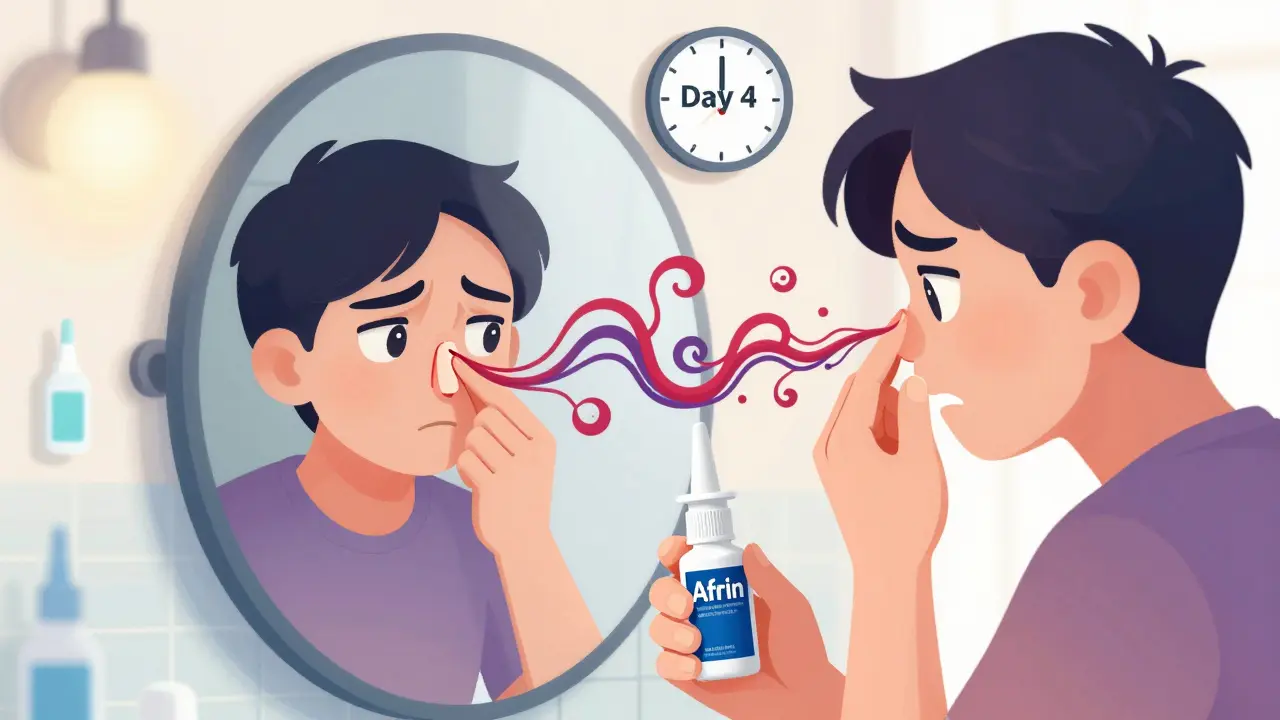
Have you ever used an OTC nasal spray to clear a stuffy nose, only to find that a few days later, your nose is even more blocked than before? You’re not alone. This frustrating cycle - relief followed by worse congestion - is called rebound congestion, and it’s one of the most common mistakes people make with nasal decongestant sprays. These sprays work fast, feel amazing at first, and seem like a miracle cure. But using them too long turns them into the problem itself.
Why Do Nasal Sprays Cause Worse Congestion?
OTC nasal decongestant sprays like Afrin, Neo-Synephrine, and Otrivin contain active ingredients such as oxymetazoline or phenylephrine. These are alpha-adrenergic agonists that shrink swollen blood vessels in your nasal passages. Within minutes, you can breathe easier. That’s why so many people reach for them during colds or sinus infections.
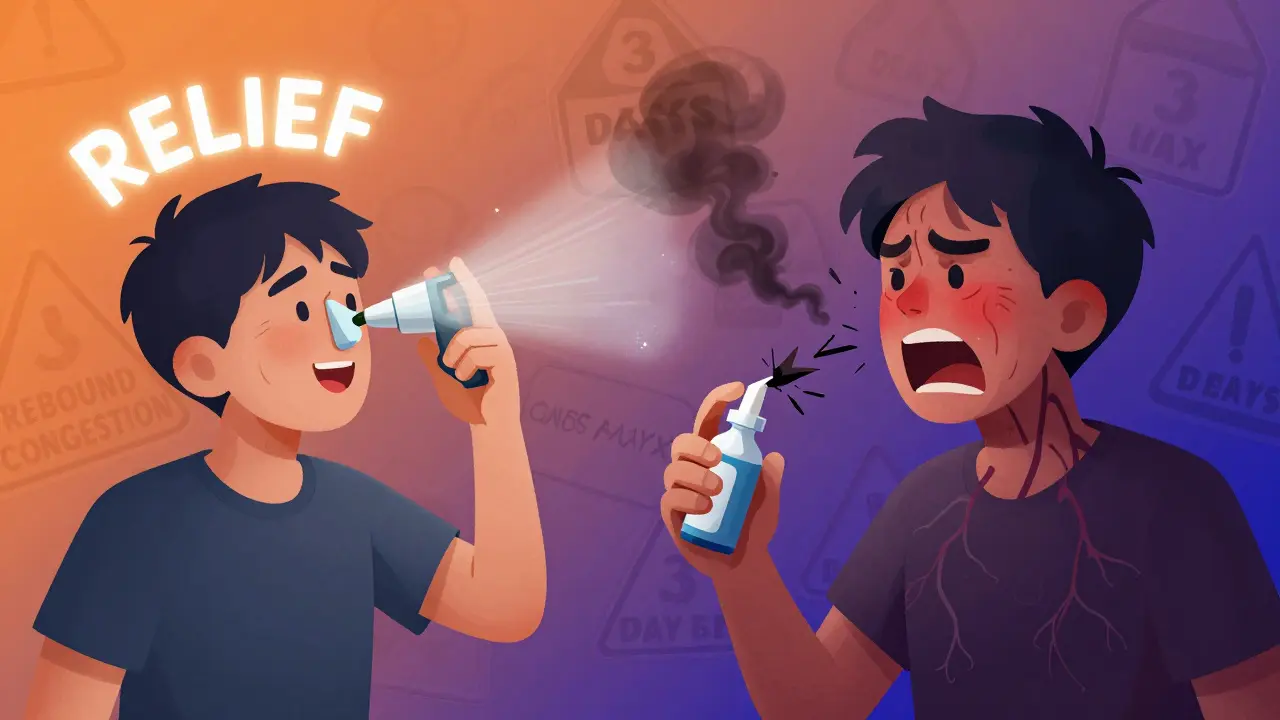
But here’s the catch: your nasal tissues don’t like being told to stay shrunken. After 3 days of continuous use, your body starts to fight back. The blood vessels become hypersensitive. When the spray wears off, instead of staying open, they dilate even more than before. That’s rebound congestion - a direct result of the medicine itself.
This isn’t just a theory. It’s a well-documented medical condition called rhinitis medicamentosa. According to the NIH StatPearls resource (2019), this happens in as many as 1-2% of the general population. The American Academy of Otolaryngology (AAOA) estimates that 15-20% of chronic rhinitis cases are caused by overusing these sprays. And it’s not rare - Healthline’s 2021 survey found that 28% of adults have experienced it at least once.
How Fast Can Rebound Happen?
You might think you have a week to use it safely. You don’t. The clock starts ticking after just 72 hours - three days.
Studies from Houston Methodist and the Mayo Clinic show that rebound congestion can begin as early as day 3. Symptoms usually show up 12 hours after your last spray, peak around day 2-3 after stopping, and can last anywhere from 1 to 3 weeks. In some cases, especially with prolonged misuse, it can drag on for a month or more.
People often don’t realize what’s happening. They think their cold is getting worse, or their allergies are flaring up. So they spray again. And again. Soon, they’re using 6-10 sprays a day instead of the recommended 2-3. That’s when real damage starts. Chronic overuse can lead to inflammation, thinning of the nasal lining, and in extreme cases, even perforation of the nasal septum.
What’s in These Sprays? And Which Ones Are Riskier?
Most OTC nasal decongestant sprays contain one of these four ingredients:
- Oxymetazoline (0.05%) - found in Afrin and Otrivin
- Phenylephrine (0.25%) - found in Neo-Synephrine
- Xylometazoline (0.05%) - common outside the U.S.
- Naphazoline (0.1%) - found in Privine
All of them work the same way. But oxymetazoline, the most popular, is often mistakenly thought to be “safer.” That’s not true. While it’s slightly less likely to cause rebound than older ephedrine-based sprays, clinical cases of rebound from oxymetazoline are well documented. The NIH and Cleveland Clinic both confirm that no decongestant spray is immune to this risk if used beyond 3 days.
And here’s something most people don’t know: store brands contain the exact same active ingredients as name brands. A generic Afrin copy from CVS or Walmart isn’t cheaper because it’s weaker - it’s cheaper because it doesn’t have the brand name. Same chemistry. Same risks.
What Should You Use Instead?
If you need long-term relief - especially for allergies, chronic congestion, or recurring sinus issues - nasal decongestant sprays are the wrong tool. Here are safer, evidence-based alternatives:
- Saline nasal sprays - 100% saltwater. No drugs. No rebound. You can use these as often as you want. They help flush out allergens, mucus, and irritants. Brands like NeilMed Sinus Rinse cost under $15 and last months.
- OTC nasal corticosteroids - Flonase (fluticasone) and Nasacort (triamcinolone) became available without a prescription in 2014. They take 3-7 days to work, but once they do, they reduce inflammation at the source. No dependency. No rebound. A 120-spray bottle costs around $25 and lasts 1-2 months.
- Ipratropium bromide (Atrovent) - used for runny noses, not stuffiness. It doesn’t help congestion but stops dripping. No rebound risk.
- Oral decongestants - pseudoephedrine (Sudafed) can be an option, but it raises blood pressure by 5-7 mmHg. Avoid if you have heart issues or high blood pressure.
For acute colds or sinus infections, use the spray for 3 days max. Then switch to saline or steroid spray. Don’t wait until you’re stuck in a cycle.
How to Break the Cycle If You’re Already Stuck
If you’ve been using nasal spray for more than a week and your nose feels worse without it, you’re in rebound mode. Here’s how to get out - without going back to the spray.
- Start a nasal steroid spray immediately. Flonase or Nasacort. Use it daily, even if you don’t feel results right away. It takes 3-5 days to work, but it’s your best defense against inflammation.
- Use saline spray 4-6 times a day. This keeps your nasal passages moist and reduces irritation. You can use it with a squeeze bottle or a neti pot.
- Stop the decongestant spray cold turkey. Tapering doesn’t work. The longer you delay quitting, the longer the rebound lasts. You’ll feel worse for 2-3 days. That’s normal. Your body is resetting.
- Don’t re-spray. This is the hardest part. The urge to spray again is strong. But each time you give in, you reset the cycle. Use a cold compress on your nose, drink warm fluids, or try steam inhalation to ease discomfort.
Most people feel better within 7-14 days. A small number (about 22%) need prescription help - like a short course of oral steroids - if symptoms don’t improve. But almost everyone recovers fully if they stop using the spray.

What the Labels Don’t Tell You
The FDA has required the warning “Do not use for more than 3 days” on these products since 2002. Yet Cleveland Clinic surveys show 38% of users ignore it. Why? Because the relief feels too good. Because they think “just one more day won’t hurt.”
But “one more day” becomes “two more days,” then “a week,” then “I need it every night.” That’s how dependency starts. And it’s not a weakness - it’s a physiological trap. Your body literally rewires itself to depend on the spray.
There are no new miracle sprays on the market in 2026 that solve this. No “rebound-proof” formulas. No smart bottles that lock after 3 days. The science hasn’t changed. The risks haven’t changed. The advice hasn’t changed.
What has changed? More people are talking about it. Reddit threads like “Afrin hell” have thousands of comments from people who spent weeks in misery before finally breaking free. The stories are raw: “I thought my allergies were getting worse.” “I lost sleep for 3 weeks.” “I didn’t know it was the spray.”
Who’s at Higher Risk?
Rebound congestion doesn’t care who you are - but some people are more vulnerable:
- People with high blood pressure - decongestants can spike blood pressure, and rebound makes it worse.
- People with chronic sinus issues - they’re more likely to reach for the spray repeatedly.
- People using it for allergies - steroids are the right choice here, not decongestants.
- People who use it daily - even 1 spray a day for 10+ days can trigger rebound.
NIH studies show that those with preexisting hypertension have 25% higher severity of rebound symptoms. If you’re managing blood pressure, avoid these sprays entirely.
Final Rule: The 3-Day Limit Is Non-Negotiable
There’s no exception. Not for allergies. Not for “just one more day.” Not for a bad cold. Not for seasonal changes. Three days. That’s it.
Think of it like a fire extinguisher. You don’t use it to clean the kitchen. You use it when the fire is burning. And you stop when the fire’s out. Nasal decongestant sprays are fire extinguishers for your nose. They’re not meant for daily cleaning.
If you need daily relief, get the right tool: saline sprays for moisture, steroid sprays for inflammation. They’re slower. They’re less flashy. But they don’t trap you.
Stop the cycle before it starts. Your nose will thank you.
Can I use OTC nasal spray every day if I only use one spray?
No. Even one spray a day for more than 3 days can trigger rebound congestion. The issue isn’t how much you use - it’s how long you use it. Continuous exposure to decongestants, even in small amounts, causes your nasal blood vessels to become dependent. Stick to 3 days max, then switch to saline or a steroid spray.
Is Afrin worse than other nasal sprays?
Afrin (oxymetazoline) is not inherently worse than other OTC decongestant sprays. All of them - including Neo-Synephrine (phenylephrine) and store brands - contain the same class of drugs and carry the same rebound risk if used beyond 3 days. The brand doesn’t matter. The active ingredient and duration of use do.
Why do steroid sprays like Flonase take so long to work?
Unlike decongestants that shrink blood vessels instantly, steroid sprays reduce inflammation at the cellular level. This takes time - usually 3 to 7 days. But once they work, they provide lasting relief without dependency. They’re meant for daily use, not quick fixes. That’s why they’re the best long-term solution for allergies and chronic congestion.
Can I use saline spray every day?
Yes. Saline nasal sprays contain only salt and water. They have no drugs, no side effects, and no risk of rebound. You can use them as often as needed - even 6 times a day. They’re perfect for daily use, especially if you’re recovering from rebound congestion or managing allergies.
What should I do if I’ve been using nasal spray for weeks and can’t stop?
Stop the spray immediately. Start using a nasal steroid spray like Flonase or Nasacort daily. Use saline spray 4-6 times a day to soothe irritation. Expect worse congestion for 2-4 days - this is normal. Most people recover fully in 1-3 weeks. If symptoms persist beyond 3 weeks, see a doctor - you may need a short course of oral steroids or further evaluation.
rebecca klady
March 23, 2026I used Afrin for like 5 days during a nasty cold last winter and thought I was dying. My nose was so blocked I couldn’t sleep. Turns out? It was the spray. Started using saline rinses and Flonase-no more cycle. Best decision ever. My sinuses finally feel like they belong to me again.
Namrata Goyal
March 24, 2026Lmao so you’re telling me the FDA knows better than my grandma who used ‘decongestant spray every day for 20 years’? She’s 82 and still breathing. You people overthink everything. Maybe your nose is just weak. Try yoga.
Alex Arcilla
March 25, 2026Bro I was in AFRIN HELL for 3 weeks. Like, full-on sobbing in the shower because I couldn’t breathe. Then I found out about saline + Flonase. No joke. I’m not even kidding. I cried happy tears the first day I could sleep without a fan on. If you’re reading this and stuck? Stop. Now. Go buy a neti pot. Your future self will hug you.
Brandon Shatley
March 26, 2026i never knew nasal sprays could do this. i thought it was just allergies. now i feel kinda dumb for using it every night for months. i started using saline spray last week and honestly? it’s not as instant but my nose doesn’t feel like it’s on fire anymore. also i’m not buying the name brand stuff anymore. generic works fine. duh.
Blessing Ogboso
March 26, 2026As someone from Nigeria where nasal decongestants are often sold without prescriptions and used daily as a ‘routine’-this is a critical conversation. In many African communities, we treat these sprays like mouthwash: ‘clean it every morning.’ But the science here is undeniable. I’ve seen friends develop chronic congestion, and no one knew why. This post should be translated into pidgin English and shared everywhere. The problem isn’t ignorance-it’s lack of accessible, clear education. Saline sprays should be as common as soap. Let’s normalize nasal hygiene over chemical quick fixes.
Jefferson Moratin
March 27, 2026The fundamental error lies not in the pharmacology, but in the epistemological framing: we mistake symptom suppression for healing. Decongestant sprays do not treat congestion-they temporarily override the body’s physiological response. By doing so, they disrupt homeostatic feedback loops. The rebound effect is not an accident; it is an inevitable consequence of pharmacological interference without resolution of the underlying pathology. The true solution is not substitution, but restoration: allowing the mucosal immune system to recalibrate through non-pharmacological support. Saline irrigation and corticosteroids are not alternatives-they are rehabilitative tools.
Zola Parker
March 29, 2026soooo… you’re saying the government knew this since 2002 but didn’t do anything? 🤔
and now we’re supposed to trust flonase? what if that’s just a gateway to… i don’t know… steroid addiction? 😏
Marissa Staples
March 30, 2026I think the real tragedy is how we’re taught to treat symptoms instead of listening to our bodies. The spray gives instant relief, so we assume it’s fixing something. But it’s just silencing a signal. Like turning off a smoke alarm because the noise is annoying. Eventually, the house burns down. And then we’re surprised. Maybe we need to slow down. Breathe. Let our bodies tell us what’s wrong instead of drowning it out with chemicals.
Rachele Tycksen
March 31, 2026i used the generic one and thought i was being smart. turns out it’s the same chem. whoops. my nose is still mad at me. 😅
Aaron Sims
April 2, 2026Wait-so you’re telling me Big Pharma doesn’t want us to know this? That they’re profiting off our nasal dependency? And the FDA just slapped a tiny warning on the bottle? And no one’s suing them? And there’s no recall? This is a classic. They make the drug. They make us addicted. They sell us the ‘solution’ (Flonase). And then they sell us the ENT visit. It’s a triad of profit. I’m not using anything anymore. I’m going back to breathing the old-fashioned way-through my mouth.