

27 Dec 2025
- 13 Comments
When you're breastfeeding and need to take medication, the first thing many people think is: pump and dump. You pump your milk, throw it away, and wait for the drug to clear your system. It feels like the safe thing to do. But here's the truth: in almost every case, you don't need to do that at all.
Most Medications Are Safe in Breast Milk
The idea that all medications are dangerous during breastfeeding comes from outdated warnings on drug labels - not science. The American Academy of Pediatrics says only a tiny fraction of drugs are truly unsafe for breastfeeding. In fact, 98% of medications transfer to breast milk in amounts too small to affect your baby, according to Dr. Thomas Hale’s Medications and Mother’s Milk (18th edition, 2023). That means if you're taking a common painkiller, antibiotic, or antidepressant, your baby is likely getting less than 1% of your dose - often less than 0.1%. Take acetaminophen, for example. When you take 650 mg, your breast milk contains only 0.04-0.1 mg/L. That’s less than one-tenth of a percent of your weight-adjusted dose. Ibuprofen? Even lower - around 0.01% of what your baby would get if they took it directly. These numbers aren’t guesses. They come from decades of research tracked in LactMed, the National Institutes of Health’s free, peer-reviewed database updated weekly.Why 'Pump and Dump' Is Usually Unnecessary
The practice of discarding milk started because drug manufacturers, afraid of lawsuits, wrote blanket warnings like “not recommended during breastfeeding.” But those warnings weren’t based on data - they were legal cover. A 2021 study in the Journal of Human Lactation found that 68% of mothers were told to pump and dump when they didn’t need to. Only about 1% of medications actually require it. So what drugs are in that 1%? Mostly radioactive isotopes used in imaging, certain chemotherapy drugs, and ergot alkaloids (used for migraines). Even then, the pause is usually short - hours, not days. For everything else, continuing to breastfeed is safer than stopping. Stopping breastfeeding - even for 24 hours - can drop your milk supply by 30-50%, according to research in Breastfeeding Medicine. And once that supply drops, 42% of mothers never fully get it back. That’s not just inconvenient. It’s a real risk to your baby’s nutrition and your mental health.How to Time Your Medication Right
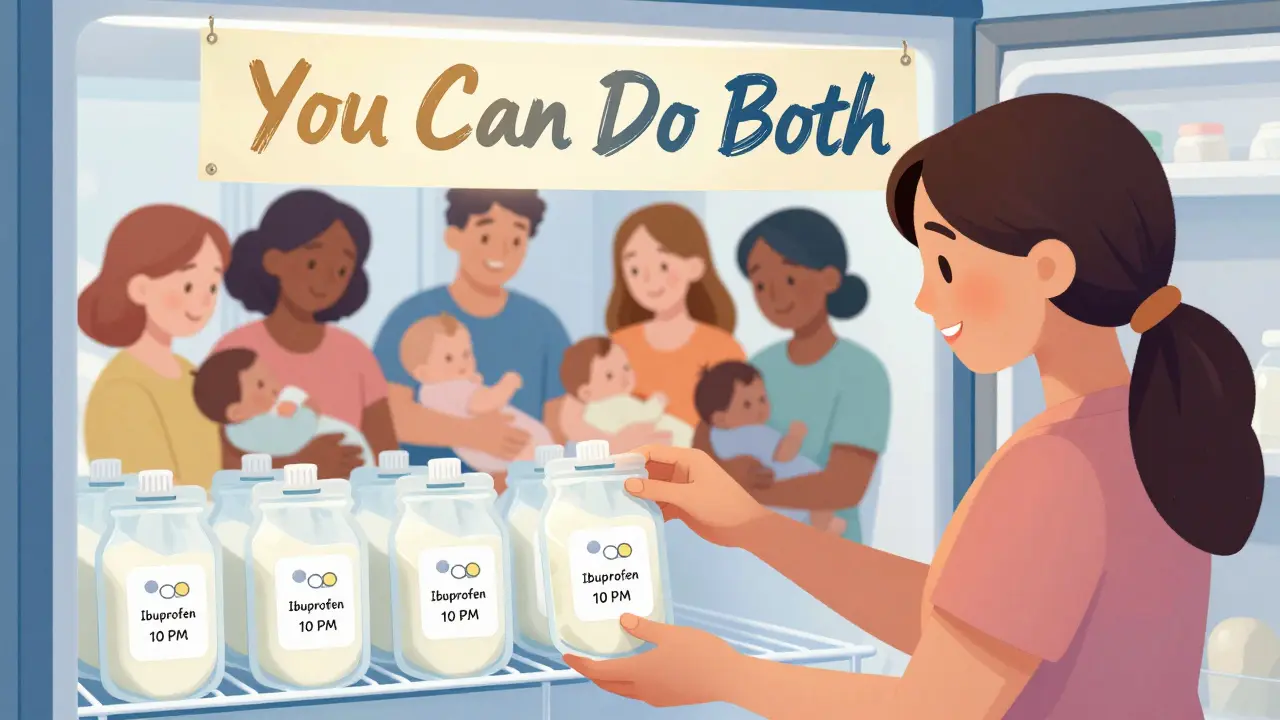
You don’t need to dump milk. You just need to time things right. For single-dose medications (like a painkiller or antibiotic you take once a day), take it right after your baby’s longest sleep stretch - usually right after the bedtime feeding. That gives your body 6-8 hours to clear most of the drug before the next feeding. If you take ibuprofen at 10 p.m. after a night feeding, by 6 a.m., the amount in your milk is barely detectable. For meds you take multiple times a day, breastfeed right before you take the pill. That way, your baby gets milk when drug levels are lowest. Your blood concentration peaks about 1-2 hours after taking the drug, so feeding just before means your baby gets milk with the least amount of medication. This isn’t guesswork. It’s pharmacokinetics. Drugs with a short half-life (under 4 hours), high protein binding (over 80%), and low lipid solubility (log P under 1) barely make it into milk. Most common drugs fit this profile.
Which Medications Are Safe? Real Examples
Not all drugs are created equal. Here’s what the data says:- Sertraline (Zoloft): Used for anxiety and depression. Relative infant dose: 0.5-2.5%. No adverse effects reported in over 98% of cases. One of the safest antidepressants for breastfeeding.
- Ibuprofen: Preferred over naproxen. Naproxen has a 14-hour half-life and has been linked to rare cases of infant anemia and bleeding. Ibuprofen clears quickly and safely.
- Cephalexin (Keflex): A common antibiotic. Relative infant dose: 0.5-1.5%. Over 1,200 documented cases with zero serious side effects.
- Clindamycin (Cleocin): Also an antibiotic, but riskier. Relative infant dose: 5-15%. Linked to diarrhea in 12% of exposed infants. Only use if no safer option exists.
- Paroxetine (Paxil): Another antidepressant, but higher transfer rate (1.5-4.3%) and more side effects. Avoid if sertraline is an option.
How to Store Milk When You’re on Medication
Medication doesn’t change how long milk stays fresh. The same CDC 2023 storage guidelines apply:- Room temperature (up to 25°C): Up to 4 hours
- Refrigerator (≤4°C): Up to 4 days
- Freezer (−18°C): Up to 6 months
Where to Get Accurate Info (And Who to Avoid)
Don’t rely on your pharmacist’s printed sheet or your doctor’s offhand comment. Most providers haven’t been trained in lactation pharmacology. A 2021 AAFP survey showed only 32% of obstetricians and 28% of family doctors could correctly identify safe antidepressants for breastfeeding. Use these trusted sources instead:- LactMed (from the NIH): Free, searchable database with detailed pharmacokinetic data. Updated weekly. Covers over 1,300 drugs.
- MotherToBaby: Call 866-626-6847. Real experts answer questions in minutes. They’ve helped over 12,000 mothers in the past year - and 92% of those cases didn’t require dumping milk.
- InfantRisk Center: Offers a free app with real-time safety ratings. Downloaded over 250,000 times. Includes a risk scale from L1 (safest) to L5 (contraindicated). Only 0.7% of drugs are L4 or L5.
What to Do If You’re Still Unsure
If you’re nervous, here’s a simple 3-step plan:- Look up your medication on LactMed. Type in the name. Read the “Infant Risk” section.
- If it’s L1 or L2 (safest or probably safe), keep breastfeeding. Time your doses as described.
- If it’s L3 (caution) or you’re unsure, call MotherToBaby. Don’t wait. Don’t guess.
Why This Matters Beyond Your Baby
Choosing to keep breastfeeding while on medication isn’t just about nutrition. It’s about your mental health, your confidence, and your body’s natural function. Women who are told to pump and dump unnecessarily are more likely to stop breastfeeding early - and more likely to feel guilty, anxious, or failed. The CDC’s 2023-2025 Breastfeeding Plan calls eliminating unnecessary barriers - like fear of medication - a top priority. Hospitals are finally updating their policies. 92% of major hospital systems now use LactMed as their standard reference, up from 67% in 2018. You’re not alone. And you’re not doing something risky by continuing to breastfeed. You’re doing exactly what your body was designed to do - even while healing.Do I need to pump and dump if I take antibiotics?
Almost never. Antibiotics like cephalexin, amoxicillin, and penicillin are among the safest for breastfeeding. They transfer in tiny amounts and rarely affect babies. Only clindamycin or metronidazole require caution - and even then, pumping and dumping isn’t usually needed. Time your doses after feedings, and keep nursing.
Can I breastfeed while taking antidepressants?
Yes, and it’s often safer than stopping. Sertraline is the most studied and safest option, with minimal transfer and no reported harm to infants. Paroxetine and fluoxetine have higher transfer rates and are less preferred. Never stop your antidepressant without talking to your doctor - untreated depression poses a greater risk to you and your baby than the medication.
Is it safe to store milk I pumped while on medication?
Yes, if the medication is safe to take while breastfeeding. Medications don’t change how long milk lasts in the fridge or freezer. Store it the same way you always do - just label it with the date, time, and drug name so you can track it if needed.
What if my doctor says to pump and dump?
Ask them to check LactMed or call MotherToBaby. Many providers rely on outdated package inserts, not current research. You have the right to evidence-based advice. If they’re unsure, suggest they consult the AAFP’s 2022 guidelines on breastfeeding and medication - they’re clear: interruption is rarely necessary.
Can I use over-the-counter meds like cold medicine while breastfeeding?
Most are fine. Acetaminophen and ibuprofen are safe. Avoid decongestants like pseudoephedrine - they can reduce milk supply. For coughs, dextromethorphan is preferred over codeine. Always check the active ingredients, not just the brand name. And if you’re unsure, call MotherToBaby - they answer questions about OTC meds too.
Next Steps: What to Do Today
If you’re currently taking medication and breastfeeding:- Go to LactMed and search your drug. Don’t wait.
- If you’ve been dumping milk unnecessarily, restart feeding immediately. Your supply can recover.
- Download the InfantRisk Center app - it’s free and works offline.
- Print or save the AAFP’s 2022 summary on breastfeeding and medication. Bring it to your next appointment.
Gran Badshah
December 29, 2025bro i pumped and dumped for 3 days on amoxicillin bc my mom said so. lost 40% of my supply. turned out i coulda kept nursing the whole time. dumb as hell. why do people still believe this crap?
Ellen-Cathryn Nash
December 29, 2025Oh honey. The pharmaceutical companies are laughing all the way to the bank while you’re dumping your liquid gold down the drain. It’s not just wasteful-it’s a quiet form of gaslighting. They profit from fear, not science. And you? You’re the one paying with your peace, your supply, your soul.
Read LactMed. Not the label. Not your cousin’s blog. LactMed. It’s free. It’s peer-reviewed. It’s the truth wrapped in a PDF.
I cried when I found out I didn’t need to dump. Not because I was sad-because I was furious. All that time. All that pain. All that guilt. For nothing.
Don’t let another mother be misled. Share this. Print it. Tape it to the fridge. Because someone’s baby deserves to eat. And someone’s sanity deserves to survive.
Samantha Hobbs
December 30, 2025omg i just checked sertraline on lactmed and it’s l1?? i’ve been terrified to take mine for 6 months. my baby’s 4 months old and i’ve been crying every night bc i thought i was hurting her. i’m restarting tonight. thank u for this.
Nicole Beasley
December 31, 2025thank you for this!! 🥹💖 i downloaded the infantrisk app and searched my migraine med (sumatriptan) - it’s l2!! i’ve been dumping for 3 weeks 😭 i’m gonna nurse tonight. i’m so emotional right now
sonam gupta
January 2, 2026indian moms still tell their daughters to dump milk if they take medicine. this is why our breastfeeding rates are low. we are taught to fear our own bodies. shame on the system
Julius Hader
January 2, 2026Look, I’m not saying you’re wrong. But let’s be real - if you’re on chemo or radioactive iodine, you’re not going to breastfeed. That’s not fear. That’s physics. The rest? Yeah, most are fine. But don’t come at me like I’m a monster for being cautious. I’ve got a newborn. I’m not taking chances.
And if you’re telling me to trust a website over my OB? That’s a leap. I need a human to say it’s safe. Not a database.
Mimi Bos
January 2, 2026soooo… i just typed ‘ibuprofen breastfeeding’ into lactmed and it said ‘no significant risk’… but i misspelled ‘ibuprofen’ as ‘ibuprufen’ and it still found it?? 😅 i’m so bad with spelling but this app is a lifesaver. thank you for sharing this!!
Payton Daily
January 3, 2026Let me tell you something. This whole ‘pump and dump’ thing? It’s not about safety. It’s about control. Who controls the narrative? Big Pharma. Hospitals. The medical industrial complex. They profit when you’re scared. When you’re confused. When you’re isolated.
They don’t want you to know your body is smarter than their warning labels. They don’t want you to know that breastfeeding isn’t a privilege - it’s a biological right. And they sure as hell don’t want you to realize that you’ve been gaslit into thinking you’re failing.
You’re not failing. You’re fighting. And now you know the truth. So go feed your baby. Don’t dump. Don’t doubt. Just breathe.
Kelsey Youmans
January 3, 2026Thank you for compiling this information with such care and precision. The evidence-based approach presented here is not only clinically sound but also deeply compassionate. It is imperative that healthcare providers, particularly those in primary care and obstetrics, receive ongoing education in lactation pharmacology. The emotional burden placed upon mothers by misinformation cannot be overstated. I will be sharing this resource with my colleagues and patients without reservation.
Sydney Lee
January 3, 2026Let’s be honest - if you’re reading this and you’re still dumping milk for ibuprofen, you’ve been living in a 1987 pharmacy pamphlet. The fact that you’re even considering this as a legitimate concern says everything about how poorly we’ve been educated. You’re not ‘being safe.’ You’re being manipulated.
Every drop you dump is a drop of autonomy stolen from you. Every hour you wait is another hour your baby goes hungry. And every time you trust a label over LactMed, you’re surrendering your right to be an informed parent.
There’s no ‘maybe.’ There’s no ‘just in case.’ The data is in. You’re not a risk. You’re a mother. And your milk? It’s medicine.
oluwarotimi w alaka
January 4, 2026they be lying to us. this is a big pharma scam. they want you to buy more formula. they want you to stop breastfeeding. they dont want african and indian mothers to be strong. i saw this on a video. its all connected. i dont trust any of this. i will still dump.
Debra Cagwin
January 5, 2026You did it. You took the time to write this. You didn’t just say ‘it’s safe’ - you gave us the tools, the sources, the timing, the real numbers. That’s not just helpful. That’s heroic.
If you’re reading this and you’re scared - I see you. If you’ve been dumping for months - I’m so sorry. You didn’t fail. You were misled.
Go to LactMed. Right now. Type in your med. Breathe. Then feed your baby. You’ve got this. And you’re not alone.
Hakim Bachiri
January 7, 2026Wait - so you’re telling me… I don’t need to dump my milk after taking Advil? After 2 kids? After 7 years of ‘pump and dump’? I’ve been wasting $300 a month on storage bags and freezers? And my husband’s been helping me dump like it’s a ritual?!
I’m going to cry. And then I’m going to nurse my 8-month-old right now. And then I’m going to burn every pamphlet my OB gave me.