
24 Jan 2026
- 13 Comments
Millions of people take statins to lower cholesterol and protect their hearts. At the same time, nearly half of all Americans take vitamin D supplements-often because they’ve been told it’s good for bones, immunity, or even muscle pain. But what happens when you take both? If you’re on a statin and struggling with muscle aches, you’ve probably heard that popping a vitamin D pill might help. The truth? It’s more complicated than that.
Why People Think Vitamin D Helps with Statin Muscle Pain
Statin-associated muscle symptoms (SAMS) are one of the most common reasons people stop taking their medication. Muscle soreness, weakness, or cramps can feel like a dealbreaker, especially when you’re trying to stay healthy. So when someone suggests vitamin D might ease the pain, it sounds like a simple fix. And it’s not just random advice-many doctors have heard it from patients, and some even recommend it.
Why? Because vitamin D plays a role in muscle function. Low levels are linked to weakness and pain in general. And since statins can lower cholesterol-the raw material your body uses to make vitamin D-some assumed the two must be connected. If statins reduce cholesterol, maybe they also reduce vitamin D. And if vitamin D is low, maybe supplementing it will fix the muscle pain. It’s a logical chain… but logic doesn’t always match the data.
The Science: What Large Studies Actually Found
The biggest, most reliable study on this question came out in 2022-the VITAL trial substudy. It tracked over 2,000 people who started taking statins. Half got vitamin D supplements; half got a placebo. Neither group knew which they were taking. After a year, the results were clear: vitamin D did nothing to prevent muscle pain or reduce statin discontinuation.
Even among people who started with low vitamin D levels (under 20 ng/mL), the numbers didn’t budge. 33% of those taking vitamin D had muscle symptoms. So did 35% of those taking the placebo. No difference. Not even close.
That’s not a fluke. This wasn’t a small, poorly designed study. It was double-blind, randomized, and controlled-the gold standard. And it didn’t just look at one group. It checked people across different vitamin D levels, ages, and statin types. The conclusion? Taking extra vitamin D won’t stop statin muscle pain.
But Some Studies Say Statins Raise Vitamin D Levels
Here’s where things get weird. While vitamin D doesn’t help with muscle pain, some research shows statins might actually increase vitamin D levels in the blood. A 2019 study found that people on statins had significantly higher vitamin D levels than those not taking them. Atorvastatin users had the highest levels-averaging 23 ng/mL. Rosuvastatin users also saw increases.
How? One theory is that statins might boost the activity of cholesterol transporters in the gut, helping your body absorb more vitamin D from food or supplements. Another idea is that statins reduce inflammation, which could improve how your body processes vitamin D. It’s not about making more vitamin D from cholesterol-it’s about better absorption or less breakdown.
But not all studies agree. A 2018 study found the opposite: statin users had lower vitamin D levels than non-users. Why the contradiction? The answer likely lies in the type of statin, how long people took it, their diet, sun exposure, and genetics. This isn’t a simple on/off switch-it’s messy, individual, and still being figured out.
Which Statins Might Interact With Vitamin D?
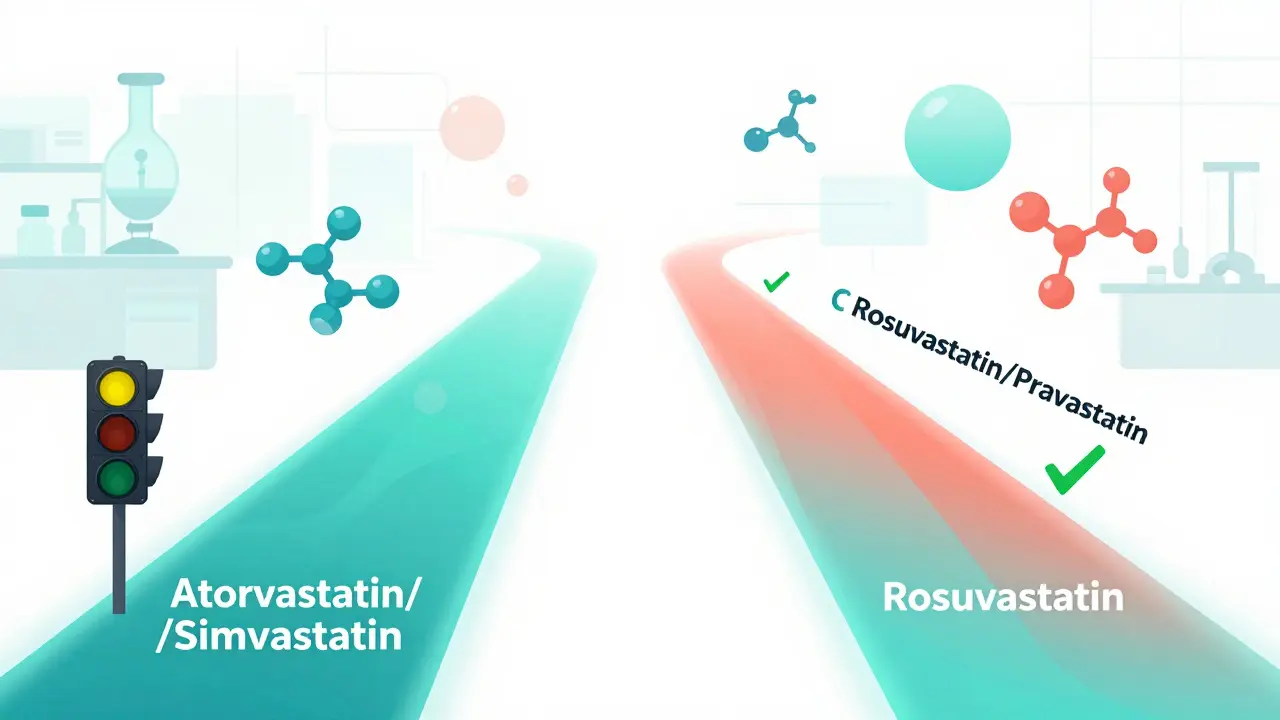
Not all statins are the same. Only a few are processed by the liver enzyme CYP3A4: atorvastatin, simvastatin, and lovastatin. These are the ones that might compete with vitamin D for the same metabolic pathway. If you’re taking one of these, there’s a small chance high-dose vitamin D supplements could affect how your body breaks down the statin.
A 2015 study found that people taking 800 IU of vitamin D daily had slightly lower levels of atorvastatin in their blood. That doesn’t mean it’s dangerous-but it does mean the interaction is real, even if it’s minor. For most people, it won’t matter. But if you’re on a high dose of atorvastatin and taking 5,000 IU of vitamin D daily, it’s worth mentioning to your doctor.
On the other hand, rosuvastatin, pravastatin, and fluvastatin don’t rely on CYP3A4. So if you’re on one of these, vitamin D supplements are unlikely to interfere with your medication at all.
What About Your Vitamin D Level?
Even if vitamin D doesn’t help with statin muscle pain, that doesn’t mean you shouldn’t have your levels checked. Vitamin D deficiency is common-especially in northern climates like the UK, where sunlight is limited in winter. And low vitamin D is linked to weak bones, fatigue, and even a higher risk of falls in older adults.
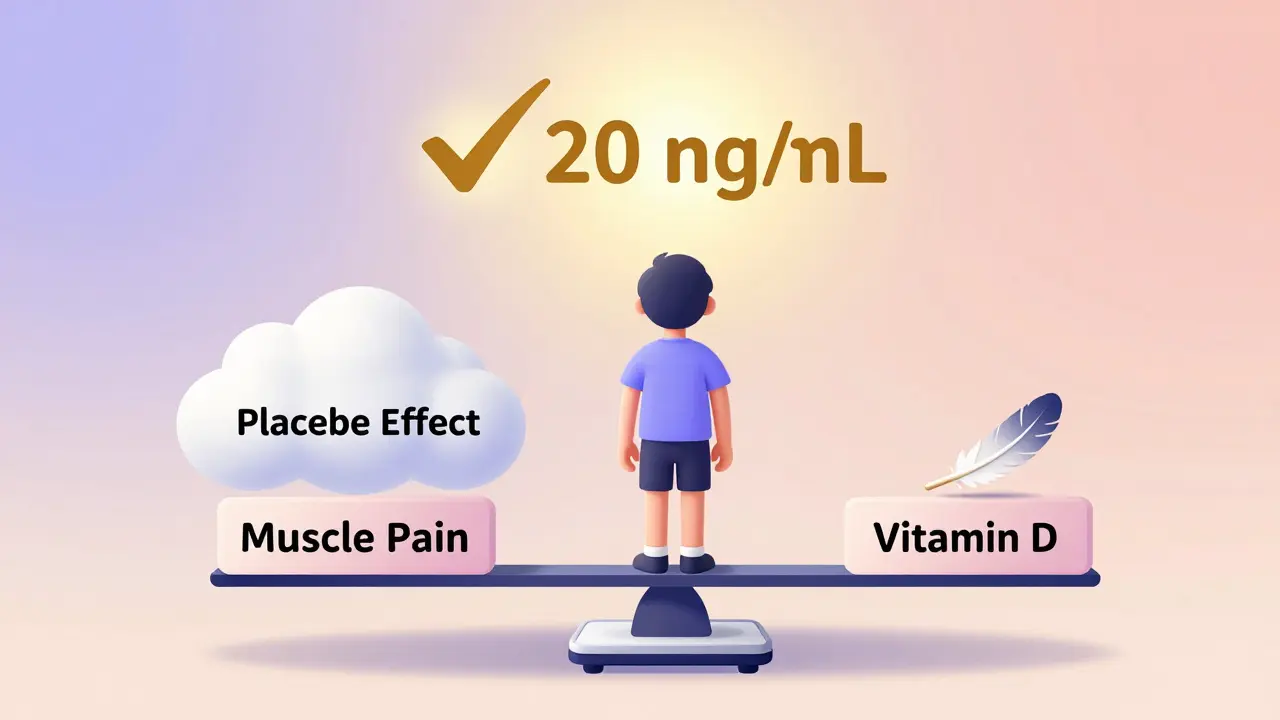
The European Atherosclerosis Society says this clearly: you don’t need to take vitamin D to prevent statin muscle pain. But you should maintain adequate levels (at least 20 ng/mL) for overall health. If your level is below that, correcting it is a good idea-not because it helps your statin, but because your body needs it.
Don’t assume you’re deficient just because you’re on a statin. Get tested if you’re tired, have bone pain, or live somewhere with little sun. Don’t start taking 5,000 IU a day without knowing your level. Too much vitamin D can cause high calcium, kidney stones, or heart rhythm problems.
Why Do So Many People Swear It Works?
If the science says vitamin D doesn’t help, why do so many people say it did? On Reddit, 54% of statin users claim vitamin D eased their muscle pain. On Drugs.com, 37% say it helped. That’s a lot of people who feel better.
Here’s the catch: placebo effect is powerful. When you believe something will help, your brain can actually reduce your perception of pain. Muscle aches from statins are often mild and fluctuate on their own. If you start taking vitamin D at the same time your pain naturally improves, you’ll credit the supplement-even if it had nothing to do with it.
Also, many people start vitamin D because they’re already low. Fixing a deficiency can improve energy and reduce general aches. That improvement gets mixed up with statin side effects. It’s not that vitamin D treats statin pain-it’s that fixing a separate problem (low vitamin D) makes you feel better overall.
What Should You Do?
Here’s the practical take:
- If you’re on a statin and have muscle pain, don’t start vitamin D hoping it’ll fix it. It won’t.
- If you’ve never had your vitamin D level checked, ask your doctor. If it’s below 20 ng/mL, supplementing to reach normal levels is a good idea-for your bones, immune system, and general health.
- If you’re on atorvastatin, simvastatin, or lovastatin, avoid mega-doses of vitamin D (over 4,000 IU daily) unless your doctor approves it.
- If you’re on rosuvastatin, pravastatin, or fluvastatin, vitamin D supplements are safe and won’t interfere.
- Don’t stop your statin because you think vitamin D should help. Talk to your doctor first. There are other statins or dosing options that might work better for you.
The bottom line? Vitamin D isn’t a magic fix for statin muscle pain. But it’s still important for your health. Treat it like any other nutrient-not as a drug to counteract side effects, but as something your body needs to function properly.
What’s Next in Research?
Scientists aren’t done yet. The PRECISION trial, currently enrolling 5,000 people, is testing whether vitamin D helps only those with severe deficiency (under 12 ng/mL). Results are due in late 2025. Early data from Johns Hopkins suggests genetics might play a role-some people’s bodies process vitamin D differently based on their DNA. That could explain why some studies show effects and others don’t.
For now, the evidence is clear: if you’re on a statin and want to take vitamin D, do it because you need it-not because you think it’ll save you from muscle pain. And if your muscle aches persist, talk to your doctor about switching statins or adjusting your dose. There are better solutions than hoping a supplement will fix it.
Does vitamin D help with statin muscle pain?
No, large, high-quality studies like the 2022 VITAL trial show vitamin D supplementation does not prevent or reduce statin-associated muscle symptoms. Even in people with low vitamin D levels, there was no difference in muscle pain between those taking supplements and those taking a placebo.
Can statins lower vitamin D levels?
Some studies suggest statins might lower vitamin D, but others show the opposite. Atorvastatin and rosuvastatin have been linked to higher vitamin D levels, possibly because they improve absorption. The effect varies by statin type, individual metabolism, and baseline health. There’s no consistent pattern across all users.
Which statins interact with vitamin D?
Only statins metabolized by the CYP3A4 enzyme-atorvastatin, simvastatin, and lovastatin-might have a minor interaction with high-dose vitamin D supplements. Rosuvastatin, pravastatin, and fluvastatin do not use this pathway and are unlikely to interact.
Should I get my vitamin D level checked if I’m on a statin?
Yes, especially if you have limited sun exposure, are over 50, or have bone pain or fatigue. The goal isn’t to treat statin side effects-it’s to make sure your vitamin D level is at least 20 ng/mL for overall health. Routine testing isn’t required, but it’s a smart move if you’re at risk for deficiency.
Is it safe to take vitamin D with statins?
Yes, for most people. If you’re on rosuvastatin, pravastatin, or fluvastatin, vitamin D is safe at standard doses (600-2,000 IU daily). If you’re on atorvastatin, simvastatin, or lovastatin, avoid doses over 4,000 IU without medical supervision. Always check with your doctor before starting high-dose supplements.
Ryan W
January 26, 2026Let’s cut through the BS. The VITAL trial is the only study that matters here. Vitamin D doesn’t fix statin myopathy. Period. All the anecdotal ‘it helped me’ posts are just placebo noise mixed with confirmation bias. If you’re still taking it for muscle pain, you’re wasting money and time.
And for the love of science, stop treating supplements like pharmaceuticals. You’re not ‘optimizing’ your health-you’re just buying hope from a Walmart shelf.
Rakesh Kakkad
January 26, 2026It is imperative to recognize that the biochemical interplay between statins and vitamin D is not merely pharmacokinetic but also epigenetically modulated. The CYP3A4 enzyme pathway, while relevant, is but one node in a vast regulatory network involving VDR polymorphisms, LDL receptor dynamics, and inflammatory cytokine feedback loops. To reduce this complexity to a binary ‘does it work’ question is scientifically reductive.
Nicholas Miter
January 26, 2026Yeah, I’ve been on rosuvastatin for 4 years and took 2000 IU of D3 daily for no reason other than my doc said ‘might help.’ Turns out I was already at 42 ng/mL. Didn’t feel any different. But I kept taking it because why not? I’m not gonna stress over a $10 bottle of pills.
My advice? Get tested. If you’re low, fix it. If you’re not? Stop chasing magic fixes. Your body’s not broken, it’s just aging.
Suresh Kumar Govindan
January 28, 2026Big Pharma funded the VITAL trial. They don’t want you to know vitamin D is a natural statin alternative. Why? Because you can’t patent sunlight. The real story? Statins deplete CoQ10, not vitamin D. That’s what causes muscle pain. And yes, vitamin D helps-but only if you’re not being lied to by the medical-industrial complex.
George Rahn
January 29, 2026Let me get this straight: we’ve got a population so terrified of cholesterol they’ll swallow a synthetic steroid daily, then turn around and chase a fat-soluble vitamin like it’s the Holy Grail? We’ve turned medicine into a cult. Vitamin D isn’t the solution-it’s the symptom of a culture that believes every problem has a pill, and every pill has a label that says ‘natural.’
We don’t need more supplements. We need better food, more sun, and less fear.
Shweta Deshpande
January 29, 2026Hi everyone! I just wanted to say I totally get it-I was on simvastatin and had terrible leg cramps at night. I started vitamin D because my mom swore by it, and honestly? It felt better. But then I got tested and found out I was at 16 ng/mL. So I think it was the deficiency fix, not the statin pain. Now I’m at 38 and feel amazing! I’m not saying it cures muscle pain, but if you’re low, it’s like turning on a light after living in a cave. So please, get checked! You never know what’s really going on. 💪🌞
Sally Dalton
January 31, 2026OMG I’m so glad someone finally said this. I’ve been telling my friends for years that vitamin D isn’t magic. I was on atorvastatin and had muscle pain so bad I almost quit. My doc said ‘try D3’ and I did-nothing. Then I switched to pravastatin and boom-gone. Turns out it wasn’t the vitamin, it was the statin type.
Also, I typoed ‘simvastatin’ as ‘simvastatine’ like 3 times in my notes. Sorry. 😅
Shawn Raja
February 2, 2026So let me get this straight-you’re telling me the same people who believe in quantum healing crystals are now pushing vitamin D as a statin side effect cure? And the medical establishment, in its infinite wisdom, spent $50 million to prove it doesn’t work?
Classic. We live in a world where the placebo effect is the only thing keeping Big Pharma afloat. And yet, somehow, we still think ‘natural’ means ‘better.’
Next up: turmeric for cancer. I’ll be here, sipping my oat milk latte, waiting for the study.
Henry Jenkins
February 2, 2026I’ve been reading through this thread and it’s fascinating how much emotion is tied to something so biologically nuanced. The VITAL trial is rock solid, but I think the deeper issue is trust. People don’t trust their doctors, they don’t trust the FDA, they don’t trust pharmaceutical companies-but they trust Reddit, or their cousin who ‘read an article,’ or that influencer who sells vitamin D gummies.
Maybe the real problem isn’t vitamin D-it’s the erosion of scientific literacy. We’ve replaced expertise with anecdote. And until we fix that, no amount of data will change behavior.
Also, I’ve been on pravastatin for 7 years. My D level is 45. I take 1000 IU. I don’t care if it helps my muscles. I care that I don’t get osteoporosis at 65.
Dan Nichols
February 3, 2026Everyone’s missing the point. Vitamin D doesn’t fix statin pain because statin pain isn’t caused by low vitamin D. It’s caused by mitochondrial dysfunction from CoQ10 depletion. So why are we even talking about D? Because it’s easier than admitting statins are toxic to muscle cells. The real scandal? Doctors still push D as a bandaid instead of switching meds or lowering dose. They’d rather you suffer quietly than admit their script might be wrong.
And if you’re on atorvastatin and taking 5000 IU? Congrats. You’re probably lowering your statin levels. But no one told you that. Because who wants to admit their advice is half-baked?
Renia Pyles
February 4, 2026So you’re telling me I wasted $200 on D3 supplements because I thought they’d help my muscle pain? And now you’re saying the study that proved it didn’t work was funded by Big Pharma? I’m so mad. I’ve been taking it for 2 years. My legs feel fine now-but I’m convinced it was the D. I don’t care what the data says. I feel better. That’s what matters.
And if you say otherwise, you’re just part of the system trying to control us.
TONY ADAMS
February 5, 2026Bro I took D3 because my bae said it helped her. My muscles felt better. Didn’t get tested. Don’t care. I’m still on statin. Still taking D. Still feel good. Science can suck it.
Ashley Karanja
February 6, 2026Okay, I just want to say how much I appreciate this nuanced breakdown. As someone with a chronic autoimmune condition, I’ve spent years navigating supplement myths and medical gaslighting. The fact that vitamin D doesn’t help with statin myopathy but still matters for bone and immune health? That’s the kind of balanced truth we need more of.
And I love how you pointed out the placebo effect-because I’ve had that exact experience. I started D3 when my pain flared, and it coincided with a quiet week at work. I thought it was the supplement. Turns out, I just needed rest. But that doesn’t make the relief any less real.
Also, I’ve been on rosuvastatin for 5 years, my D is 48, and I take 2000 IU daily. I’m not doing it to fix muscle pain. I’m doing it because I live in Seattle, I’m 52, and I don’t want to break a hip. That’s not magic. That’s just smart. 🌲☀️