

4 Jan 2026
- 13 Comments
When you hear the word genetic testing, you might think of ancestry kits or fun facts about your DNA. But for people with a family history of cancer, it’s something far more serious-and potentially life-saving. Genetic testing for cancer risk isn’t about predicting the future. It’s about giving you power over it. If you’ve lost a parent to ovarian cancer, or a sibling was diagnosed with colon cancer in their 30s, this isn’t theoretical. It’s personal. And the science behind it has changed dramatically in the last five years.
What BRCA and Lynch Really Mean
BRCA1 and BRCA2 aren’t just names on a lab report. They’re genes that normally help fix damaged DNA. When they’re broken by an inherited mutation, your body loses a key defense against cancer. Women with a harmful BRCA1 mutation have up to a 72% chance of developing breast cancer by age 80. For BRCA2, it’s around 69%. Compare that to the general population’s 13% risk. Ovarian cancer risk jumps from less than 2% to 44% with BRCA1 and 17% with BRCA2. Lynch syndrome is different. It’s not about breast or ovarian cancer primarily-it’s about colon, endometrial, stomach, and other cancers. It’s caused by mutations in MLH1, MSH2, MSH6, PMS2, or EPCAM. Someone with Lynch can have up to an 80% lifetime risk of colorectal cancer, depending on which gene is affected. That’s why people with Lynch often start colonoscopies at age 20-25, instead of 45 like everyone else. These aren’t rare. About 1 in 400 people carry a BRCA mutation. Lynch is even more common-1 in 280. Most people don’t know they have it until someone in the family gets sick young.Testing Has Changed-It’s Not Just One Gene Anymore
Ten years ago, if you had a strong family history, you got tested for BRCA1 and BRCA2 only. Now? That’s outdated. Most clinics use multigene panel testing, which looks at 30 to 80 genes at once. This includes not just BRCA and Lynch genes, but also PALB2, ATM, CHEK2, and others that raise cancer risk-some moderately, some significantly. Why does this matter? Because in a 2023 study of over 38,000 people, nearly half of those with a harmful mutation didn’t have BRCA or Lynch. They had something else. If you’d only tested for BRCA, you’d have missed it. But there’s a catch. The more genes you test, the more likely you are to get a result that says: “Variant of Uncertain Significance” (VUS). That means the lab found a change in the gene, but they don’t know if it causes cancer or not. In the past, VUS rates for panels were around 7-8%. Now, thanks to new research-like the 2025 Mayo Clinic study that analyzed nearly 7,000 BRCA2 variants using CRISPR-they’ve dropped to under 2% in key regions. That’s huge. It means fewer people are left hanging, wondering if they’re at risk.Who Should Get Tested?
You don’t need to have cancer to qualify. The National Comprehensive Cancer Network (NCCN) guidelines say you should consider testing if:- You were diagnosed with breast cancer before age 45
- You have ovarian, pancreatic, or metastatic prostate cancer at any age
- You have two or more close relatives with breast, ovarian, or colorectal cancer
- A family member has a known hereditary cancer mutation
- You’re of Ashkenazi Jewish descent and have any family history of breast, ovarian, or pancreatic cancer
What About Direct-to-Consumer Tests Like 23andMe?
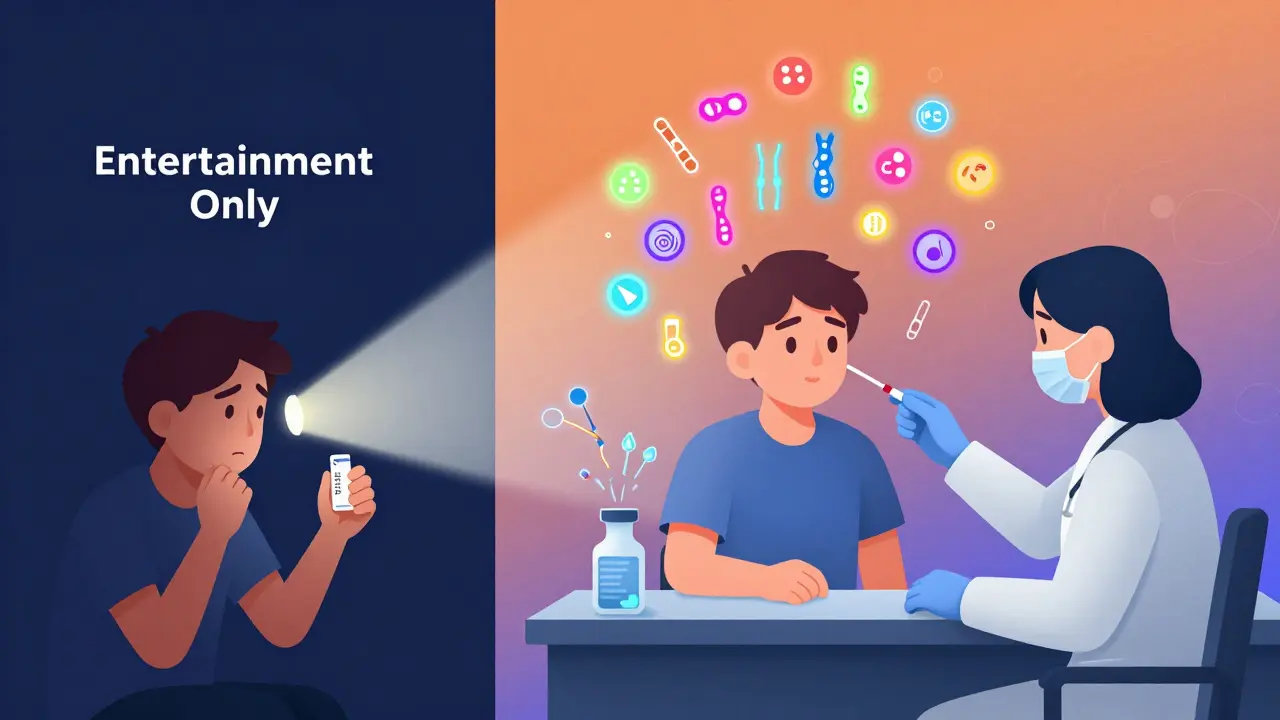
They’re not the same. 23andMe’s FDA-approved test only checks for three specific BRCA mutations found mostly in people of Ashkenazi Jewish descent. That’s it. If you’re not from that background, you’re getting false reassurance. In fact, a 2024 study in the New England Journal of Medicine found that 97% of harmful BRCA mutations in non-Ashkenazi people would be missed by these tests. These kits were never meant to be medical tools. They’re entertainment. Relying on them for cancer risk is like using a flashlight to check your car’s engine-you might see something, but you won’t know what you’re looking at.What Happens After the Test?
Testing isn’t a one-time event. It’s a process. You need genetic counseling-before and after. Before: A certified genetic counselor will map your family history, explain what the test can and can’t tell you, and help you decide if it’s right for you. This isn’t optional. It’s required by professional guidelines. After: If you get a positive result, you’ll get a clear plan. For BRCA, that might mean starting mammograms and MRIs at 25, considering preventive surgery, or taking drugs like tamoxifen. For Lynch, it’s colonoscopies every 1-2 years, starting in your 20s, and sometimes endometrial screenings. If you get a VUS? You don’t change your care plan. You stay on standard screening. And you’ll be notified if that variant gets reclassified later-something that happens more often now thanks to global databases like ClinGen.Cost and Insurance
Medicare and most private insurers cover testing if you meet NCCN criteria. In 2025, approval rates were over 98%. The test itself usually costs between $250 and $500 out-of-pocket if you’re uninsured. Some labs offer financial aid. But here’s the problem: insurance doesn’t always cover testing for relatives. If you test positive, your sibling or child might want to be tested too. That’s called cascade testing. And while NCCN says it’s standard care, 32% of people in online support groups reported being denied coverage for it. It’s a gap in the system.
What’s Next?
The future of genetic testing isn’t just about single genes anymore. Researchers have now identified over 380 DNA regions that control how genes turn on and off in cancer. These aren’t mutations-you can’t change them. But they help explain why two people with the same BRCA mutation might have very different cancer risks. Soon, we’ll start combining these with traditional gene testing to create “polygenic risk scores.” Think of it like a weather forecast for your cancer risk-not just “you have a storm coming,” but “you have a 70% chance of a heavy downpour in the next 10 years.” Right now, this is still research. But by 2030, it could be part of routine care. The goal isn’t to scare people. It’s to give them control.Real Stories, Real Impact
One woman in her 40s, diagnosed with colon cancer, tested positive for Lynch syndrome. Her doctors added immunotherapy to her treatment-and she went into complete remission. That’s not magic. That’s science. Her mutation made her tumor more visible to her immune system. Another woman, 28, tested positive for BRCA2. She had two young children. She chose to have her breasts and ovaries removed. She didn’t feel like she lost anything. She felt like she saved her life. And then there are the ones who didn’t test. A 2024 study in JAMA Internal Medicine followed three people who got negative results on a panel test-then developed cancer years later. Turns out, their test missed a rare mutation because the lab didn’t analyze the whole gene. That’s why labs now confirm positive results with a second method, and why you need a specialist to interpret the results.Don’t Wait for a Diagnosis
Cancer doesn’t always announce itself. But your genes might. If you’ve got a family history, or if you’ve had cancer young, don’t assume it’s just bad luck. Genetic testing isn’t about doom. It’s about preparation. It’s about knowing your options before you need them. The tools are here. The science is solid. The guidance exists. What’s missing is the conversation. If you’re unsure where to start, talk to your doctor. Ask if you qualify for genetic counseling. Don’t wait for someone else to get sick. The next person who needs to know might be you.Is genetic testing for cancer risk covered by insurance?
Yes, if you meet clinical criteria set by the National Comprehensive Cancer Network (NCCN). Medicare and most private insurers cover multigene panel testing for people with personal or family histories of early-onset cancer, multiple cancers, or known hereditary syndromes. Approval rates are over 98% for qualifying patients. However, coverage for testing relatives (cascade testing) can be inconsistent, and some insurers still deny it despite guidelines.
Can I get tested without seeing a genetic counselor?
Technically, yes-you can order a test online or through some clinics without counseling. But it’s strongly discouraged. Genetic test results are complex. A positive result doesn’t mean you’ll definitely get cancer. A variant of uncertain significance (VUS) doesn’t mean you’re safe. Only certified genetic counselors are trained to interpret these results in the context of your family history and personal health. Skipping counseling increases the risk of misinterpretation, unnecessary procedures, or false reassurance.
What’s the difference between BRCA testing and Lynch syndrome testing?
BRCA testing looks for mutations in the BRCA1 and BRCA2 genes, which mainly increase the risk of breast, ovarian, pancreatic, and prostate cancers. Lynch syndrome testing checks for mutations in MLH1, MSH2, MSH6, PMS2, or EPCAM, which raise the risk of colorectal, endometrial, stomach, and other cancers. The screening and prevention strategies are completely different. Someone with BRCA might get breast MRIs and consider ovary removal. Someone with Lynch gets frequent colonoscopies and may need endometrial biopsies.
Are direct-to-consumer tests like 23andMe reliable for cancer risk?
No. 23andMe’s FDA-authorized test only detects three specific BRCA mutations found in people of Ashkenazi Jewish descent. It misses over 97% of harmful BRCA mutations in the general population. It doesn’t test for Lynch syndrome or any other cancer genes. Relying on these tests for medical decisions can lead to dangerous false reassurance. They’re not medical-grade tools.
What if I get a variant of uncertain significance (VUS)?
A VUS means the lab found a change in your DNA, but scientists don’t yet know if it increases cancer risk. You should not change your medical care based on a VUS. Continue with standard screening based on your family history. Most VUS results are eventually reclassified as either benign or pathogenic-thanks to global research efforts like ClinGen. You’ll be notified if your result changes. Don’t panic. Don’t make drastic decisions. Just stay in touch with your genetic counselor.
Can genetic testing help if I already have cancer?
Yes. Finding a hereditary mutation can change your treatment. For example, people with BRCA mutations may respond better to certain chemotherapy drugs or PARP inhibitors. Those with Lynch syndrome often respond well to immunotherapy drugs like pembrolizumab. Testing can also help your family members avoid cancer by identifying who else should be tested. Even after diagnosis, genetic testing can be a critical part of your care plan.
Is genetic testing safe for my privacy?
Legally, your genetic information is protected under GINA (Genetic Information Nondiscrimination Act), which prevents health insurers and employers from discriminating based on test results. However, GINA doesn’t cover life insurance, disability insurance, or long-term care insurance. There have been documented cases of data breaches affecting hundreds of thousands of people since 2020. Always choose a lab that follows HIPAA and NIST security standards, and ask how your data is stored and shared.
Jennifer Glass
January 5, 2026My mom had ovarian cancer at 47. We didn’t know about BRCA back then. If we had, maybe she’d still be here. I got tested last year-BRCA2 positive. I had the surgery. No regrets. It’s not about fear. It’s about not letting luck decide your fate.
Still, the waiting for results? Brutal. Like living in a fog for weeks.
Thanks for writing this. It’s the kind of thing people need to read before it’s too late.
Michael Rudge
January 7, 2026Oh wow, another ‘genetic destiny’ sermon. Let me guess-you also think your DNA is a crystal ball and your insurance should pay for your emotional preparedness plan?
Next you’ll tell me we should gene-test newborns and pre-emptively remove organs based on statistical ghosts.
Save the TED Talk. I’ll take my chances with the universe, thanks.
Ethan Purser
January 8, 2026Bro. I just lost my aunt to pancreatic cancer. She was 42. She didn’t even know she was at risk. I cried for three days straight. Then I Googled ‘BRCA testing near me’ and cried harder because the waitlist was 6 months.
This isn’t sci-fi. This is my family’s obituary page. And now I’m sitting here wondering if I’m a walking time bomb with a 70% expiration date.
Why does it feel like we’re only talking about this after someone’s already gone?
Also-can someone explain why my cousin’s test was covered but mine got denied? I’m 29. No cancer. But my mom’s side looks like a horror movie. #CascadeTestingIsACrime
Doreen Pachificus
January 8, 2026Interesting. I got a 23andMe result last year-negative for the three BRCA variants. Felt relieved. Then I read this. Now I’m just… confused. Like, what even was the point of paying $100 for that? Was it just a fancy horoscope with DNA?
Maybe I should talk to my doctor. But I’m scared to ask. Feels like opening a door you can’t close.
Cassie Tynan
January 9, 2026Let’s be real-this isn’t about science. It’s about control. We’re all just scared little humans trying to outsmart death with spreadsheets and lab reports.
My sister got a VUS. She spent 14 months Googling ‘BRCA2 variant c.5477T>A’ like it was a cursed spell. She stopped sleeping. Started avoiding hugs.
Turns out? It’s benign now. Thanks to ClinGen.
So here’s my take: get tested. But don’t let your DNA own your soul. You’re more than your genes. You’re also your choices. Your laughter. Your stubborn hope.
And if your insurance denies cascade testing? Fight. Like your life depends on it. Because it does.
Rory Corrigan
January 11, 2026Just got my results. BRCA1 positive. I’m 31. Two kids. I cried. Then I made a playlist. Then I called my mom. She said, ‘We’re all just trying to survive this mess.’
So I’m doing the surgery. Not because I’m brave. Because I’m tired of watching people I love disappear too soon.
Also-can we talk about how weird it is that we’re okay with giving people cancer meds but not counseling? Like, why is the mental toll not part of the treatment plan?
😭
Roshan Aryal
January 12, 2026What a western medical cult. You people believe in DNA like it’s holy scripture. In India, we treat cancer with turmeric, yoga, and faith. Your labs are just corporate tools to sell more scans and surgeries. Why do you trust a machine more than your ancestors?
Also, why are you so obsessed with fear? Life is short. Enjoy it. Not every mutation is a death sentence. Your panic is your real disease.
Jack Wernet
January 13, 2026Thank you for this comprehensive and compassionate overview. As someone who works in public health, I’ve seen too many patients dismissed due to lack of awareness or insurance barriers. The disparity in access to cascade testing is not just a policy gap-it’s a moral failure.
I urge clinicians to proactively offer genetic counseling referrals, especially to patients with early-onset cancers or strong family histories. Prevention is not a luxury. It is equity in action.
Also, I appreciate the emphasis on VUS. Too often, patients are left to interpret ambiguous results alone. This is where trained genetic counselors are indispensable.
Catherine HARDY
January 14, 2026Did you know that 87% of genetic data is owned by private labs? And they sell it to pharma. And those same labs? They’re owned by the same corporations that make chemo drugs.
Think about it. You get tested. You find a mutation. They sell you the treatment. They profit. You pay. They get richer.
What if this whole thing is engineered? What if they need people to be afraid so they keep buying tests, surgeries, drugs?
I’m not saying don’t get tested. I’m saying… question everything. Even the science.
Vicki Yuan
January 16, 2026I just wanted to add a data point: In a 2024 study published in JAMA Oncology, women with BRCA mutations who received genetic counseling before surgery had 42% higher adherence to follow-up screening protocols compared to those who didn’t. Counseling isn’t just a formality-it’s a clinical intervention.
Also, if you’re considering testing, request the full panel. Don’t settle for BRCA-only. And if your provider says, ‘You don’t need it,’ ask for the NCCN guidelines. Print them. Bring them. Be the patient who shows up prepared.
Knowledge isn’t power-it’s insurance against regret.
Uzoamaka Nwankpa
January 17, 2026My sister died of breast cancer at 35. We didn’t test. We didn’t know. Now I’m scared to have kids. What if I pass this on? What if I’m the reason my daughter gets sick? I can’t sleep. I cry every night. I don’t even know if I should get tested. What if I’m positive? What if I’m not? What if I’m just… broken?
Can someone tell me I’m not alone?
Chris Cantey
January 17, 2026There’s a quiet horror in knowing your body might betray you. Not the dramatic kind. The slow, creeping kind. The kind where you start counting birthdays like they’re countdowns.
I got my results last month. VUS. No change. But I still check my breasts every morning. Like a ritual. Like if I stare hard enough, I can see the mutation before it wakes up.
They say ‘you’re not your genes.’ But I feel like mine are whispering in the dark.
Still… I’m alive. And that’s something.
Abhishek Mondal
January 17, 2026Excuse me-but why are we so obsessed with genetic determinism? In my country, we believe in karma, not SNPs. You think you can control fate by sequencing DNA? That’s arrogance wrapped in a lab coat. You’re not ‘empowering’ people-you’re creating a new class of anxious, over-tested, medically-saturated zombies.
And who benefits? The corporations. The labs. The insurers. Not you. Not your family. Not your soul.
Also-your ‘polygenic risk scores’? That’s just statistical witchcraft. You’re turning biology into a spreadsheet. That’s not science. That’s capitalism with a microscope.