
9 Jan 2026
- 15 Comments
Red Yeast Rice & Statin Risk Calculator
Calculate Your Combined Risk
This tool calculates your total statin-equivalent exposure when combining red yeast rice with prescription statins. The FDA recommends no more than 20mg of statin equivalents daily to avoid dangerous side effects.
Stop taking red yeast rice immediately and contact your doctor.
Recommendations
Do NOT take red yeast rice while taking statins.
If you're experiencing side effects from statins, speak with your doctor about safer alternatives.
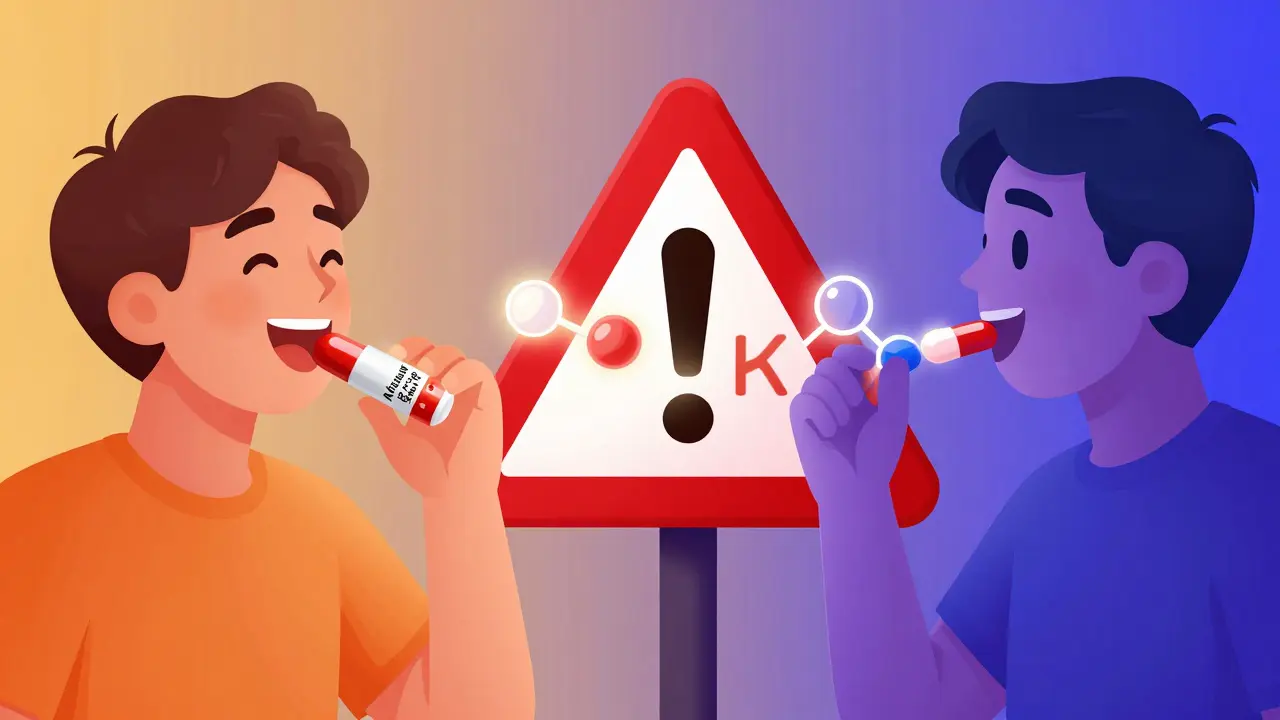
Many people turn to red yeast rice because they believe it’s a "natural" way to lower cholesterol-especially if they’ve had bad reactions to statins. But here’s the hard truth: if you’re already taking a statin, adding red yeast rice isn’t a smart move. It’s not just risky-it’s potentially life-threatening. The reason? Red yeast rice isn’t some gentle herbal tea. It contains monacolin K, which is chemically identical to lovastatin, a prescription statin drug. Taking both together means you’re doubling down on the same powerful cholesterol-lowering mechanism-and that’s like stepping on the gas and the brake at the same time.
What Exactly Is Red Yeast Rice?
Red yeast rice isn’t rice you find in a grocery store. It’s rice fermented with a specific mold called Monascus purpureus. For over a thousand years, it’s been used in traditional Chinese medicine for digestion and circulation. But modern science uncovered something unexpected: in the late 1970s, researchers found that this fermented rice contains monacolin K-the exact same compound as the statin drug lovastatin. That’s not a coincidence. It’s the same molecule, same structure, same effect on the body.
Unlike prescription statins, which are manufactured under strict controls, red yeast rice supplements vary wildly in potency. One capsule might have 1 mg of monacolin K. Another might have 10 mg. A 2022 analysis by ConsumerLab.com found that only 30% of tested products matched their label claims. Some even contained dangerous levels of citrinin, a kidney-toxic mold byproduct found in 25-30% of commercial products. You can’t know what you’re getting unless it’s USP-verified-and even then, you’re still getting a drug, not a supplement.
How Statins Work-and Why Red Yeast Rice Does the Same Thing
Statins like atorvastatin, rosuvastatin, and simvastatin work by blocking HMG-CoA reductase, an enzyme your liver uses to make cholesterol. Lower that enzyme’s activity, and your LDL (bad cholesterol) drops. That’s why statins are among the most prescribed medications in the world.
Red yeast rice does exactly the same thing. Monacolin K is lovastatin. It binds to the same enzyme, inhibits the same pathway, and reduces LDL by 20-30%-similar to a low-dose statin. A 2019 study in the Journal of the American College of Cardiology confirmed that red yeast rice lowered LDL just as effectively as a 10-20 mg dose of lovastatin. So if you’re taking a 20 mg statin and also taking red yeast rice with 5 mg of monacolin K, you’re effectively taking 25 mg of statin. That’s not "natural"-it’s pharmacological overdose.
The Real Danger: Muscle Damage and Rhabdomyolysis
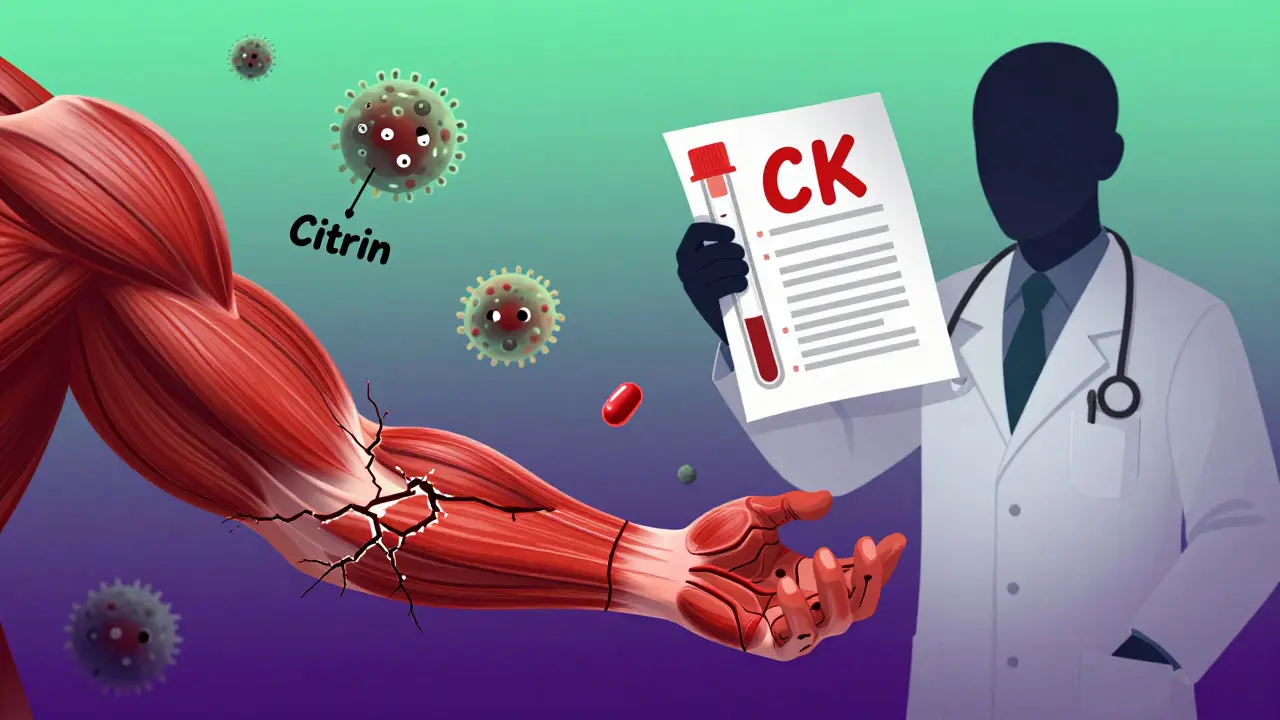
The biggest risk of combining red yeast rice with statins? Muscle damage so severe it can shut down your kidneys. This is called rhabdomyolysis. It’s rare with statins alone-but when you add red yeast rice, the risk jumps dramatically.
The FDA’s adverse event database recorded 127 cases of severe muscle damage between 2018 and 2022 involving people who took both. One Reddit user, "CardioWarrior99," shared his story: after taking 1,200 mg of red yeast rice daily while on 20 mg of atorvastatin, his creatine kinase (CK) levels spiked to 18,500 U/L. Normal is under 200. He was hospitalized. His kidneys were at risk. He called it "the scariest week of my life."
Doctors see this pattern. At the Mayo Clinic, the risk of myopathy (muscle pain and weakness) increases 3.7 times when red yeast rice is taken with statins. The American Heart Association, the American College of Cardiology, and the FDA all say: don’t mix them. The warning isn’t theoretical. It’s based on real people ending up in the ER.
Who Might Think This Is a Good Idea?
Many people who try red yeast rice are statin-intolerant. About 7-29% of statin users develop muscle pain, fatigue, or liver enzyme spikes and stop taking their meds. For them, red yeast rice looks like a lifeline. And for some, it can be-if used correctly.
A 2017 study in the Journal of Alternative and Complementary Medicine found that 60% of statin-intolerant patients could tolerate red yeast rice at 1,800 mg daily (roughly 3 mg monacolin K). Their LDL dropped by 25-30%. No major side effects. That’s promising. But here’s the catch: they were taking red yeast rice alone. Not with statins. Not with grapefruit juice. Not with other CYP3A4 inhibitors. Just red yeast rice, under medical supervision.
That’s the key: monotherapy. Not combination therapy. Switching from statins to red yeast rice? Possible-with monitoring. Adding red yeast rice to statins? Never recommended.
What About the "Natural" Label?
"Natural" doesn’t mean safe. Aspirin comes from willow bark. Morphine comes from poppies. Both are natural. Both are powerful drugs. Red yeast rice is no different. It’s a concentrated source of a pharmaceutical compound. Calling it "natural" is marketing, not science.
The FDA has issued 12 warning letters to red yeast rice manufacturers since 2008, declaring products containing monacolin K to be unapproved drugs. But because of the Dietary Supplement Health and Education Act of 1994, the FDA can’t pull them off shelves unless they prove harm. That means you’re buying a drug without knowing the dose, without knowing the purity, and without knowing if it’s even legal in your state.
What Should You Do Instead?
If you’re statin-intolerant and want to lower your cholesterol, here’s what actually works:
- Switch to a different statin-some people tolerate rosuvastatin better than simvastatin.
- Try ezetimibe, a non-statin pill that blocks cholesterol absorption in the gut.
- Consider PCSK9 inhibitors (injections) if you’re at high risk for heart disease and need aggressive lowering.
- Use lifestyle changes: more soluble fiber (oats, beans, apples), regular aerobic exercise, and reducing saturated fats.
If you still want to try red yeast rice, do it right:
- Stop your statin first-don’t take both.
- Get baseline blood tests: CK, liver enzymes (ALT, AST), and a lipid panel.
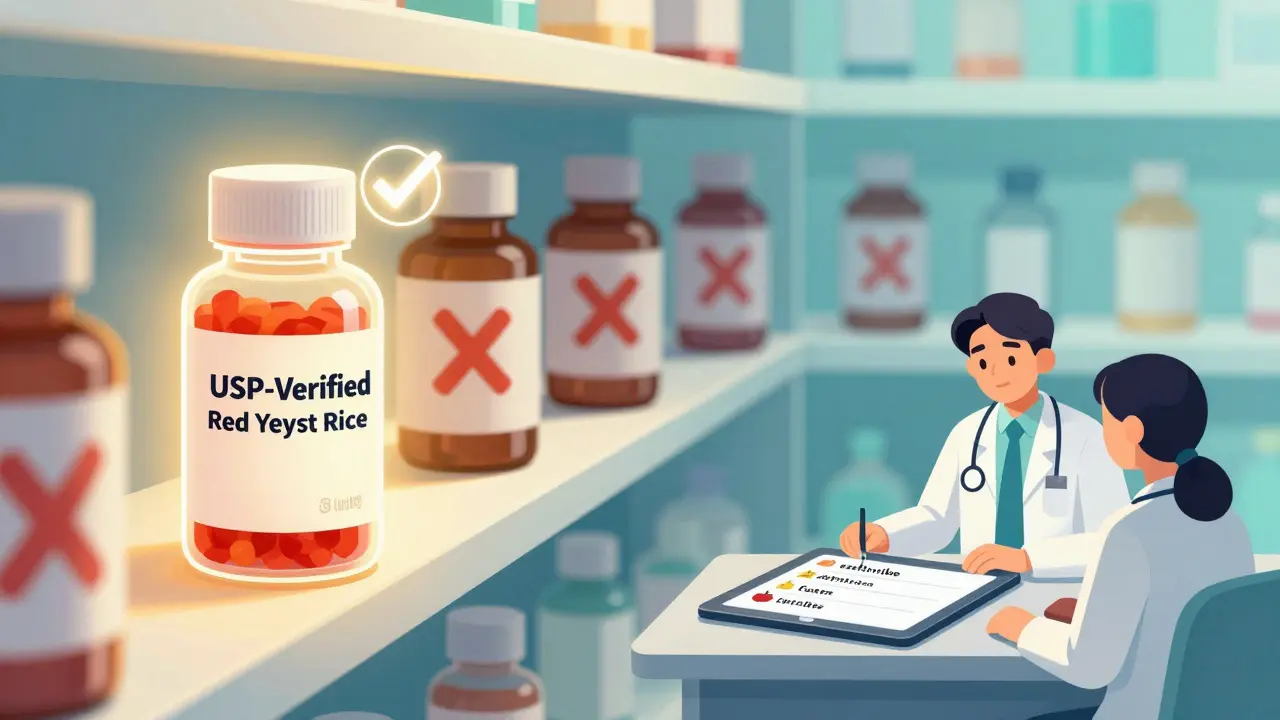
- Choose a USP-verified product (look for the USP mark on the bottle).
- Start with 600 mg daily-don’t go over 1,200 mg without doctor approval.
- Avoid grapefruit, amiodarone, clarithromycin, and other CYP3A4 inhibitors.
- Get blood tests again at 8-12 weeks to see if it’s working.
And always tell your doctor you’re taking it. A 2021 Mayo Clinic study found that 45% of patients didn’t disclose supplement use-even when it could kill them.
Bottom Line: Don’t Mix Them
Red yeast rice isn’t a magic herb. It’s a hidden statin. Taking it with a real statin is like doubling your dose without your doctor’s knowledge. The risk of muscle damage, kidney failure, and hospitalization is real. The benefits? Only if you use it alone-and even then, only under medical care.
If you’re struggling with statin side effects, talk to your doctor about alternatives. There are safer, proven options. You don’t need to gamble with a supplement that’s essentially an unregulated drug.
Can I take red yeast rice instead of my statin?
Yes-but only under medical supervision and after stopping your statin. Red yeast rice can lower LDL similarly to a low-dose statin, but it’s not standardized. Use only USP-verified products, start with a low dose (600 mg), and monitor your liver enzymes and muscle enzymes (CK) every 8-12 weeks. Never switch without consulting your doctor.
Is red yeast rice safer than statins?
Not necessarily. Red yeast rice has the same active ingredient as lovastatin, so it carries the same risks: muscle pain, liver stress, and rare but serious rhabdomyolysis. The difference is unpredictability. Statins have consistent dosing. Red yeast rice doesn’t. You might get 1 mg of monacolin K one day and 10 mg the next. That makes it riskier, not safer.
Why do some people say red yeast rice works better than statins?
Some people who couldn’t tolerate statins find they can handle red yeast rice better-likely because the dose is lower (3-5 mg monacolin K vs. 20-40 mg of synthetic statins). But this isn’t about effectiveness. It’s about tolerability. Red yeast rice isn’t stronger; it’s often weaker and less consistent. If you feel better on it, that’s good-but still, don’t combine it with statins.
What brands of red yeast rice are safe?
Only products verified by the USP (United States Pharmacopeia) are reliable. USP tests for monacolin K content, citrinin contamination, and label accuracy. Look for the USP Verified mark on the bottle. Most store-brand or Amazon-sold products don’t meet this standard. In 2022, only 30% of tested products matched their claims.
How long does it take for red yeast rice to lower cholesterol?
It takes 8-12 weeks to see full effects. A 2018 meta-analysis in Nutrients found LDL reductions peaked at 12 weeks. Don’t expect results in a week. And don’t increase the dose early-wait for your follow-up blood test before making any changes.
What to Do Next
If you’re currently taking both red yeast rice and a statin, stop the supplement immediately. Contact your doctor. Get a blood test for CK and liver enzymes. If you’ve had unexplained muscle pain, fatigue, or dark urine, seek medical help right away.
If you’re thinking about starting red yeast rice, talk to your doctor first. Ask if you’re a candidate for ezetimibe, a different statin, or a PCSK9 inhibitor. These are regulated, tested, and safer options. Red yeast rice might seem like a simple fix-but it’s a hidden risk you don’t need.
Jake Nunez
January 10, 2026My uncle took red yeast rice with his statin and ended up in the ER with muscle necrosis. He thought it was "natural" so it must be safe. Turns out natural doesn’t mean harmless. He’s lucky he didn’t lose a kidney.
Michael Marchio
January 10, 2026Let’s be clear: anyone who thinks supplement labels are trustworthy is either delusional or has never read the fine print. The FDA doesn’t regulate these like drugs, so you’re essentially gambling with your muscles and kidneys. And yet people still buy them like they’re organic kale chips. This isn’t wellness-it’s reckless self-experimentation dressed up as common sense.
lisa Bajram
January 12, 2026Okay, I get it-people want to avoid statins because of side effects, and red yeast rice seems like the gentle, earthy alternative. But here’s the thing: it’s not gentle. It’s a hidden drug with a wild west dosage. I’ve seen so many patients come in thinking they’re being "smart" by going natural, only to find out they’ve doubled their statin dose without knowing it. Please, if you’re going to try this, do it right: stop the statin first, get tested, use USP-certified stuff, and talk to your doctor like a human being, not a Google search.
And no, grapefruit juice doesn’t count as a "natural" enhancer-it’s a chemical grenade in this scenario.
Ted Conerly
January 14, 2026If you’re struggling with statin side effects, don’t panic. There are real, safe alternatives-ezetimibe, different statins, even PCSK9 inhibitors. Red yeast rice isn’t the answer; it’s a trap wrapped in a marketing slogan. I’ve worked with dozens of people who thought they were being proactive by switching to supplements. Most of them ended up needing medical help because they didn’t realize they were overdosing. You don’t need to suffer. Talk to your doctor. There’s a better path.
Faith Edwards
January 15, 2026It is, frankly, astonishing that individuals continue to elevate unregulated, untested, and pharmacologically active botanical extracts above evidence-based pharmaceutical interventions, especially when the former carry demonstrably higher risks due to unstandardized potency and frequent contamination. The notion that "natural" equates to "safe" is not merely erroneous-it is dangerously archaic, a relic of pre-scientific thinking that has no place in modern medicine. To conflate traditional use with clinical efficacy is to confuse anecdote with evidence, and to do so while simultaneously disregarding the FDA’s repeated warnings is not just irresponsible-it is ethically indefensible.
Jay Amparo
January 15, 2026My cousin in India used red yeast rice for years-no statins, just the supplement. His LDL dropped, no side effects. But he never mixed it with anything else. He also got his from a trusted Ayurvedic shop with lab reports. So it’s not the herb-it’s the combo and the chaos of buying random stuff online. We need education, not fear. People just need to know: one or the other, not both.
Lisa Cozad
January 17, 2026I had statin muscle pain for months. I stopped the statin, waited two weeks, then started USP-verified red yeast rice at 600 mg. My cholesterol dropped 28% in 10 weeks. No muscle pain. No issues. But I told my doctor. I got blood tests. I didn’t just Google and buy a bottle. This isn’t magic-it’s medicine. And you need to treat it like that.
Saumya Roy Chaudhuri
January 18, 2026Anyone who takes red yeast rice without knowing the exact monacolin K content is either a fool or a lab rat. And if you’re combining it with statins? You’re not just dumb-you’re a walking medical liability. The FDA has warned about this for 15 years. People still do it. It’s like driving blindfolded and hoping you don’t hit a tree. Spoiler: you will.
anthony martinez
January 18, 2026So let me get this straight: you’d rather trust a random capsule from Amazon than a pill that’s been tested on millions of people and prescribed by doctors for decades? Cool. Let me know how your CK levels are in six weeks.
Mario Bros
January 19, 2026Statins gave me cramps so bad I couldn’t walk. I switched to USP red yeast rice-low dose, no statin-and I feel better than I have in years. My doctor monitors me. I don’t drink grapefruit juice. I don’t take other supplements. It’s not magic. It’s just smart. Don’t be scared of alternatives-be scared of ignorance.
Jaqueline santos bau
January 20, 2026Why do people think they know better than doctors? You’re not a biochemist. You’re not a pharmacist. You’re just some guy who read a blog. And now you’re risking kidney failure because you think "natural" means "no consequences." I’ve seen people die from this. You’re not special. You’re not immune. Stop being reckless.
chandra tan
January 20, 2026My village in Kerala has used red yeast rice for generations. No statins. No problems. But we never mixed it with anything. We didn’t need to. The key is balance-not fear, not hype. People in the West turn everything into a war. It’s just food, medicine, tradition. Use it right, respect it, don’t mix.
Jake Kelly
January 22, 2026Thank you for writing this. I’ve been scared to tell my doctor I was taking red yeast rice because I thought he’d judge me. But after reading this, I’m going in tomorrow to talk about switching properly. You’re right-it’s not about being perfect. It’s about being safe.
Ritwik Bose
January 23, 2026While I appreciate the scientific rigor of this post, I must respectfully note that cultural context matters. In many traditional systems, including Ayurveda and TCM, red yeast rice is not viewed as a standalone drug but as part of a holistic regimen-diet, exercise, mindfulness. Reducing it to a "hidden statin" overlooks its broader therapeutic intention. Perhaps the issue isn’t the herb, but the reductionist Western mindset that treats everything as a chemical bullet.
Paul Bear
January 23, 2026Per the 2022 ConsumerLab meta-analysis, 70% of red yeast rice products fail label accuracy standards. Of those, 25–30% contain citrinin, a nephrotoxic mycotoxin. The mean monacolin K concentration in non-USP products is 8.7 mg per capsule, with a standard deviation of 6.2 mg-meaning a "standard dose" of 1,200 mg could deliver anywhere from 0.1 mg to 21.1 mg of active compound. This is not a supplement. It is a pharmacokinetic lottery. The risk-benefit ratio is not merely unfavorable-it is catastrophically unviable when combined with statins. Your liver enzymes are not a suggestion-they are a biological alarm system.