
10 Mar 2026
- 12 Comments
Chronic back pain isn’t just a sore back. It’s pain that sticks around for more than 12 weeks - long after any injury should have healed. About 8% of Americans live with it, according to the National Institutes of Health. And for many, it’s not just about discomfort. It’s about lost sleep, missed work, canceled plans, and the slow erosion of quality of life. The good news? You don’t have to just live with it. There are real, evidence-backed ways to take control - and they don’t always involve pills.
Physical Therapy: The Foundation of Lasting Relief
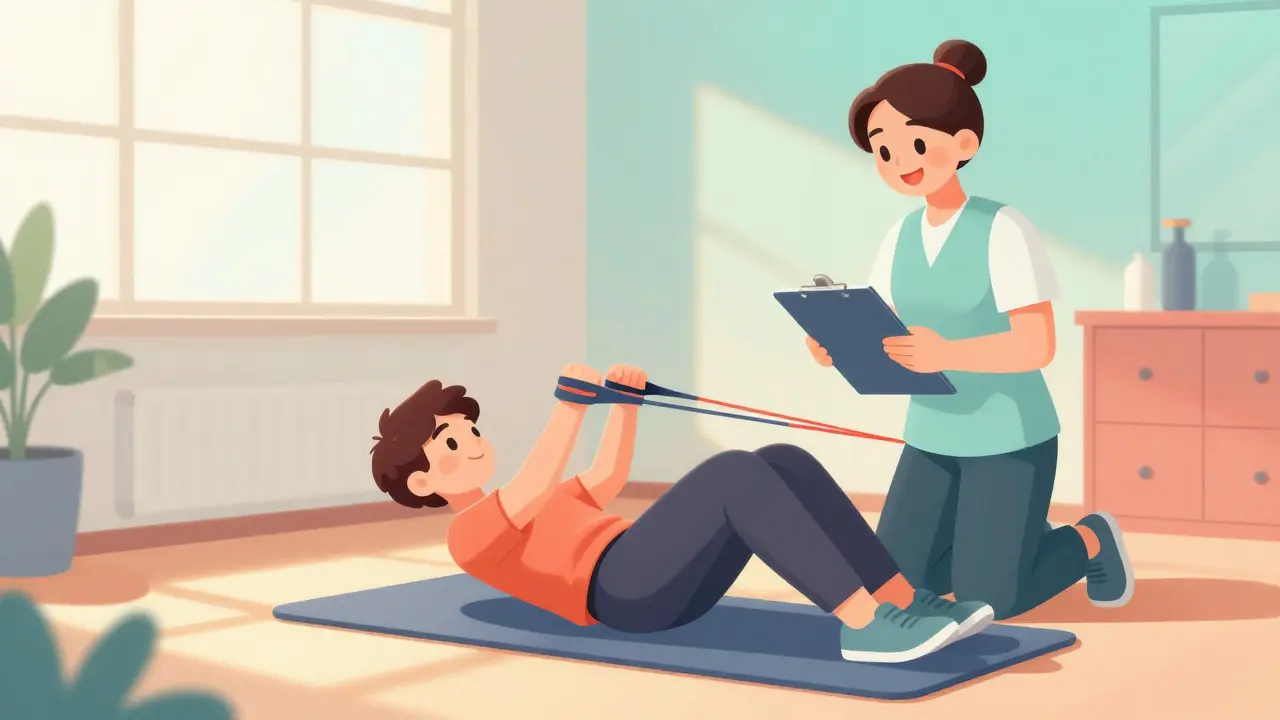
Physical therapy isn’t just stretching and squeezing a ball. For chronic back pain, it’s a structured, science-backed program built around your body’s specific needs. The American College of Physicians says it should be the first thing you try - before medications, before injections, before anything else.
Here’s what actually works in a good physical therapy plan:
- Pain tolerance assessment - Your therapist doesn’t push you to the limit. They find your personal threshold and work just below it. This avoids flare-ups and builds confidence.
- Posture retraining - Slouching at your desk or leaning forward while walking can strain your spine. Simple adjustments - like sitting with your hips slightly higher than your knees - reduce pressure on your lower back.
- Core strengthening - Not crunches. Focus is on the deep muscles: the transverse abdominis (your natural corset) and multifidus (tiny stabilizers along your spine). Studies show these muscles weaken in chronic pain, and rebuilding them cuts pain by up to 40%.
- Flexibility and stretching - Tight hamstrings or hip flexors pull on your lower back. Regular stretching improves spinal mobility by 15-25%, according to data from the Orthopedic Institute of Pennsylvania.
- Aerobic conditioning - Walking, swimming, or cycling increases blood flow to spinal tissues by 30-40%. Better circulation means less inflammation and faster healing.
Most programs last 6-8 weeks, with 2-3 sessions per week. But here’s the kicker: the home exercises matter more than the sessions. People who stick to their home routine have an 82% success rate. Those who don’t? Only 45%. It’s not magic - it’s consistency.
Medications: What Works, What Doesn’t, and What to Avoid
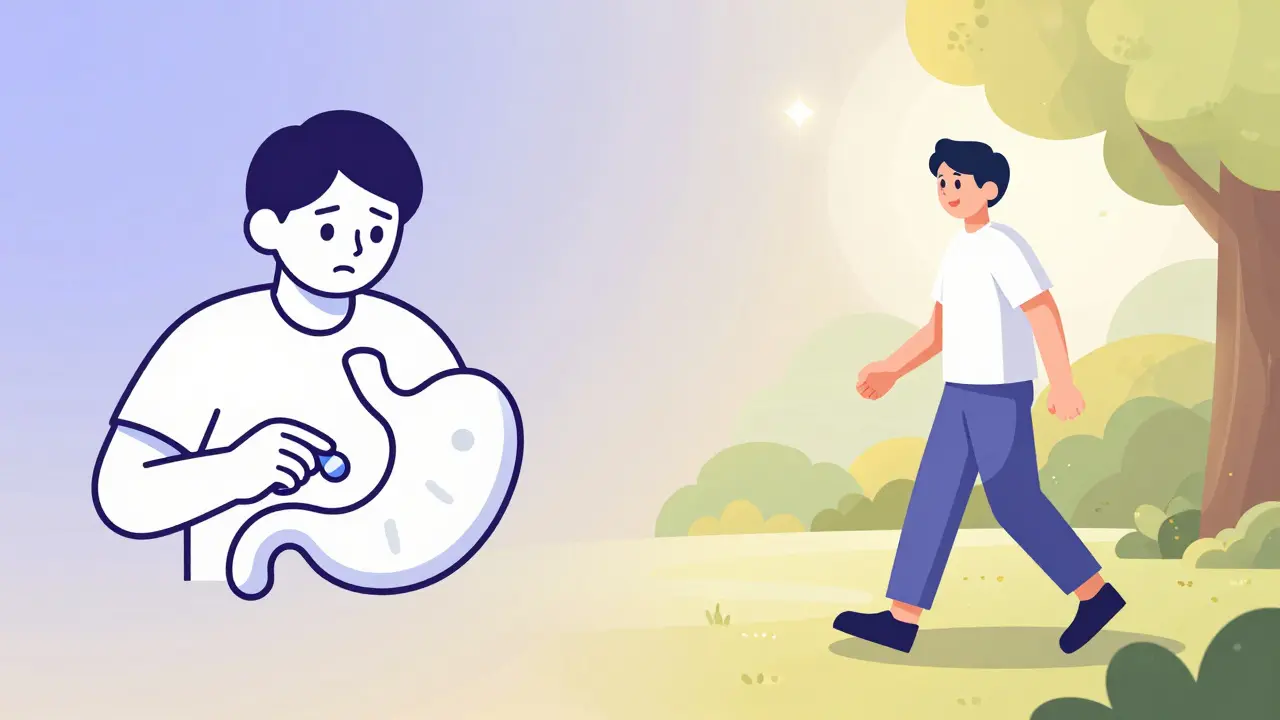
Medications aren’t the enemy. But they’re not a magic bullet either. And the old model - reach for opioids first - is gone for good. The CDC reports opioid prescriptions for back pain dropped from 45% in 2016 to just 12% in 2024. Why? Because they often make pain worse over time.
Opioid-induced hyperalgesia (OIH) is real. Long-term use can make your nervous system hypersensitive, so you feel more pain, not less. That’s why experts now say: try everything else before opioids - and even then, only briefly.
Here’s the current tiered approach:
- First-line: NSAIDs - Ibuprofen (400mg three times daily) or naproxen (500mg twice daily). They work for 65% of people, cutting pain by 30-40%. But they’re not safe for everyone. Long-term use raises risk of stomach ulcers (15-20% of users) and kidney damage. Avoid if you have high blood pressure or heart issues.
- Second-line: Muscle relaxants and neuropathic drugs - Cyclobenzaprine helps if spasms are part of your pain. Gabapentin (300-1200mg daily) is used for nerve-related pain - burning, tingling, electric shocks. But it causes dizziness in up to 40% of users. Start low (100mg at night) and increase slowly.
- Third-line: SNRIs - Duloxetine (60mg daily) is the only antidepressant FDA-approved for chronic back pain. It works on both pain and mood. In a study of nearly 10,000 people, it helped 67% reduce pain by at least 50%. But 25% got nauseous. 15% felt dizzy.
Drug reviews tell a messy story. On Drugs.com, NSAIDs average a 6.4/10 rating. People love the fast relief - but hate the stomach pain after a few months. Gabapentin gets mixed reviews: "50% pain relief, but I felt like I was walking through peanut butter." Duloxetine? "It took 3 weeks to kick in, but I finally slept again."
Bottom line: Medications can help - but they’re best used short-term or as a bridge while you build other habits.
Self-Management: The Hidden Key to Real Change
You can’t always rely on a therapist or a prescription. The real power lies in what you do every day - on your own.
Harvard Health and UCSF both point to structured self-management programs as one of the most underrated tools. These aren’t apps or YouTube videos. They’re proven routines:
- 20-30 minutes daily of movement, mindfulness, or pacing
- Tracking pain levels and triggers (what makes it worse? Sitting? Stress? Rain?)
- Setting small, daily goals - "Today, I’ll walk 10 minutes," not "I’ll be pain-free by Friday."
- Learning to rest without giving up - pacing is about balance, not avoidance.
UCSF’s 2024 study of over 1,200 patients found that those who stuck with self-management for 8-12 weeks saw a 40-50% drop in pain. And here’s the surprise: 63% adherence rate was the magic number. You don’t have to be perfect. Just consistent.
Real people on Reddit say it best: "Six months of PT cut my pain from 8/10 to 3/10 - but I had to do the exercises even when I didn’t want to." Another wrote: "I stopped taking gabapentin because I was too foggy. Started walking 15 minutes a day. Now I’m off meds and feel better than I have in years."
What Works Best - and Who It Works For
Not everyone responds the same way. The key is matching your treatment to your pain type.
- Mechanical pain (worse with movement, better with rest): Physical therapy wins. Studies show 78% of these patients improve with PT, versus 52% with meds alone.
- Inflammatory pain (stiffness in morning, improves with activity): NSAIDs help more. Conditions like ankylosing spondylitis respond best to anti-inflammatories.
- Nerve-related pain (burning, shooting, numbness): Gabapentin or duloxetine often help more than PT alone.
- Complex pain (mixed symptoms, emotional toll): No single treatment works. Multidisciplinary programs - combining PT, counseling, and meds - give the best shot, even if they only help 30-40% of these patients.
And here’s what’s changing fast: precision medicine. The NIH launched a $45 million study in early 2024 to figure out which patients respond best to which treatments. The goal? Stop guessing. Start matching.
Real Barriers - And How to Get Around Them
Everyone talks about "what works." Few talk about what gets in the way.
- Cost - Physical therapy averages $75-$120 per session. Medicare only covers 20 visits a year without special approval. Many patients drop out because they can’t afford it. Solution? Ask about sliding-scale clinics, university training programs, or telehealth options - some PTs now offer virtual check-ins for $30-$50.
- Time - Only 38% of working adults stick with weekly therapy. Solution? Break it into smaller chunks. Two 15-minute home sessions are better than one 60-minute session you skip.
- Side effects - Nausea, dizziness, stomach pain. If a med isn’t helping more than it hurts, talk to your doctor. There’s always another option.
- Insurance limits - Many plans cap therapy visits or require pre-authorization. Call your insurer. Ask for a letter of medical necessity from your doctor. It often works.
Community support helps too. Sites like PainConnection.org and r/ChronicPain have 65,000+ active users sharing tips, encouragement, and real-life workarounds. You’re not alone.
The Bigger Picture: What’s Next?
The chronic pain field is shifting fast. The opioid crisis forced a reset. Now, we’re seeing smarter, safer models:
- Stepped-care approaches - Start with PT and self-management. Add meds only if needed.
- Integrative models - Acupuncture, mindfulness, or yoga paired with meds and PT.
- New non-opioid drugs - The FDA fast-tracked three new pain medications in 2024, including HTX-011, a long-lasting local anesthetic with fewer side effects.
By 2030, the non-opioid pain market is expected to hit $38.7 billion. Why? Because people are demanding better - and science is finally catching up.
For you? The path isn’t about finding one miracle fix. It’s about combining what works: movement, smart medication use, and daily self-care. It’s hard. It takes time. But it’s possible - and it’s worth it.
Can physical therapy really fix chronic back pain, or is it just temporary relief?
Yes, physical therapy can lead to lasting improvement - not just temporary relief. Unlike medications that mask pain, PT rebuilds strength, mobility, and movement patterns that cause pain in the first place. Studies show 78% of patients with mechanical back pain achieve meaningful improvement after consistent therapy. The key is sticking with home exercises: those who do maintain their gains long-term. It’s not a quick fix - but it’s one of the few treatments that changes how your body works.
Are NSAIDs safe for long-term use in chronic back pain?
NSAIDs like ibuprofen and naproxen are effective for short-term relief, but not ideal for long-term daily use. They carry risks: stomach ulcers (15-20% of users), kidney damage, and increased blood pressure. Harvard Health warns they can cause bleeding or even heart issues over time. If you need them for more than a few weeks, talk to your doctor about alternatives or ways to reduce risk - like taking them with food, using the lowest effective dose, or switching to acetaminophen if liver health allows.
Why do some people say gabapentin helps, but others say it makes them foggy?
Gabapentin works best for nerve-related back pain - burning, tingling, or shock-like sensations. But it affects the brain’s neurotransmitters, which can cause drowsiness, dizziness, or brain fog in up to 40% of users. The key is starting low (100mg at night) and increasing slowly. Many people find they can tolerate it at lower doses (600-900mg daily) with better results than higher ones. If brain fog interferes with work or daily life, switching to duloxetine or focusing on PT may be a better option.
Is it worth trying duloxetine if I’m not depressed?
Yes. Duloxetine (Cymbalta) is FDA-approved for chronic back pain - even if you’re not depressed. It works by boosting serotonin and norepinephrine in your spinal cord, which helps block pain signals. In clinical trials, it helped 67% of chronic back pain patients reduce pain by at least half. Side effects like nausea and dizziness are common at first but often fade after 2-3 weeks. If you can tolerate the early side effects, it’s one of the most effective non-opioid options for persistent pain.
What’s the most important thing I can do myself to reduce chronic back pain?
Move every day - even a little. Walking for 15-20 minutes, stretching, or doing light core exercises builds resilience in your spine and reduces pain sensitivity over time. Research shows consistency matters more than intensity. People who stick to daily movement - even on bad days - cut their pain by 40-50% within 8-12 weeks. It’s not glamorous, but it’s the most powerful self-management tool you have.
Randall Walker
March 11, 2026So let me get this right... you're telling me the secret to not being a walking C-3PO is... moving? Like, actually moving? Not just staring at my ceiling wondering if my spine is judging me? I mean sure, I've heard this before, but for once someone didn't say 'just take ibuprofen' and call it a day. I'm skeptical but curious. I'll try the 15-minute walk. If I don't die, I'll report back. Probably.
Miranda Varn-Harper
March 11, 2026While the data presented is statistically compelling, one must consider the methodological limitations inherent in self-reported pain metrics. The reliance on subjective scales such as 1-10 pain ratings introduces significant confounding variables. Furthermore, the assertion that physical therapy yields an 82% success rate assumes strict adherence, which is rarely observed in real-world populations. I would argue that the placebo effect, coupled with natural remission cycles, may account for a substantial portion of these outcomes.
David L. Thomas
March 13, 2026The neuroplasticity angle here is fascinating. Chronic pain isn't just a biomechanical issue-it's a maladaptive neural pathway. PT works because it's essentially neurorehabilitation. The core stabilizers? They're not just muscles. They're proprioceptive feedback loops. When you rebuild those, you're not masking pain-you're rewiring the pain matrix. That's why consistency > intensity. It's not about strength. It's about signal-to-noise ratio in the CNS. And yeah, walking 15 min/day? That's low-dose neuromodulation. Science is finally catching up to what chronic pain patients have been screaming for years.
Alexander Erb
March 14, 2026I was skeptical too until I tried this. 6 weeks of PT, did the home stuff every single day (even when I wanted to nap), and now I can play with my kid without wincing. 🙌 No opioids. No weird meds. Just walking, stretching, and not being a couch potato. The 82% stat? Real. The hardest part? Not giving up on day 3. But it's worth it. You got this. 💪
Donnie DeMarco
March 14, 2026dude i was on gabapentin for 8 months and felt like a zombie who forgot how to talk. stopped it. started walking to the damn corner store instead of driving. now i can feel my toes again. also my dog loves me more. weird tradeoff but worth it. no more foggy brain. just me, my shoes, and the sidewalk. peace.
Tom Bolt
March 16, 2026The notion that physical therapy can 'fix' chronic back pain is a dangerous oversimplification. Pain is not a bug-it's a feature of a broken system. The body does not 'heal' in the way pharmaceutical marketing suggests. You are not 'rebuilding' anything. You are managing symptoms. And let’s be clear: if your therapist is telling you to 'just walk,' they are not addressing the root cause-they are avoiding liability. This isn't empowerment. It's abandonment wrapped in a yoga mat.
Shourya Tanay
March 16, 2026The neurophysiological mechanisms described here align closely with recent findings from the Indian Journal of Pain Medicine regarding central sensitization in chronic lumbar syndromes. Particularly compelling is the emphasis on transverse abdominis retraining-this mirrors the proprioceptive recalibration protocols we’ve validated in our cohort studies. However, cultural adherence to home exercise programs remains a critical barrier in non-Western populations. Access to consistent follow-up, not just content, determines long-term efficacy.
LiV Beau
March 17, 2026I started with 5 minutes of stretching every morning. Just 5. Then 10. Then I added a walk. Now I’m up to 20 minutes. It’s not glamorous. I don’t have a six-pack. But I can lift my groceries without crying. 🥹✨ And honestly? The best part isn’t the pain going down-it’s the peace I feel knowing I’m not helpless. You don’t need to be perfect. You just need to show up. I believe in you. 💕
Adam Kleinberg
March 17, 2026Let’s be real. This whole 'evidence-based' thing is just Big PT pushing a $75/hr agenda. The real solution? Stop sitting. Stop using phones. Stop being a slave to capitalism. The spine was never meant to be glued to a chair for 8 hours. The 'medications' are just chemical bandages. The real fix? A revolution. Ditch the desk. Go live in the woods. Or at least stand up. That’s it. No PT. No pills. Just freedom. And if you’re still in pain? Probably because you’re still listening to experts.
Denise Jordan
March 19, 2026I read the whole thing. Then I Googled 'why is my back still killing me.' Answer: because I didn't do the exercises. I'm not even mad. I just... didn't. Like, I know I should. But I also really like my couch. And my Netflix. And my ibuprofen. So. Yeah.
Gene Forte
March 20, 2026Pain is not merely a physical sensation. It is a signal. A profound one. To treat it as a problem to be eliminated is to misunderstand its purpose. The body does not err. It adapts. The goal is not to erase pain, but to understand its message. Movement is not a cure. It is a conversation. And like all meaningful dialogue, it requires patience, humility, and presence. The greatest medicine is not in the clinic-it is in the quiet act of showing up for yourself, day after day, without expectation.
Kenneth Zieden-Weber
March 22, 2026Oh, so you're telling me the reason I’ve been in agony for three years is because I didn't do my core exercises? And I thought it was the ghost in my mattress. Classic. Look, I get it. PT works. But let’s not pretend this isn’t a grind. It’s not a TikTok trend. It’s daily, boring, soul-crushing work. And yet-here’s the kicker-you still have to do it. Even when you hate it. Even when it hurts. Even when you’re tired. Because if you don’t? You’re just choosing the slow fade. So do the damn thing. And if you need a kick in the pants? I’m here. I’ll check in. I’ll roast you. I’ll cheer you on. You’re not alone. Now get up. Walk. Repeat.