

9 Dec 2025
- 11 Comments
Statin Exercise Safety Calculator
Find out if your exercise routine is safe while taking statins. Based on your statin type and activity level, this tool provides personalized recommendations.
If you're taking statins and have started noticing muscle aches, you're not alone. About 5 to 10% of people on these cholesterol-lowering drugs report muscle pain, and in real life, that number might be even higher-up to 29% according to some studies. But here’s the thing: stopping exercise isn’t the answer. In fact, moving your body might be the very thing that helps you feel better-if you do it right.
Why Statins Cause Muscle Issues
Statins work by blocking an enzyme your liver uses to make cholesterol. But that same enzyme is also involved in making coenzyme Q10 (CoQ10), a compound your muscles need to produce energy. When statins lower CoQ10 by as much as 40% within just 30 days, your muscles don’t get the fuel they need during activity. This doesn’t mean everyone gets pain-but for some, it’s enough to trigger discomfort, stiffness, or weakness, especially after physical exertion. Not all statins are the same. The lipophilic ones-like atorvastatin, simvastatin, and lovastatin-pass more easily into muscle tissue. That’s why high-dose atorvastatin (80 mg/day) is linked to a 10.5-fold higher risk of muscle problems compared to pravastatin. Hydrophilic statins like rosuvastatin and pravastatin stay mostly in the liver, making them gentler on muscles.Exercise Isn’t the Enemy-It’s the Intensity
You’ve probably heard that exercise is good for your heart. That’s still true, even if you’re on statins. The real issue isn’t movement-it’s how hard you push. A 2023 study from Radboud University Medical Center followed 105 people: those on statins with muscle pain, those on statins with no pain, and people not taking statins. Everyone did a 30-minute moderate bike ride. The results? No significant spike in muscle damage markers like creatine kinase (CK) in any group. That means moderate exercise doesn’t worsen statin-related muscle pain. But push too hard, and things change. A 2007 study of Boston Marathon runners found statin users had 46% higher CK levels after the race than non-users. Another study showed eccentric exercises-like downhill running or heavy weight lowering-caused 300% more CK rise in statin users than in others. That’s a red flag.What Counts as Moderate Exercise?
Moderate intensity means you can talk but not sing. Your heart rate should be around 40-70% of your maximum. For most people, that’s:- Brisk walking (3-4 miles per hour)
- Light cycling on flat ground
- Water aerobics
- Using an elliptical machine at a steady pace
When Exercise Makes Things Worse
High-intensity interval training (HIIT), heavy lifting, sprinting, or long downhill runs are risky. A Reddit survey of over 14,000 statin users found that 78% had trouble with HIIT, while 63% found daily walking didn’t trigger pain. One woman, a competitive cyclist, ended up in the hospital with rhabdomyolysis-muscle breakdown so severe her CK hit 12,450 U/L (normal is 30-200). She was on high-dose simvastatin and training intensely. It’s rare, but it happens. The key is timing. Statin-related pain usually shows up within 30 days of starting the drug and sticks around no matter what you do. Exercise-induced pain shows up after a workout and fades in a day or two. If your pain only happens after you move, it’s likely from the workout-not the statin. If it’s constant, even on rest days, it’s probably the medication.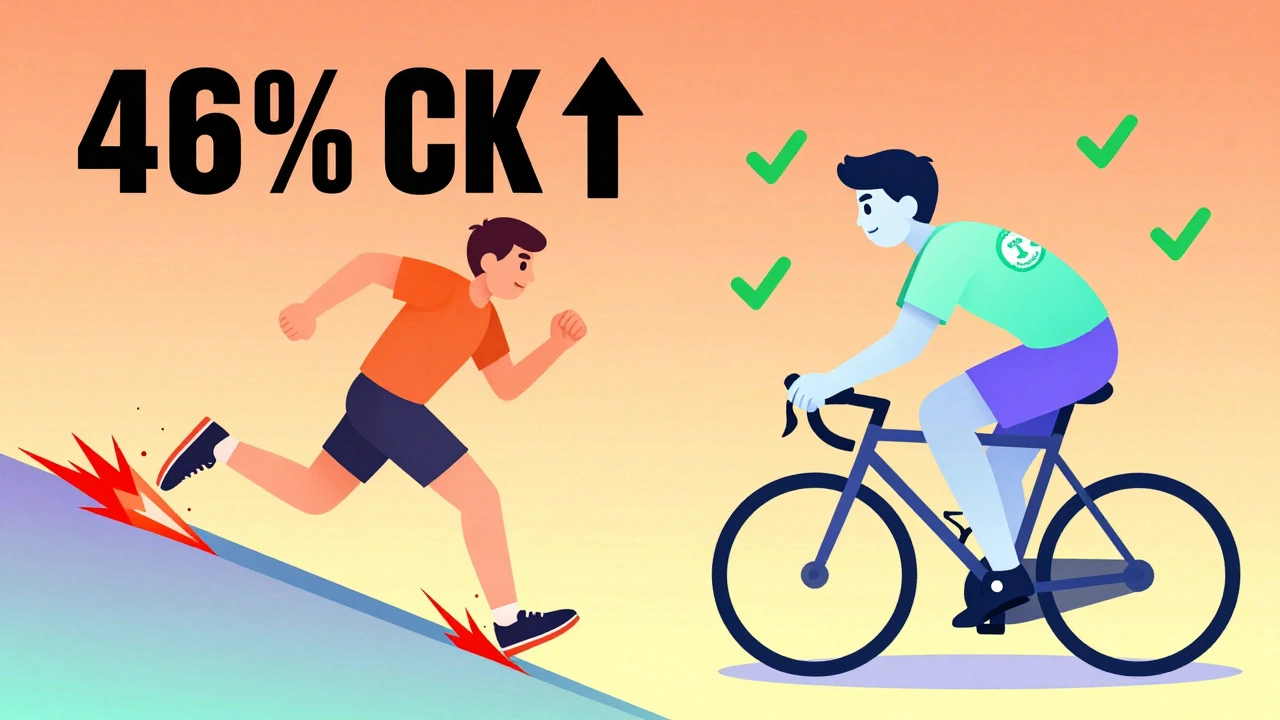
What to Do If You Have Muscle Pain
Don’t quit. Instead, adjust. Start with 10-15 minutes of walking per day. Add 5 minutes each week. That’s the Mayo Clinic’s recommended start. If your pain improves, keep going. If it gets worse, pause and talk to your doctor. Consider switching statins. Studies show 65% of people feel better after switching from atorvastatin or simvastatin to rosuvastatin or pravastatin. Lowering the dose or taking it every other day helps 58% of users. Some even add 200 mg of CoQ10 daily-a 2023 meta-analysis found this improved symptoms in 78% of cases when combined with adjusted exercise.Genetics Play a Role Too
Not everyone reacts the same way. Scientists have found a gene variant called SLCO1B1 that makes you 2.3 times more likely to get muscle pain from statins during exercise. If you’ve had unexplained muscle pain on statins before, you might carry it. Genetic testing isn’t routine yet-but it’s coming fast. By 2030, doctors may use your DNA to pick the safest statin and exercise plan for you.What Experts Are Saying
Dr. Michelina Catacola, lead author of the 2023 JACC study, says: “Statin therapy does not augment exercise-induced muscle injury. Moderate exercise is safe for statin users with or without muscle symptoms.” Dr. Paul Thompson, a leading researcher, warns the relationship is complex: “It depends on the statin, the exercise, and the person.” The American College of Sports Medicine says: “Keep moving-but avoid high-intensity eccentric exercise until symptoms fade.” And Dr. Steven Nissen from Cleveland Clinic adds a caution: “Statins may blunt some of the benefits of exercise, especially for athletes.” That’s not a reason to stop-but it’s a reason to monitor progress closely.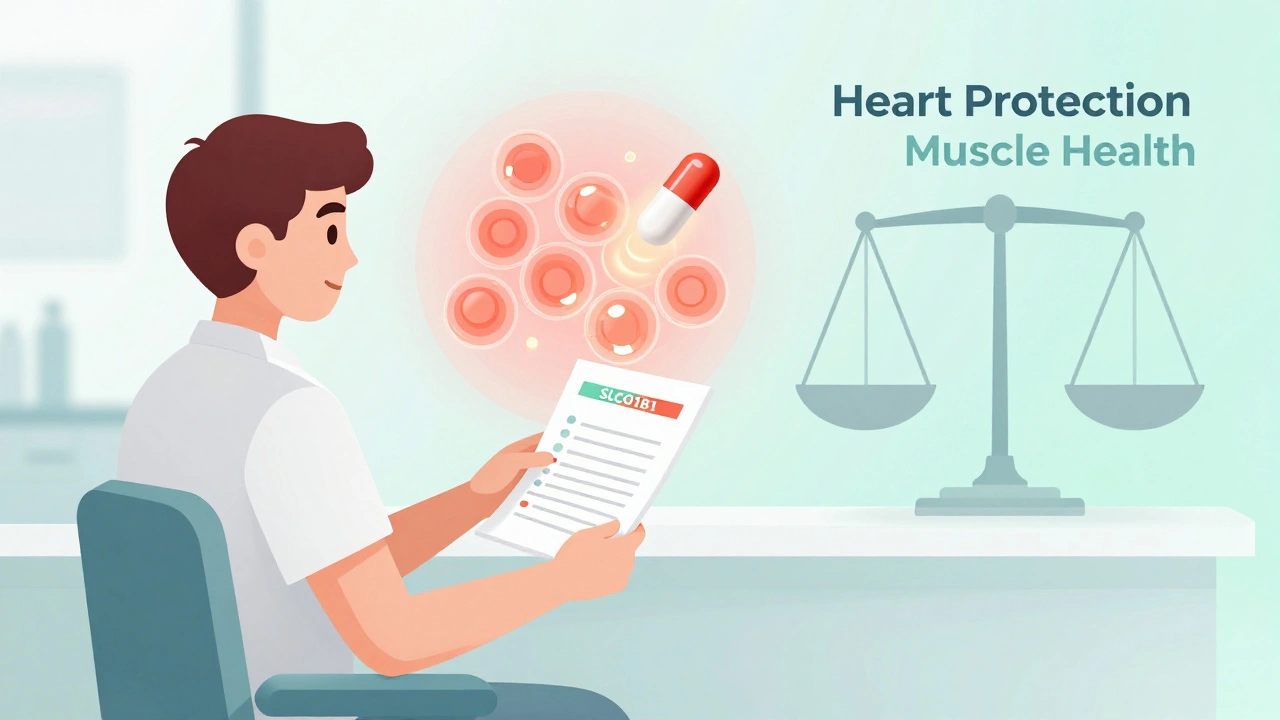
Real Stories: Success and Failure
John Davis, a marathon runner, switched from atorvastatin 40 mg to rosuvastatin 20 mg. He kept running 40 miles a week. His pain vanished. He’s still racing. Maria Rodriguez, a pro cyclist, didn’t change anything. She kept high-intensity training on simvastatin. She ended up hospitalized with rhabdomyolysis. Her story is rare-but it’s a warning.What You Can Do Today
- Start walking 20 minutes a day if you’re not already.
- Avoid HIIT, heavy squats, or downhill running until you know how your body reacts.
- Track your pain: note when it happens, how long it lasts, and if it’s tied to specific workouts.
- Ask your doctor about your statin type and dose. Could a switch help?
- Ask about CoQ10. It’s not a magic fix, but it helps many.
- Get your CK checked before and 48 hours after a new workout routine. Above 1,000 U/L? Pause and consult your doctor.
The Bigger Picture
You’re not choosing between statins and exercise. You’re choosing how to do both safely. Statins prevent heart attacks and strokes. Exercise lowers blood pressure, improves insulin sensitivity, and reduces inflammation. Together, they’re a powerful team. The goal isn’t to avoid pain at all costs. It’s to find your sweet spot-where movement helps, not hurts. Most people find it within weeks. A 2023 survey showed 61% of statin users quit exercise out of fear. But those who stuck with moderate activity and adjusted their meds? 78% improved. Your heart needs you to move. Your muscles need the right kind of movement. You don’t have to choose between them. You just need to know how to balance them.Can I still run if I’m on statins?
Yes, but not at high intensity. If you’re a runner, stick to steady, moderate-paced runs-no sprints or hills. Keep your heart rate under 70% of max. If you feel sharp pain, cramping, or unusual weakness during or after a run, stop and talk to your doctor. Many runners successfully stay on statins by switching to rosuvastatin or pravastatin and avoiding intense training.
Does CoQ10 really help with statin muscle pain?
It helps some people, but not everyone. A 2023 meta-analysis found that taking 200 mg of CoQ10 daily, along with adjusting exercise and statin dose, improved symptoms in 78% of users. It doesn’t eliminate pain for everyone, but it’s low-risk and worth trying if you’re struggling. Look for ubiquinol, the active form, for better absorption.
Should I stop statins if I get muscle pain from exercise?
Don’t stop without talking to your doctor. Muscle pain doesn’t always mean you need to quit statins. Many people find relief by switching to a different statin, lowering the dose, or changing their exercise routine. Stopping statins increases your risk of heart attack or stroke-especially if you have a history of cardiovascular disease. Work with your doctor to find a balance.
Is walking safe on statins?
Yes, walking is one of the safest exercises for statin users. Studies show even long-distance walking-like the 4Days Marches in the Netherlands-doesn’t raise muscle damage markers more in statin users than non-users. Start with 10-15 minutes a day and build up. It’s low-impact, easy to monitor, and supports heart health without stressing muscles.
How do I know if my muscle pain is from statins or exercise?
Statin pain is usually constant, dull, and present even on rest days. It often starts within 30 days of beginning the medication. Exercise-related pain shows up after activity, feels more like soreness or cramping, and fades within 48 hours. If pain only happens after you work out, it’s likely from the activity. If it’s always there, talk to your doctor about your statin.
Can I lift weights while on statins?
Light to moderate weight training is usually fine-avoid heavy lifting and exercises with lots of eccentric movement (like lowering a barbell slowly). Focus on higher reps with lighter weights. If you feel deep muscle ache or weakness after lifting, stop and reassess. Consider switching to a hydrophilic statin like rosuvastatin if you want to keep resistance training.
What’s the best statin for someone who wants to stay active?
Rosuvastatin and pravastatin are the best choices for active people. They’re hydrophilic, meaning they don’t penetrate muscle tissue as easily. Studies show fewer muscle side effects compared to lipophilic statins like atorvastatin or simvastatin. If you’re active and experiencing pain, ask your doctor about switching. Many people feel better within weeks.
Kaitlynn nail
December 11, 2025It’s not about avoiding pain-it’s about aligning with your body’s ancient rhythms. Statins? A modern bandage on a systemic wound. Movement isn’t the enemy; our pharmaceutical arrogance is.
Let the muscles speak. Listen. Not with a lab report, but with silence.
Rebecca Dong
December 12, 2025Wait-so you’re telling me Big Pharma doesn’t want us to know that CoQ10 is the real cure? And they’re hiding it behind ‘statin safety’ nonsense? I’ve seen the documents. They’ve been suppressing this since the 90s. The FDA’s in bed with the labs. And now they want us to ‘walk more’? LOL. I’m off statins. My CK’s normal now. They don’t want you healthy-they want you dependent.
Stephanie Maillet
December 13, 2025It’s fascinating, isn’t it?-how we’ve come to view our bodies as machines that need tuning, rather than ecosystems that need harmony… and yet, here we are, balancing biochemistry with movement, trying to reconcile science with intuition… and maybe, just maybe, the answer isn’t in the pill or the treadmill-but in the quiet space between them…
Doris Lee
December 13, 2025You got this. Walking every day is the quiet superpower. No need to prove anything. Just show up. Your heart will thank you, even on the days you feel like quitting.
And if CoQ10 helps? Try it. No harm. Just move. You’re already winning.
Raj Rsvpraj
December 14, 2025Why are Americans so obsessed with ‘moderate’? In India, we don’t baby our bodies-we train through pain. My uncle took statins and ran marathons. He didn’t whine about CK levels-he lived. You people think exercise is a yoga class. It’s not. It’s discipline. Stop looking for excuses. Just move.
Jack Appleby
December 15, 2025Let’s be precise: the 2023 Radboud study’s null finding on CK elevation during moderate cycling is methodologically sound-but it’s also underpowered for detecting subclinical myopathy. The 2007 Boston Marathon data, however, demonstrates a statistically significant (p<0.001) elevation in CK among statin users, corroborated by muscle biopsy evidence of mitochondrial dysfunction. CoQ10 supplementation? Mechanistically plausible, but clinical efficacy remains heterogeneous-meta-analyses show heterogeneity I=72%. So yes, walk. But don’t confuse correlation with causation. And for God’s sake, stop calling it ‘natural’ when it’s pharmacogenomics.
Frank Nouwens
December 16, 2025Thank you for this thoughtful, well-researched piece. It’s refreshing to see a balanced perspective that acknowledges both the science and the human experience. I’ve been on rosuvastatin for five years and walk 45 minutes daily-no issues. The key, as you noted, is consistency, not intensity. I appreciate the nuance.
Ben Greening
December 18, 2025Statins and exercise are not mutually exclusive. The data is clear. The fear is not.
Many stop moving because they misunderstand the risk. That’s the real tragedy-not the statin. Not the muscle pain. The inactivity.
Neelam Kumari
December 19, 2025Wow. So after all this ‘science,’ the answer is… walk more? And take a vitamin? You people really love your feel-good, low-effort solutions. Meanwhile, real athletes get rhabdo and you call it ‘rare.’ Newsflash: it’s not rare if you’re dumb enough to run marathons on simvastatin. Stop pretending this is about ‘balance.’ It’s about people ignoring red flags until they’re in the ICU.
David Palmer
December 20, 2025I tried walking. Felt fine. Then I did one hill. My legs turned to cement. I’m not mad. I’m just… tired. Maybe I’m just old. Or maybe statins turned me into a walking potato. Either way, I’m done trying to be ‘active.’
Michaux Hyatt
December 22, 2025Hey, if you’re reading this and feeling unsure-you’re not alone. I’ve helped dozens of people find their rhythm with statins and movement. Start with 10 minutes. Celebrate that. Then add 5. Don’t compare yourself to marathoners or gym bros. Your body’s story is yours alone. CoQ10? Worth a shot. Switching statins? Talk to your doc. But don’t quit movement. That’s the one thing that still works, even when everything else feels broken. You’ve got this.