

15 Dec 2025
- 10 Comments
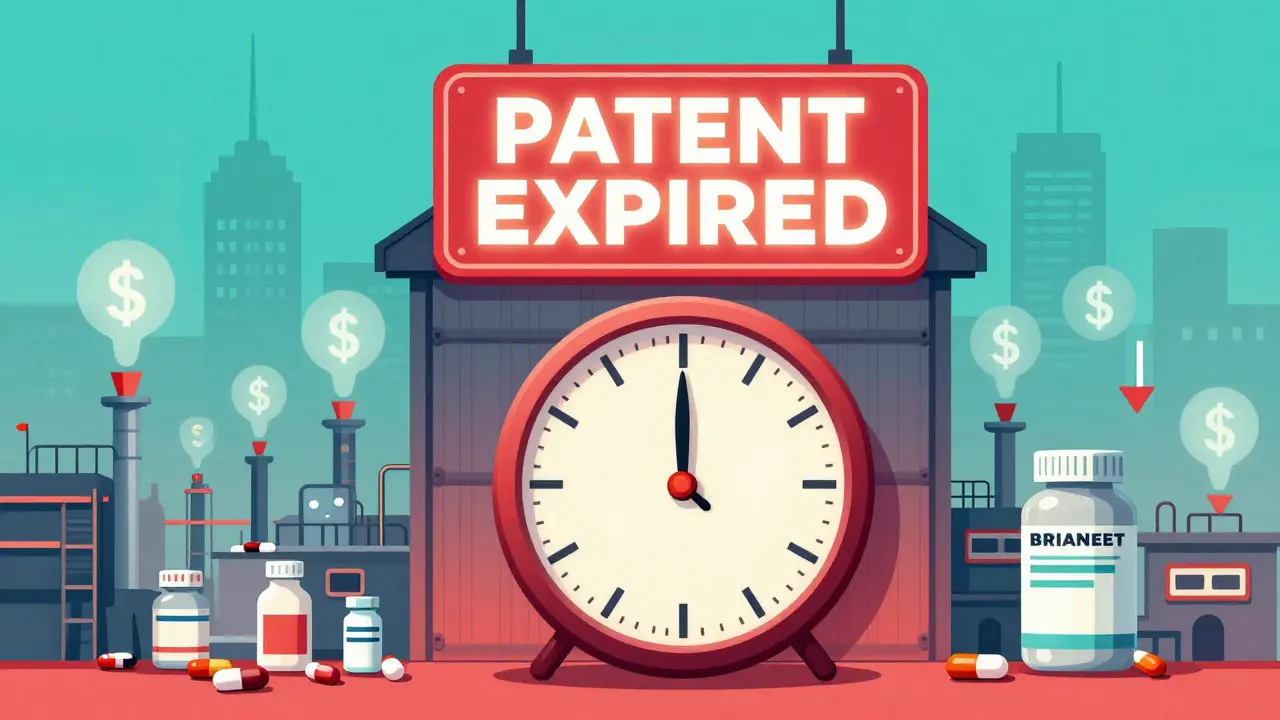
When a drug’s patent runs out, prices don’t just dip-they plummet. It’s not magic. It’s economics. For years, a single company owns the right to sell a medicine at whatever price it wants. No competition. No pressure. Then, one day, the patent expires. And everything changes.
What Happens When a Patent Expires?
The moment a drug’s patent expires, other companies can legally make and sell the same medicine. These are called generics. They’re chemically identical to the brand-name version but cost a fraction of the price. The first generic to enter the market usually cuts the price by 15% to 20%. That’s noticeable. But it’s just the beginning.By the time five or ten generic makers join the race, prices can drop by 80% or more. In the U.S., the average drug falls to just 18% of its original price eight years after patent expiry, according to a 2023 study in JAMA Health Forum. In countries like Australia and the UK, the drop is still massive-around 60%. But in places like Switzerland, where pricing rules are tighter, the fall is slower, closer to 20%.
This isn’t theoretical. Patients on Eliquis (apixaban), a blood thinner, paid up to $850 a month before generics hit the market in 2020. After generics arrived, the same dose cost $10. That’s a 99% drop. One drug. One patent. One life-changing shift.
Why Do Prices Drop So Fast?
It’s simple supply and demand. When only one company sells a drug, it’s a monopoly. Monopolies charge high prices because customers have no choice. Once generics enter, it becomes a free-for-all. Each new manufacturer wants to win market share. They undercut each other. The more competitors, the lower the price.The FDA tracks this closely. In 2023, it approved 870 generic drugs-up 12% from the year before. Many of those were for drugs that just lost patent protection. The first generic usually takes months to get approved. But by the third or fourth entrant, prices start collapsing. Why? Because pharmacies and insurers want the cheapest option. They push generics hard.
It’s not just about the number of makers-it’s about how fast they come in. In the U.S., generics typically enter 30 months after patent expiry. In Europe, it’s often under 18 months. That’s why price drops happen faster overseas. The U.S. system has more legal and regulatory delays. But once generics arrive, the drop is steeper.
Biologics Are Different
Not all drugs are the same. Most are small-molecule pills-easy to copy. But biologics, like Humira or Ozempic, are complex proteins made from living cells. You can’t just copy them. You have to make a biosimilar. That’s harder, more expensive, and takes longer.Humira’s patent expired in 2016, but it didn’t face real competition until 2023. Why? AbbVie, the maker, filed over 130 secondary patents on tiny changes-packaging, dosing, delivery devices. Each one delayed generics. This is called a “patent thicket.” It’s legal. And it’s common. According to I-MAK’s 2025 report, 78% of new patents filed on drugs aren’t for new medicines. They’re for old ones with minor tweaks.
When biosimilars finally arrived for Humira in early 2023, prices didn’t crash right away. Why? Because AbbVie had contracts with insurers that paid them rebates. So even though the biosimilar cost less, the final price to patients didn’t change much. It took nearly a dozen competitors entering the market before real savings appeared.
Patent Thickets Are Slowing Down Savings
The system was meant to balance innovation with affordability. But in practice, companies are gaming it. The average blockbuster drug now gets 10 to 15 extra patents after the original one expires. These extend market control by 12 to 14 years. That’s not innovation. That’s delay.Take semaglutide-the active ingredient in Ozempic and Wegovy. The base patent expires in 2026. But the company has filed 142 patents covering formulations, delivery pens, dosing schedules, and even how it’s manufactured. If all hold up, generic versions might not be available until 2036. That’s a decade of monopoly pricing.
Regulators are starting to push back. The U.S. Patent Office has begun rejecting obvious or repetitive patents. The European Commission proposed limits on supplementary protection certificates in 2024. But change moves slowly. And while the system waits, patients pay.

Who Benefits When Prices Drop?
Patients do. Insurers do. Taxpayers do. A 2023 Kaiser Family Foundation survey found 68% of insured adults saw lower out-of-pocket costs when generics arrived. For those on Medicare, the savings are even bigger. The Congressional Budget Office estimates generic and biosimilar competition will save the U.S. healthcare system $1.7 trillion over the next ten years.But savings don’t always reach patients right away. Insurance companies sometimes delay switching to generics because of rebates from brand-name makers. Pharmacists can’t substitute generics unless the doctor allows it. And in some states, biosimilars can’t be swapped automatically like regular generics.
Doctors notice the shift. Rheumatologist Dr. Sarah Kim in Chicago says patients with rheumatoid arthritis switched to biosimilars for infliximab quickly after 2016. But for Humira? “It’s been a fight,” she says. “Payers are tied to AbbVie’s contracts. Patients are stuck paying more, even when cheaper options exist.”
What’s Next?
The next wave of patent expirations is huge. Between 2020 and 2025, drugs worth $220 billion in annual sales will lose patent protection. That’s more than the entire GDP of Switzerland. Generic companies are ready. The global generic drug market is projected to hit $700 billion by 2030.But the real question isn’t whether generics will come. It’s whether patients will actually get the savings. Until patent thickets are cracked open, and rebate systems are reformed, many people will keep paying high prices long after the patent expires.
The science is clear: when patents expire, prices drop. The system works-when it’s allowed to work. The challenge now isn’t making generics. It’s making sure they reach the people who need them.
Do generic drugs work the same as brand-name drugs?
Yes. The FDA requires generics to have the same active ingredient, strength, dosage form, and route of administration as the brand-name drug. They must also prove they’re absorbed the same way in the body. Generics are not cheaper because they’re weaker-they’re cheaper because there’s no marketing, R&D, or patent monopoly cost.
Why don’t all patients see lower prices after a patent expires?
Because insurance plans and pharmacy benefit managers often use rebates and formulary rules that favor brand-name drugs-even when generics are available. A drug might be cheaper, but if the insurer gets a big rebate from the brand maker, they may keep the brand on the preferred list. Patients end up paying more out of pocket because their plan doesn’t encourage switching.
How long does it take for generics to appear after a patent expires?
In the U.S., it usually takes 18 to 30 months. That’s because generic makers must file paperwork, run tests, and wait for FDA approval. For complex drugs like biologics, it can take 5 to 7 years due to extra regulatory steps and patent lawsuits. In Europe, generics often arrive within 12 to 18 months.
Can a drug company stop generics from entering the market?
Not directly, but they can delay them. They file secondary patents on small changes, sue generic makers for infringement, or sign deals with insurers to block generics from being covered. These tactics are legal under current rules, even if they delay competition for years.
Are there any drugs that never get generics?
Rarely. Even complex drugs like insulin or cancer treatments eventually get generics or biosimilars. But some drugs-especially those with very small patient populations or extremely complex manufacturing-may never have affordable generics because it’s not profitable for manufacturers to make them. These are called “orphan drugs” and often remain expensive for decades.
Tim Bartik
December 15, 2025bro the f***ing pharma giants are laughable. i paid $700 for a month of that blood thinner before generics. now i pay 12 bucks. they had the nerve to charge that for years like we were dumb sheep. patent expires? oh wait, they got 142 more. f*** that noise.
Daniel Thompson
December 16, 2025The economic implications of patent expiration are both predictable and profoundly beneficial to public health systems. The entry of generic manufacturers introduces competitive pricing dynamics that efficiently reallocate resources, reduce fiscal burdens on insurers, and enhance pharmaceutical accessibility. This is not merely a market phenomenon-it is a structural correction.
Alexis Wright
December 16, 2025Let’s be brutally honest: the entire patent system is a rigged casino. Big Pharma doesn’t innovate-they litigate. They file patents on the color of the pill, the shape of the bottle, the fucking packaging. It’s not capitalism. It’s feudalism with lawyers. And we’re the serfs paying for their velvet ropes. Humira? 130 patents. That’s not protection. That’s extortion dressed up as IP law.
And don’t get me started on the rebate black holes. Insurers get kickbacks to keep brand-name drugs on formularies even when generics are cheaper. Patients pay more. Doctors are powerless. Pharmacists are silenced. This isn’t broken. It’s designed this way.
The $1.7 trillion savings projection? That’s if we stop letting them game it. But we won’t. Because the lobbyists own Congress. And your insulin? Still $500. Because the system loves you suffering just enough to keep buying.
Natalie Koeber
December 16, 2025you ever wonder why the FDA approves generics so slow? it’s not about safety. it’s about control. the same people who run the pharma companies also sit on the advisory boards. they’re letting the big guys drag their feet so they can keep milking the system. and don’t tell me it’s ‘regulation’-they approved 870 generics last year? yeah right. they’re just waiting for the right moment to flood the market… after the stock price drops.
Rulich Pretorius
December 17, 2025In South Africa, we see this every day. A drug like metformin, once patented, now costs less than a loaf of bread. But access is still a problem-because distribution networks are weak, not because the drug is expensive. The science works. The system just fails to deliver. We need more than market forces-we need infrastructure, education, and political will.
Patent expiration is not the end of the story. It’s the beginning of the real challenge: making sure the savings reach the people who need them most.
Thomas Anderson
December 19, 2025my mom switched to the generic version of her blood pressure med last year. went from $400 a month to $12. she cried. not because she was sad-because she finally didn’t have to choose between her meds and groceries. this stuff isn’t abstract. it’s life or death.
Wade Mercer
December 19, 2025It’s disgusting how corporations prioritize profit over human life. These drug companies are morally bankrupt. They exploit illness for greed. There is no excuse for charging $800 for a pill when the cost to produce it is less than $2. This is not capitalism-it’s criminal.
Dwayne hiers
December 20, 2025From a pharmacoeconomic standpoint, the price elasticity of demand for essential medications is highly inelastic in the pre-generic phase, creating monopolistic rent extraction. Post-expiry, the introduction of multiple ANDA filers triggers a Bertrand competition model, driving prices toward marginal cost. The 80%+ reduction observed correlates directly with the number of entrants, per FDA Orange Book data. However, biosimilars exhibit delayed market penetration due to higher manufacturing complexity and regulatory uncertainty under the BPCIA. The patent thicket phenomenon is a classic example of strategic patenting to extend market exclusivity beyond statutory limits, effectively circumventing the original intent of the Hatch-Waxman Act.
Jonny Moran
December 21, 2025As someone who’s worked in community health for 15 years, I’ve seen the difference generics make. Not just in cost-but in dignity. A patient who can afford their meds doesn’t skip doses. They don’t ration pills. They show up to follow-ups. They live longer. This isn’t just economics. It’s humanity.
And yeah, the system’s broken. But we’re not powerless. Vote for reps who’ll crack down on patent abuse. Support pharmacy benefit reform. Demand transparency. Change doesn’t come from the top. It comes from us.
Sarthak Jain
December 21, 2025in india we make most of the world's generics. i used to work in a pharma plant that made apixaban copies. we shipped them to usa, canada, europe. the price difference? 100x. but here, even generics are expensive because of taxes and middlemen. i wish more people knew how simple this could be. just cut the greed. not the science.