
25 Dec 2025
- 8 Comments
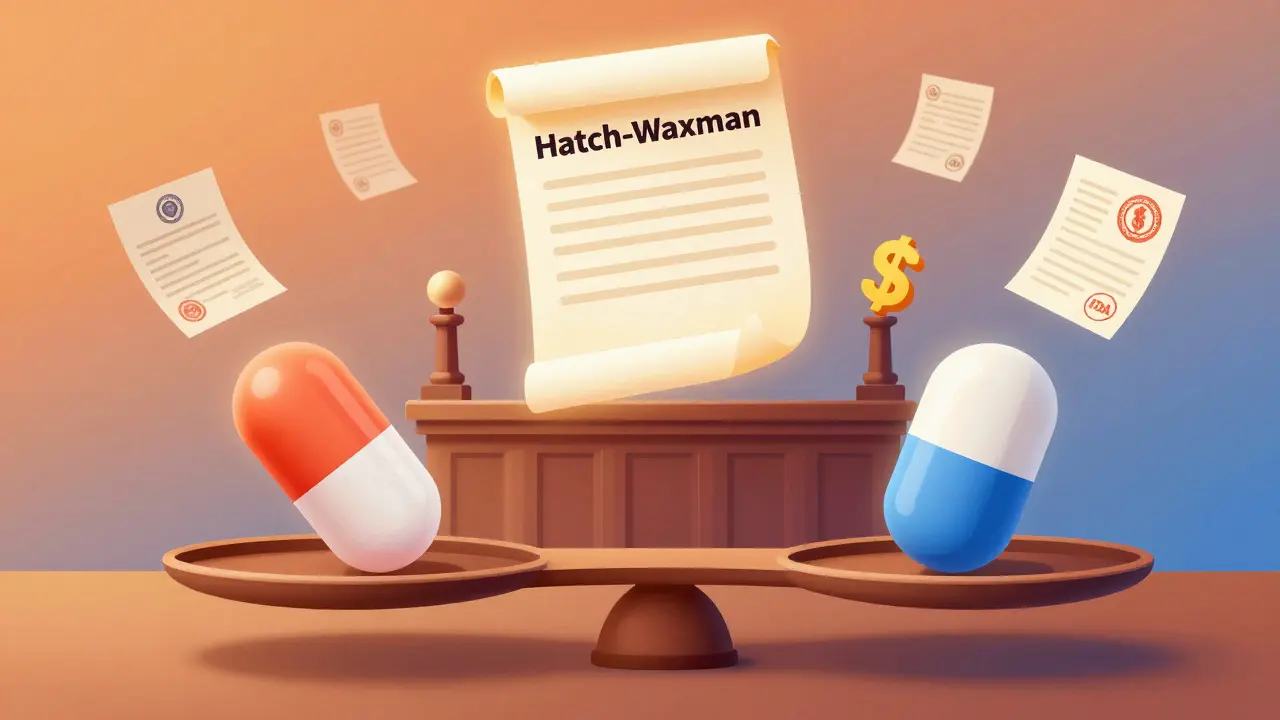
The U.S. generic drug market didn’t just grow-it exploded. Today, 90% of all prescriptions filled in America are for generic medicines. But that wasn’t always the case. Before 1984, if you needed a cheaper version of a brand-name drug, you were out of luck. The system was stacked against generics. The Hatch-Waxman Amendments is a 1984 U.S. law that created the legal and regulatory framework for generic drugs to enter the market without repeating costly clinical trials, while also giving brand-name drugmakers extra patent time to make up for FDA delays. It didn’t just tweak the rules-it rebuilt them from the ground up.
What Was the Problem Before Hatch-Waxman?
Before 1984, generic drugmakers had to prove a drug was safe and effective all over again-even if it was chemically identical to the brand-name version. That meant running full clinical trials, which cost millions and took years. It made no sense. If the original drug had already been approved by the FDA, why make generics repeat the same tests? The answer? The law didn’t allow it. And then there was the patent problem.
In 1983, the Federal Circuit Court ruled in Roche v. Bolar that even testing a generic version of a patented drug before the patent expired counted as infringement. That meant generic companies couldn’t start preparing until the patent ran out. For drugs with 17-year patents, that could mean waiting over a decade after the drug hit the market before a cheaper version could even be tested. Patients paid higher prices longer. Innovation didn’t suffer-but access did.
The Two Goals of Hatch-Waxman
The law, officially called the Drug Price Competition and Patent Term Restoration Act of 1984, had two clear goals. First: make it faster and cheaper for generics to get approved. Second: give brand-name companies a little extra patent time to make up for the years they lost waiting for FDA approval.
These goals were not just political compromises-they were economic necessities. Without incentives, brand-name companies wouldn’t invest in new drugs. Without access, patients couldn’t afford them. The law had to balance both. And it did-by creating a new approval path called the Abbreviated New Drug Application (ANDA).
How the ANDA Pathway Changed Everything
The ANDA was the game-changer. Instead of proving safety and efficacy from scratch, generic companies only had to show their product was bioequivalent to the brand-name drug. That meant the generic delivered the same amount of active ingredient into the bloodstream at the same rate. No need for new clinical trials. Just a few small studies on healthy volunteers.
The cost difference? Staggering. Developing a new brand-name drug could cost over $1 billion. An ANDA? Around $1-2 million. That’s an 80-90% drop in development costs. Suddenly, it made financial sense for companies to enter the generic market. And they did. By 2023, over 10,000 generic drug products were available in the U.S.-up from fewer than 1,000 in 1984.
The Orange Book and Patent Challenges
To keep things orderly, Hatch-Waxman created the Orange Book-the FDA’s official list of approved drugs and their patents. Brand-name companies had to list every patent that might block a generic. Generic companies then had to respond with one of four certifications.
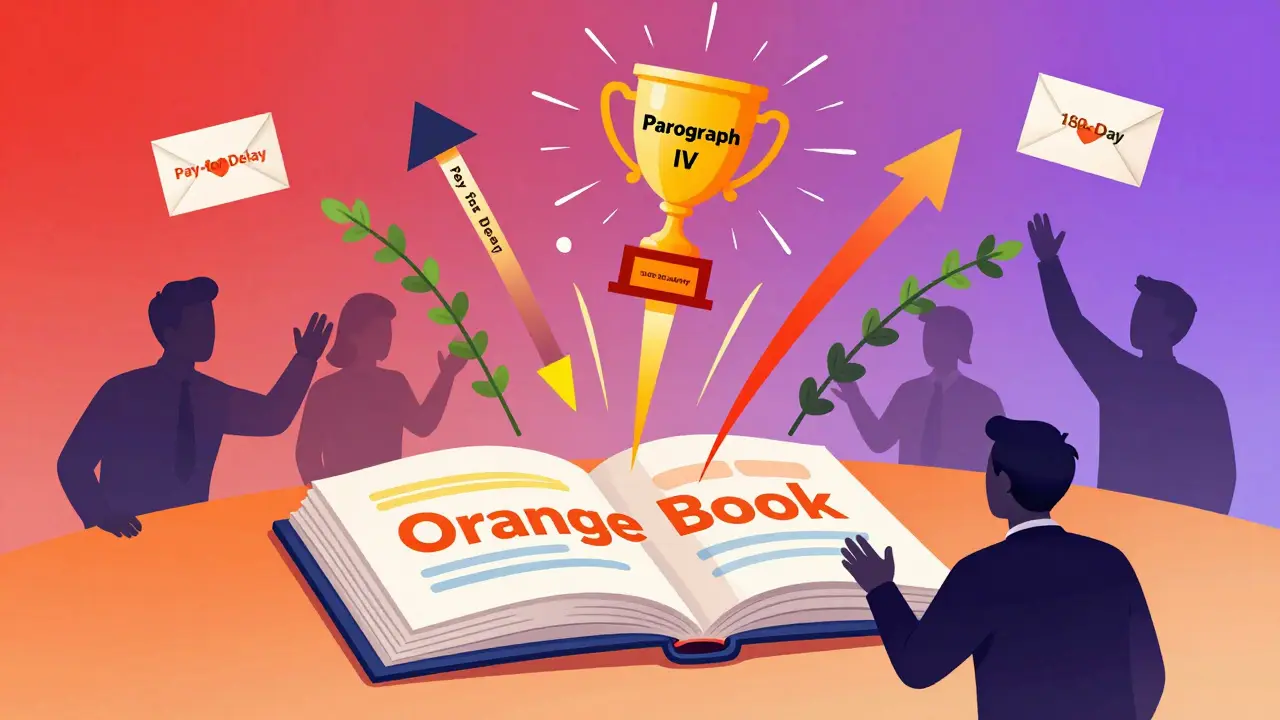
The most important? Paragraph IV certification. That’s when a generic company says, “Your patent is invalid or we don’t infringe it.” It’s a legal challenge disguised as a paperwork step. And it came with a huge reward: 180 days of exclusive market access. The first generic to file a Paragraph IV certification gets to be the only one on the market for six months. That’s a massive financial incentive. It’s why companies race to file-and why patent litigation became a central part of the generic drug game.
Patent Term Restoration: The Brand-Name Lifeline
While generics got a faster path, brand-name companies got something too: patent term restoration. The FDA’s review process could take years. That ate into the patent clock. Hatch-Waxman let companies apply to extend their patent by up to five years, but not beyond 14 years total from when the drug hit the market.
It wasn’t a handout. It was compensation. The idea was simple: if it took you seven years to get FDA approval, you should get seven extra years of exclusivity to make back your investment. The law also added regulatory exclusivity: five years for a completely new chemical, three years for a new use or formulation, and seven for rare disease drugs.
These protections kept innovation alive. Without them, big pharma might have walked away from risky projects. With them, they had the breathing room to develop new drugs while knowing generics would eventually arrive.
The Safe Harbor: Legalizing Preparation
One of the quietest but most powerful parts of Hatch-Waxman is the safe harbor provision (35 U.S.C. § 271(e)(1)). It says: if you’re doing research to get FDA approval, you’re not infringing a patent-even if the patent hasn’t expired yet.
Before this, even preparing a generic version before patent expiration could land you in court. Now, companies can start testing, manufacturing, and filing paperwork years ahead of time. That’s why today, a generic drug can hit the market the day after a patent expires. The preparation happened in the shadows, legally.
What Went Wrong? The Dark Side of the Compromise
For all its success, Hatch-Waxman didn’t fix everything. It created loopholes. One big one: pay-for-delay deals. Sometimes, instead of fighting in court, brand-name companies pay generic makers to delay their launch. The FTC found over 600 of these deals between 1999 and 2012. They cost consumers an estimated $35 billion a year in higher drug prices.
Another problem: evergreening. Companies file new patents on minor changes-like a new pill shape or a slightly different dose-to reset the clock. The FDA gets flooded with citizen petitions, often filed by brand-name companies, to delay generic approvals. These aren’t safety concerns-they’re tactics.
And then there’s the 180-day exclusivity. Sometimes, multiple companies file on the same day. The FDA now shares exclusivity, but back in the 90s, companies would “camp” at the FDA office, submitting applications the second the clock struck midnight. The race became absurd.
The Legacy: Cheaper Drugs, But at What Cost?
Today, generic drugs account for 90% of prescriptions in the U.S. and cost 80-85% less than brand-name versions. That’s $300 billion saved every year. Millions of people can afford their medications because of this law.
But the trade-offs are real. Drug prices are still sky-high. Innovation is still expensive. And the system is still gamed. The FDA has tried to fix things with the Generic Drug User Fee Amendments (GDUFA), which gave the agency funding to hire more reviewers. Since 2012, the average ANDA review time dropped from 30 months to under 12.
Still, the core tension remains: how do you reward innovation without blocking access? Hatch-Waxman struck a balance. But that balance is fraying. New bills like the 2023 Preserve Access to Affordable Generics and Biosimilars Act aim to ban pay-for-delay deals. Whether they’ll succeed remains to be seen.
Why It Still Matters Today
Hatch-Waxman didn’t just change drug approval. It changed how we think about medicine. It proved that competition could lower prices without sacrificing safety. It showed that patents and public health don’t have to be enemies.
It’s not perfect. But without it, insulin, blood pressure meds, and antibiotics would still be unaffordable for most Americans. The law didn’t end high drug prices-but it gave us the tools to fight them.
What is the main purpose of the Hatch-Waxman Amendments?
The main purpose is to balance two goals: making it faster and cheaper for generic drugs to reach the market by allowing them to rely on the FDA’s previous approval of brand-name drugs, while also giving brand-name drugmakers extra patent time to make up for delays caused by FDA review. This created the modern generic drug industry.
How did Hatch-Waxman change the generic drug approval process?
Before Hatch-Waxman, generic manufacturers had to run full clinical trials to prove safety and effectiveness. After the law, they could file an Abbreviated New Drug Application (ANDA), proving only bioequivalence to the brand-name drug. This cut development costs by 80-90% and reduced approval time from years to months.
What is Paragraph IV certification and why is it important?
Paragraph IV certification is when a generic drug company claims that a brand-name drug’s patent is invalid or that their product doesn’t infringe it. It’s important because the first company to file this certification gets 180 days of exclusive market rights-making it a powerful incentive to challenge patents and bring down prices faster.
What is the Orange Book and how does it work?
The Orange Book is the FDA’s official list of approved drug products with their patent and exclusivity information. Brand-name companies must list all patents that could block generics. Generic companies must check this list and respond with a certification-either agreeing the patent is valid or challenging it with a Paragraph IV filing.
What are pay-for-delay agreements and why are they controversial?
Pay-for-delay agreements happen when a brand-name drug company pays a generic manufacturer to delay launching its cheaper version. These deals keep prices high and are controversial because they undermine the competition Hatch-Waxman was meant to encourage. The FTC estimates they’ve cost consumers over $35 billion annually.
Has Hatch-Waxman been updated since 1984?
Yes. Major updates include the Generic Drug User Fee Amendments (GDUFA) in 2012 and 2017, which gave the FDA funding to hire more reviewers and cut ANDA approval times. Other changes came through the Food and Drug Administration Modernization Act of 1997 and the Medicare Prescription Drug Act of 2003.
What’s Next for Generic Drugs?
The FDA is now focused on clearing the backlog of ANDAs and speeding up reviews. GDUFA has helped, but challenges remain. Biosimilars-generic versions of biologic drugs-are the next frontier. They’re more complex than traditional generics, and Hatch-Waxman wasn’t built for them. A new framework, the Biologics Price Competition and Innovation Act of 2009, tried to fill that gap, but it’s still evolving.
Meanwhile, lawmakers are pushing to close loopholes. Pay-for-delay deals are under fire. Evergreening is being scrutinized. The public wants lower prices. The industry wants protection. Hatch-Waxman gave us the foundation. Now, it’s up to the next generation of regulators and lawmakers to build on it.
david jackson
December 27, 2025Let me tell you-this law didn’t just change the drug market, it rewrote the entire social contract between Big Pharma and the American people. Before Hatch-Waxman, if you had diabetes, you were basically paying for the same molecule twice: once when the company invented it, and again every time you filled the prescription. The system was designed to make you suffer until the patent clock ran out, and even then, they’d sneak in new patents on the color of the pill. I mean, come on. The ANDA pathway? That’s the moment the little guy finally got a seat at the table. And that 180-day exclusivity? That’s not just a loophole-it’s the only thing keeping generic companies from getting crushed before they even start. The fact that we’re saving $300 billion a year isn’t a statistic-it’s a lifeline for single moms, retirees on fixed incomes, veterans skipping doses to make their meds last. This law didn’t just lower prices-it restored dignity.
jesse chen
December 28, 2025Wow, this is so well-explained... I didn’t realize how much of a balancing act this was... I mean, on one hand, you’ve got patients who need affordable meds, and on the other, you’ve got companies that spent billions developing the drug in the first place... It’s not just about profit-it’s about survival for pharma, too... And the safe harbor provision? That’s genius... It lets generics prepare without fear... Like, imagine if you had to wait until the patent expired to even start testing... You’d lose years... So many people don’t get how technical and fragile this system is... Thank you for laying this out so clearly...
Joanne Smith
December 29, 2025Oh honey, let me tell you about the Orange Book. It’s not a book-it’s a battlefield. Brand-name companies treat it like a bingo card: ‘Oh, we just added a new coating? Patent!’ ‘New packaging? Patent!’ ‘We changed the pill from blue to green? PATENT!’ And then they file citizen petitions like it’s a hobby. The FDA gets 200 of these a year-95% of them have zero to do with safety. It’s not regulation, it’s harassment. And the 180-day exclusivity? That’s not competition-it’s a monopoly lottery. One company files first, and suddenly they’re the only one allowed to sell a $2 insulin for six months while the rest of us wait. This law was supposed to be the people’s win. Instead, it became a game of legal poker. And guess who always has the best hand? The ones with the lawyers.
Prasanthi Kontemukkala
December 30, 2025As someone from India where generics are a lifeline, I’ve seen how this model works on the ground. In the U.S., it’s easy to take for granted that insulin costs $30 instead of $300-but that’s because Hatch-Waxman created a system where competition actually works. I’ve watched friends in rural India get life-saving meds because generics from the U.S. became affordable enough to export. The law wasn’t perfect, but it proved that innovation and access can coexist-if you design the rules right. The pay-for-delay deals? Those are the cancer. But the core idea? Still beautiful. We need more countries to adopt this balance, not just copy the loopholes.
Lori Anne Franklin
December 31, 2025so like… i just found out my blood pressure med is generic and costs 5 bucks?? like… i thought that was just how it was?? turns out it’s because of this law?? mind blown. i mean, i always knew drugs were expensive but i never connected the dots… thanks for explaining this so simply!! i’m gonna tell my grandma!! she’s been taking the same pill for 15 years and still thinks it’s ‘brand name so it’s better’ 😅
Bryan Woods
January 1, 2026The Hatch-Waxman Amendments represent a rare example of legislative equilibrium in U.S. healthcare policy. The framework successfully reconciled two competing interests: the imperative for pharmaceutical innovation and the societal need for accessible therapeutics. The introduction of the ANDA pathway, coupled with patent term restoration, created a durable incentive structure that has persisted for nearly four decades. While subsequent abuses-such as pay-for-delay and evergreening-have emerged, these are regulatory failures, not inherent flaws in the legislation. The model remains fundamentally sound and continues to deliver substantial public health benefits.
Ryan Cheng
January 3, 2026Let’s not forget the real heroes here: the scientists and pharmacists who worked for years to prove bioequivalence without clinical trials. They didn’t get headlines, but they made sure that a generic metformin wasn’t just ‘close enough’-it was identical in how your body used it. That’s science, not magic. And the Paragraph IV filings? Those were brave. One company had to go up against a $20 billion corporation with a team of 50 lawyers and a patent portfolio thicker than a phone book. They won. And because of that, millions now pay $4 instead of $400. That’s the quiet power of this law-not the lobbyists, not the politicians. It’s the people who just wanted to do the right thing.
wendy parrales fong
January 3, 2026It’s kind of beautiful, really. A law that didn’t try to destroy big pharma or ban patents, but said, ‘Hey, you both need each other.’ You need the innovators to make the drugs. We need the generics to make them affordable. And instead of war, they built a bridge. Sure, some people climbed over it to cheat… but the bridge is still there. And it’s still holding up. Maybe the next step isn’t tearing it down… maybe it’s just fixing the loose boards.