
22 Feb 2026
- 12 Comments
When you’re on multiple medications, you might expect that a single pill combining those drugs would be cheaper and easier than taking two separate pills. But when it comes to insurance coverage, that’s not always the case. In fact, many people are shocked to find out their plan covers the two individual generic drugs for $10 each - but charges $50 for the combination version that contains the exact same ingredients.
Why Insurance Plans Treat Combination Drugs Differently
Generic combination drugs are single pills that contain two or more active ingredients, like a blood pressure pill with both amlodipine and benazepril. These aren’t new. They’ve been around for years. But insurance companies don’t always treat them the same way they treat the individual generics. Most Medicare Part D and private insurance plans have a tiered system. Tier 1 is for the cheapest drugs - usually generic medications with low copays, sometimes even $0. Tier 2 and 3 include brand-name drugs or less common generics. Specialty drugs? Those go on Tier 4 or 5 with high out-of-pocket costs. Here’s the twist: a combination drug might be placed on a higher tier than the individual generics that make it up. Why? Because insurers look at cost, not chemistry. If the combination drug is made by a single manufacturer with no competition, it doesn’t face the same price pressure as generics with multiple makers. That means even though it’s a generic, it can cost more than the separate pills. A 2022 analysis of over 4 million Medicare Part D prescriptions found that 84% of plans covered only generic drugs - not brand-name ones. That’s a huge shift from 2012, when it was just 69%. But that doesn’t mean all generics are treated equally. The FDA says generics are bioequivalent to brand-name drugs - same strength, same dose, same safety. But insurance companies don’t always care about that. They care about price and formulary rules.When the Combo Costs More Than the Parts
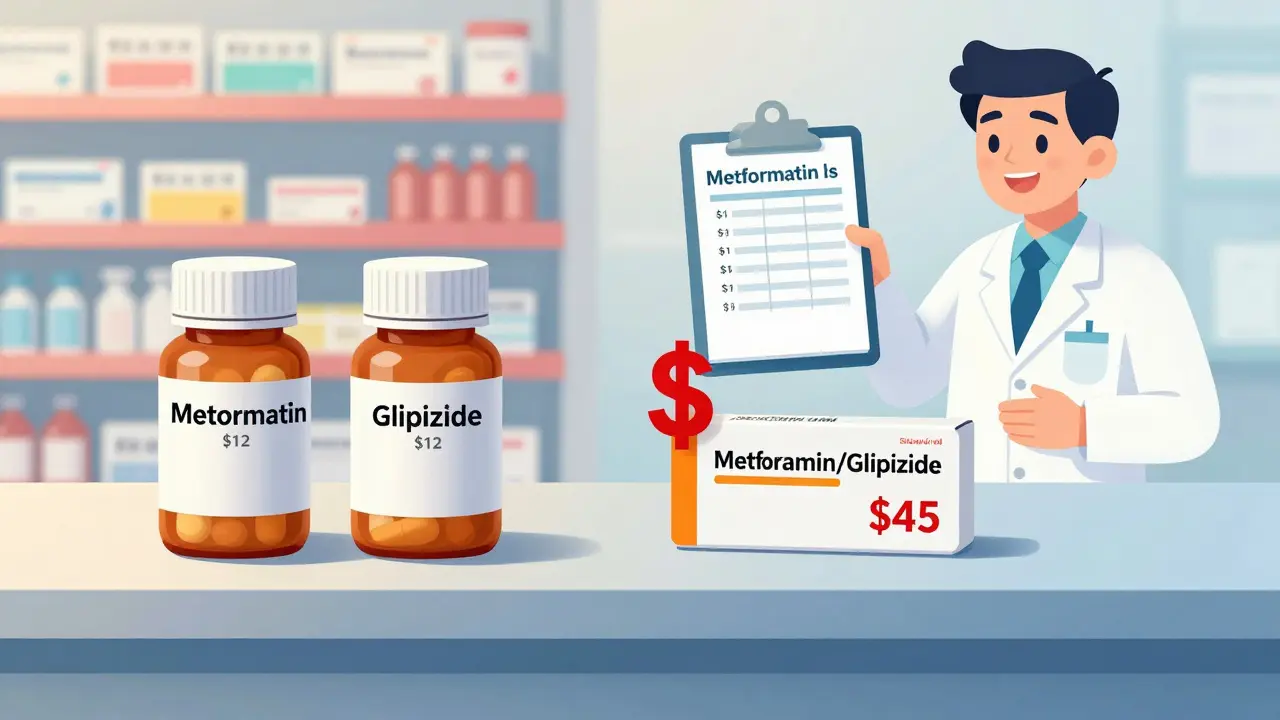
Let’s say you take two generic drugs: metformin and glipizide for type 2 diabetes. Each costs $12 per month. Together, that’s $24. Now, there’s a combination pill - metformin/glipizide - that does the same thing. But your plan only covers it on Tier 3. Your copay? $45. This isn’t rare. On Reddit, users like "PharmaPatient87" shared stories of having to ask their doctor to write two prescriptions just to save money. The combination drug might be more convenient, but if the plan doesn’t put it on the lowest tier, you pay more. The problem gets worse with "single-source generics." These are generics made by only one company. Without competition, prices don’t drop. A 2023 Truveris report found that these drugs can cost nearly as much as brand-name versions. Insurance plans often respond by putting them on higher tiers - or refusing to cover them at all. Meanwhile, the individual generics? They’re made by five or six different manufacturers. Prices are driven down. Copays drop. The plan loves them. So you end up paying less for two pills than one.How Medicare and Private Plans Compare
Medicare Part D plans are more standardized than private insurance. Almost all of them use four or five tiers. Tier 1 is reserved for preferred generics. The average copay for a Tier 1 generic in 2024? $1 to $15. Brand-name drugs? $47 to $112. Private insurers have more flexibility. Some plans cover combination drugs on Tier 1. Others don’t. It depends on the pharmacy benefit manager (PBM) - the middlemen that negotiate drug prices. CVS Caremark, Express Scripts, and OptumRx control 80% of the market. Each has its own rules. One plan might cover the combo. The next one might not. There’s also step therapy. That’s when your insurer makes you try the cheaper option first - even if your doctor says it won’t work for you. If you’re on two separate generics and your plan says you have to try the combo first, you might be stuck paying full price until they approve it.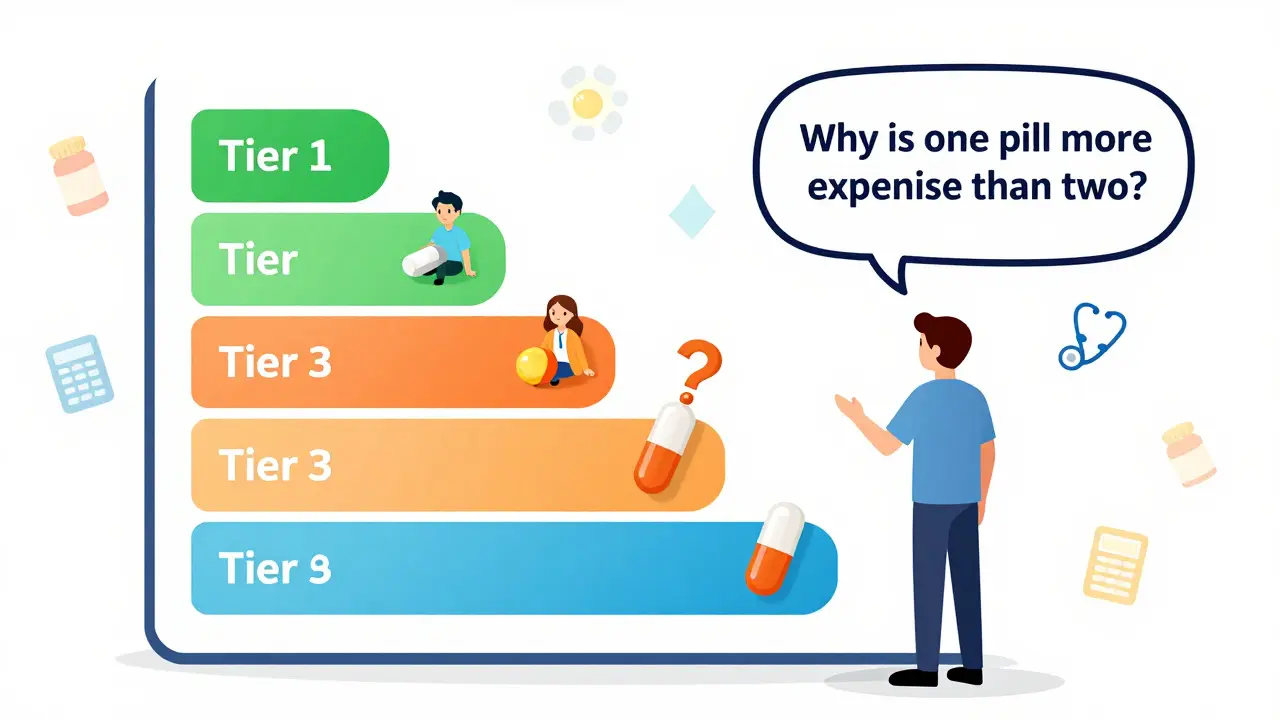
What Changed in 2024 - And What It Means for You
Starting January 1, 2024, Medicare Part D eliminated deductibles and capped out-of-pocket spending at $2,000 per year. That’s huge. It means no matter how many drugs you take, you won’t pay more than that. But here’s the catch: the cap only applies to what you pay at the pharmacy. It doesn’t include what your plan pays. So if your combo drug costs $50 and your plan only covers $20 of it, you still pay $30 - and that counts toward your $2,000 limit. Also in 2023, a federal court ruled against "copay accumulator" programs. These were sneaky policies where drug manufacturers’ coupons didn’t count toward your deductible or out-of-pocket maximum. That meant people on expensive brand-name drugs had to pay way more before getting full coverage. Now, those coupons count. That helps people who can’t switch to generics - but it also pressures insurers to cover cheaper options.What You Can Do to Save Money
If you’re paying more for a combination drug than the individual generics:- Check your plan’s formulary online. Look for the drug name in each tier.
- Compare the copay for the combo vs. the two separate drugs. Use the Medicare Plan Finder tool or your insurer’s website.
- Ask your doctor to prescribe the individual generics instead. Many doctors don’t realize the combo isn’t covered well.
- If your plan denies coverage for the combo, file a coverage determination request. It takes 72 hours for a standard review, 24 for urgent cases.
- Use GoodRx or SingleCare. Sometimes the cash price for the combo is lower than your copay.

Why This Matters Beyond the Cost
It’s not just about money. Taking multiple pills every day is harder. You might forget one. You might run out of one before the other. That’s why combination drugs exist - to improve adherence. Studies show patients are 20-30% more likely to stick to their regimen when they take one pill instead of two. But if insurance makes the combo expensive, patients switch back to multiple pills - and adherence drops. The FDA and the American Academy of Family Physicians both say generics are safe and effective. But if your insurance doesn’t cover the combination - even though it’s made of two approved generics - you’re forced into a less convenient, less effective option.What’s Coming Next
The generic drug market is growing fast. It was worth $135 billion in 2022. By 2028, it’s expected to hit $219 billion. More combination drugs are going generic. The FDA’s GDUFA III program is speeding up approvals. That means more competition. More price drops. More chances for insurers to put combos on Tier 1. But until then, the system is still broken. Insurance plans are built to save money - not to make life easier. And sometimes, saving money means making patients pay more - or take more pills. If you’re on multiple generics, don’t assume the combo is better. Check the numbers. Ask your pharmacist. Talk to your doctor. You might be able to save $30 a month - or more.Why is my combination drug more expensive than the two separate generics?
Insurance plans often place combination drugs on higher tiers if they’re made by only one manufacturer (a "single-source generic"). Without competition, the price stays high. Meanwhile, individual generics have multiple makers, driving prices down. Even though the ingredients are identical, the plan sees the combo as less cost-effective - so it charges more.
Can I ask my doctor to prescribe the individual generics instead?
Yes, absolutely. Many doctors don’t realize the combo isn’t covered well. If the two separate generics cost less than the combination pill, ask your doctor to write two prescriptions. This is a common and legal workaround - and it’s used by thousands of Medicare beneficiaries every year to save money.
Does Medicare cover combination drugs better than private insurance?
Medicare Part D plans are more consistent because they follow federal guidelines. Almost all use tiered formularies with generic drugs on Tier 1. Private insurers vary widely - some cover combos well, others don’t. It depends on your pharmacy benefit manager (PBM). Always check your specific plan’s formulary before assuming coverage.
What’s a single-source generic, and why does it matter?
A single-source generic is a drug made by only one manufacturer, even though the patent has expired. Without competition, the price doesn’t drop like it does with multi-source generics. These drugs often end up on higher insurance tiers, making them more expensive than expected - even though they’re technically "generic."
How do I check if my plan covers my combination drug?
Log in to your insurer’s website or use the Medicare Plan Finder tool. Search for the exact drug name (including brand and generic versions). Look at which tier it’s on and what your copay will be. Compare it to the cost of the individual drugs. If the combo costs more, ask your pharmacist or doctor about alternatives.
Can I appeal if my plan won’t cover my combination drug?
Yes. You can file a "coverage determination" request with your plan. Your doctor needs to submit a letter explaining why the combination is medically necessary. Standard requests take 72 hours; urgent cases are reviewed in 24 hours. If denied, you can appeal further. Many people successfully get coverage this way - especially if the combo is the only way to take their meds safely.
Bottom line: insurance doesn’t care if a pill is convenient. It cares about price. And sometimes, the cheapest option isn’t the one with fewer pills.
Anil bhardwaj
February 23, 2026Man, I just found out my combo pill for blood pressure costs $48, but the two separate ones are $8 each. I switched back last month and saved $30. My pharmacist laughed and said, "Welcome to the real world, buddy."
lela izzani
February 24, 2026This is such a common issue, and honestly, doctors rarely bring it up. I had to research this myself after my copay jumped. I called my insurer, checked GoodRx, and found the individual generics were cheaper even without insurance. I asked my doctor to switch - no problem. They were surprised I knew to ask. You don’t need a PhD, just a little curiosity.
Joanna Reyes
February 25, 2026I’ve been on multiple generics for years, and this whole system is a mess. The insurance companies claim they’re saving money, but they’re just shifting the burden onto patients who are already struggling. Combination drugs exist for a reason - adherence. When people can’t afford the convenient option, they skip doses, end up in the ER, and then the system pays way more. It’s short-sighted and cruel. And don’t get me started on PBMs - they’re the real villains here, quietly negotiating behind closed doors while we’re stuck choosing between food and our meds.
Stephen Archbold
February 25, 2026Just had this happen with my diabetes meds. Combo was $52. Separate ones? $11 each. I went to my doc and said, "I’m not paying $30 extra for convenience." She wrote two scripts. No hassle. I’m now taking two pills and saving $700 a year. I told my buddy who’s on the combo - he’s switching too. Simple fix. Why doesn’t everyone know this?
Southern Indiana Paleontology Institute
February 26, 2026USA is the only country where you pay more for one pill than two. We got the best healthcare system in the world, right? Yeah, right. My neighbor took three pills a day, got the combo, and got hit with a $90 copay. He switched back, now he’s saving $40 a month. Meanwhile, the CEO of Express Scripts bought a new yacht. Coincidence? I think not.
Nerina Devi
February 28, 2026This is why I always check my formulary before accepting any new prescription. I print out the tier list and bring it to my doctor. I’ve saved hundreds over the years. People think doctors know everything - but they don’t always know the insurance loopholes. You have to be your own advocate. It’s exhausting, but necessary.
Dinesh Dawn
March 2, 2026My mom’s on three meds. Two are generics, one’s combo. She cried last month because her copay went up. I looked it up - combo was $55, separate were $14 each. We switched. She’s happier, healthier, and has $40 extra in her pocket every month. Why is this even a thing? It’s not rocket science.
Vanessa Drummond
March 3, 2026They’re laughing at us. Seriously. They know we’re too tired, too confused, too broke to fight. So they stick the combo on Tier 3 and call it "cost-effective." Meanwhile, we’re juggling five pill bottles, forgetting doses, and getting scolded by our doctors for "non-compliance." It’s a trap. And they know it.
Nick Hamby
March 5, 2026There’s a philosophical tension here: efficiency versus equity. The combination pill is more efficient - one pill, one routine, better adherence. But the insurance model is designed for cost-minimization, not human well-being. We’ve outsourced moral responsibility to algorithms and formularies. The result? A system that rewards the cheapest option, not the best one. We’re not just paying more - we’re paying for a moral failure.
kirti juneja
March 5, 2026My cousin in India told me their government covers combo drugs at zero cost. I laughed. Then I cried. Here, I have to Google "metformin glipizide copay" like it’s a treasure hunt. The system is rigged. I’m not mad - I’m just tired. We need to stop treating medicine like a game of Monopoly where the rich get the best properties and the rest of us trade in Monopoly money.
Spenser Bickett
March 5, 2026Oh wow, I didn’t know insurance companies were so... *creative*. I guess next they’ll charge extra for breathing. "Sorry sir, your lungs are not on Tier 1. You’ll need to upgrade to Platinum Plus."
Christopher Wiedenhaupt
March 6, 2026It is important to note that while the financial implications of tiered formularies are significant, the underlying regulatory framework governing pharmaceutical pricing and coverage remains complex and often opaque. Patients are advised to consult their pharmacy benefit manager’s formulary documentation, as well as to request a prior authorization when clinically appropriate. The system is imperfect, but procedural diligence can mitigate unexpected costs.