
26 Dec 2025
- 14 Comments
Every year, millions of people in the U.S. skip doses, stop taking meds early, or switch to cheaper alternatives because they can’t afford their prescriptions. The problem isn’t always that the medicine doesn’t work-it’s that they don’t understand it, or they’re paying too much for it. Enter medication therapy management (MTM): a service led by pharmacists that doesn’t just fill prescriptions, but fixes the gaps in how people use them-especially when it comes to generic drugs.
What Medication Therapy Management Really Means
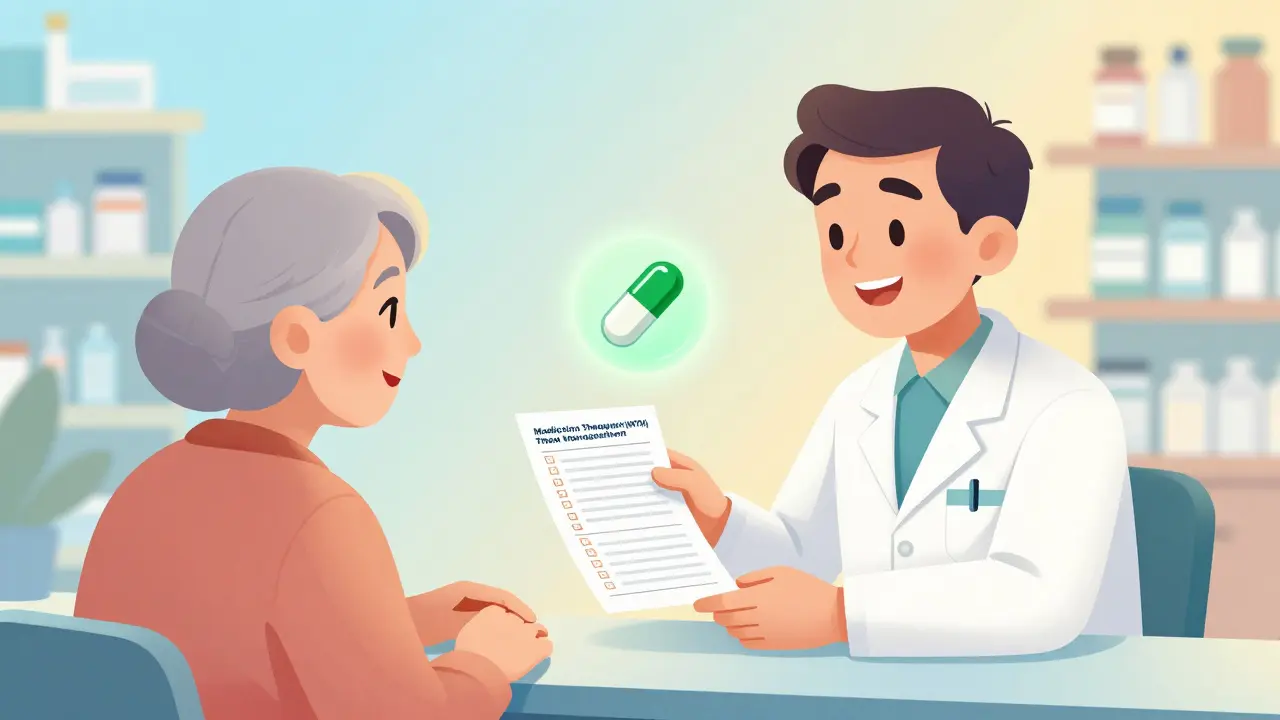
MTM isn’t a buzzword. It’s a structured, face-to-face or virtual session where a pharmacist sits down with a patient and reviews every single medication they’re taking-prescription, over-the-counter, supplements, even herbal stuff. The goal? Make sure each drug is necessary, safe, effective, and affordable. This isn’t the same as handing out pills at the counter. It’s a full audit of a person’s entire medication picture.
Since 2006, Medicare Part D has required all its plans to offer MTM to high-risk beneficiaries. That means if you’re on five or more chronic meds, spend over $5,000 a year on drugs, or have multiple health conditions, you’re eligible. But here’s the catch: only about 1 in 4 eligible people actually take part. Why? Most don’t know it exists-or think it’s just another pharmacy formality.
The Pharmacist’s Secret Weapon: Generic Drugs
Generic drugs aren’t cheap knockoffs. They’re exact copies of brand-name drugs in active ingredients, dosage, strength, and how they work in the body. The FDA requires them to be bioequivalent-meaning they deliver the same effect with the same safety profile. But here’s what most patients don’t realize: generics can cost 80% to 85% less.
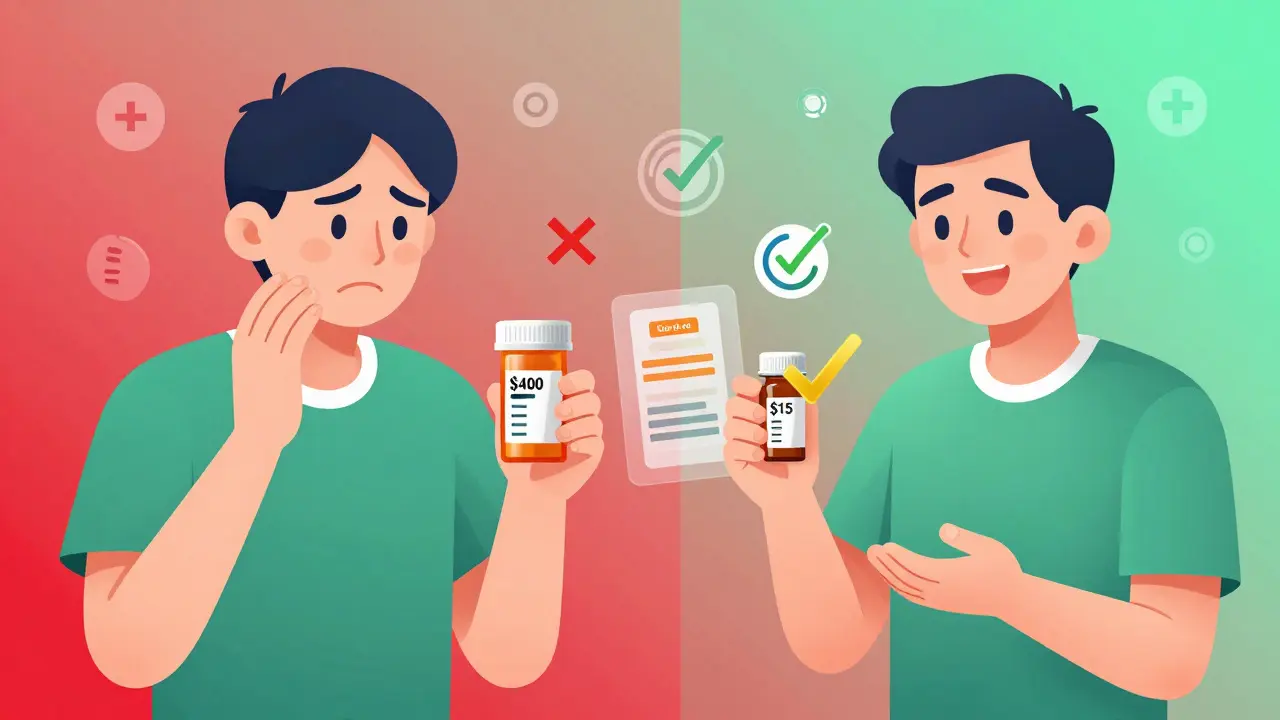
Pharmacists are trained to spot these opportunities. In a typical MTM session, they cross-reference the patient’s meds with the FDA’s Orange Book, which lists approved generic equivalents. For example, a patient paying $400 a month for a brand-name inhaler might be switched to a generic version costing $15-with identical results. That’s not a compromise. That’s better care.
One study from HealthPartners showed that when pharmacists actively recommended generic substitutions during MTM visits, patients saved an average of 32% on their monthly drug costs. And those savings weren’t just numbers-they translated to real life. One patient reported saving $287 a month, enough to cover groceries or rent.
Why Pharmacists, Not Just Doctors?
Doctors manage diagnoses. Pharmacists manage medications. That’s the key difference.
A doctor might prescribe a brand-name statin because it’s what they’re used to. A pharmacist sees the patient’s full list: the statin, the blood pressure med, the diabetes pill, the OTC painkiller, and the fish oil. They notice the statin has a generic version that’s been proven just as effective. They check for interactions. They see that the patient’s out-of-pocket cost for the brand-name drug is $120, while the generic is $8. They explain it. They help the patient switch.
Studies show pharmacist-led MTM reduces medication errors by 61% and cuts hospital readmissions by 23% within 30 days. Why? Because pharmacists catch what others miss: duplicate therapies, unnecessary doses, or drugs that don’t even match the diagnosis. And when it comes to generics, they’re the only ones who track therapeutic equivalence down to the molecular level.
Breaking Down the Myths About Generics
Many patients still believe generics are inferior. They think, “If it’s cheaper, it must be weaker.” That’s not true-but it’s a myth that keeps people from saving money.
Pharmacists in MTM sessions spend time debunking this. They show patients the FDA’s approval data. They explain how generics are tested in the same labs, under the same standards. They point out that 90% of all prescriptions filled in the U.S. are for generics. Even brand-name drug makers make their own generics.
Some drugs need extra caution-like warfarin, levothyroxine, or certain seizure meds-because they have a narrow therapeutic index. A tiny difference in absorption can cause problems. Pharmacists know this. They don’t just swap any generic. They check the Orange Book for A-rated equivalents, monitor blood levels if needed, and coordinate with prescribers to ensure safety.
How MTM Works: The Process
Here’s what happens in a real MTM session:
- Collection: The pharmacist gathers all medications-prescriptions, OTCs, vitamins-from the patient or pharmacy records.
- Assessment: Using tools like the Medication Appropriateness Index (MAI), they evaluate each drug for indication, effectiveness, dosage, duration, and cost.
- Identification: They flag problems: duplicates, interactions, unnecessary meds, high-cost brand names with generic alternatives.
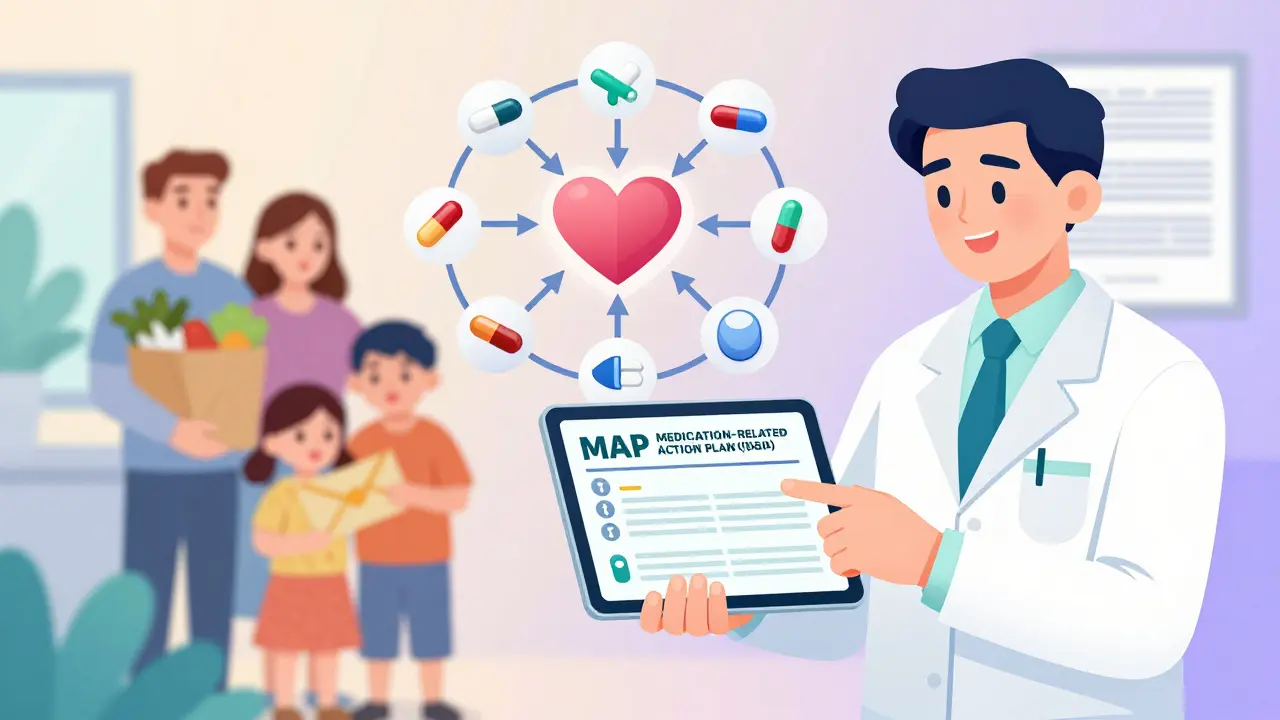
- Planning: They create a personalized Medication-Related Action Plan (MAP) with clear steps: which meds to switch, which to stop, what to monitor.
- Follow-up: A 10- to 20-minute check-in in 30 to 60 days to see if the plan worked.
Each session takes 20 to 40 minutes. Documentation takes another 5 to 15. That’s time most pharmacies don’t have-unless they’re set up for MTM.
Barriers to Getting MTM
Even though MTM saves money and lives, it’s not everywhere. Why?
- Reimbursement is patchy. Medicare pays $50 to $150 per session. Private insurers? Often $25 to $75. Many pharmacies can’t afford the time unless they’re paid fairly.
- Not all states allow pharmacists to make changes. Only 42 states have laws letting pharmacists adjust meds under collaborative agreements with doctors.
- Electronic records don’t talk. Only 38% of community pharmacies can seamlessly share MTM notes with doctors’ EHRs. That means follow-up care gets delayed.
- Patient awareness is low. Most people don’t know they can ask for MTM. They think it’s automatic.
Some pharmacies say, “We don’t offer MTM because it’s not worth the paperwork.” But that’s changing. More health systems are embedding pharmacists into care teams-not just as dispensers, but as clinical decision-makers.
What Patients Are Saying
Real stories show the impact:
- A woman on Reddit shared how her MTM pharmacist switched her $400/month brand-name inhaler to a $15 generic. “I cried because I didn’t have to choose between my meds and groceries.”
- A 72-year-old man in Texas saved $214 a month after his pharmacist found three unnecessary brand-name drugs and replaced them with generics.
- A 2022 survey of 1,247 MTM participants found 76% improved adherence, 89% understood their meds better, and 68% cut their out-of-pocket costs.
But there’s frustration too. One Medicare beneficiary wrote on the CMS forum: “I qualified, but my pharmacy said they don’t offer it because the reimbursement isn’t worth it.” That’s the system’s failure-not the pharmacist’s.
The Future of MTM
MTM is growing fast. In 2022, over 12.7 million Medicare beneficiaries received MTM services. Commercial plans cover another 85 million Americans. Employers are seeing a $3.17 return for every $1 spent on MTM.
New tools are emerging: telehealth MTM sessions are now standard after pandemic-era changes. Pharmacists are starting to use pharmacogenomics-testing how a patient’s genes affect drug metabolism-to pick the best generic version for their body.
And legislation is catching up. The Pharmacist Medicare Benefits Act, passed by the House in 2021, could expand direct Medicare reimbursement to pharmacists, opening MTM to 38 million more people.
By 2025, 78% of health systems plan to expand pharmacist roles in MTM. The Bureau of Labor Statistics predicts a 4.6% growth in pharmacist jobs through 2032-mostly because of clinical services like this.
What You Can Do
If you’re on multiple medications, especially if you’re paying hundreds a month for prescriptions:
- Ask your pharmacy: “Do you offer Medication Therapy Management?”
- If they say no, ask your doctor or insurance plan. You’re eligible if you meet the criteria.
- Bring your full med list-even the supplements and OTCs-to the session.
- Ask: “Are there generic versions of these? Are they safe for me?”
MTM isn’t about saving pharmacies money. It’s about saving patients from financial stress, side effects, and hospital stays. And at the center of it all? The pharmacist-who knows more about your pills than anyone else.
What is medication therapy management (MTM)?
Medication Therapy Management (MTM) is a service provided by pharmacists to review all of a patient’s medications-prescription, over-the-counter, and supplements-to ensure they’re safe, effective, and affordable. The goal is to improve health outcomes by fixing medication-related problems like duplicates, interactions, or unnecessary costs.
Can pharmacists switch my brand-name drugs to generics?
Yes, but only with the prescriber’s approval. Pharmacists identify generic alternatives that are FDA-approved and therapeutically equivalent. They then recommend the switch to your doctor, who makes the final change. In many states, pharmacists can make substitutions under collaborative agreements without needing a new prescription.
Are generic drugs really as good as brand-name ones?
Yes. The FDA requires generics to have the same active ingredient, strength, dosage form, and route of administration as the brand-name drug. They must also be bioequivalent-meaning they work the same way in your body. The only differences are inactive ingredients (like fillers) and cost. Generics cost 80-85% less on average.
Who qualifies for MTM services?
Medicare Part D beneficiaries qualify if they have three or more chronic conditions (like diabetes, heart disease, or high blood pressure), take five or more Medicare-covered prescription drugs, and are expected to spend more than $5,000 per year on medications. Many commercial insurance plans also offer MTM to high-risk patients.
How much does MTM cost?
For Medicare Part D beneficiaries, MTM services are free. Private insurers may charge a copay or cover it fully. Pharmacies are reimbursed by insurance plans-not patients-for these services. If you’re asked to pay out of pocket for MTM, ask your plan if it’s covered.
Why don’t all pharmacies offer MTM?
Reimbursement is inconsistent. Medicare pays $50-$150 per session, but many private insurers pay only $25-$75. Some pharmacies can’t afford the time (20-40 minutes per session) unless they’re paid enough. Also, only 42 states allow pharmacists to make medication changes without a doctor’s new prescription, limiting how much they can do.
Can MTM help me save money on my prescriptions?
Yes. A 2022 study found patients saved an average of $214 per month through MTM pharmacist recommendations-mostly by switching to generic drugs. In one HealthPartners program, patients saved 32% on drug costs just by optimizing generic use. MTM doesn’t just improve safety-it directly reduces out-of-pocket spending.
Nicola George
December 27, 2025So let me get this straight-you're telling me a pharmacist can save me $287 a month just by knowing where to look? And we still act like they're just the people who hand out pills like candy? I mean, if my doctor prescribed me a $400 inhaler and I didn't know there was a $15 version, that's not my fault. That's the system being a crooked middleman.
Raushan Richardson
December 28, 2025I had my first MTM session last month and honestly? It changed my life. I was on 7 meds, didn't know half of them were redundant, and my pharmacist found TWO generics I could switch to that cut my monthly bill by 60%. I didn't even know I could ask for this. Everyone should. Just walk in and say, 'Do you do MTM?' No shame. Just savings.
Todd Scott
December 29, 2025The real issue here isn't just generic substitution-it's the structural underfunding of clinical pharmacy services. Pharmacists are trained in pharmacokinetics, drug interactions, adherence barriers, and therapeutic equivalence at a level that most physicians simply don't prioritize. MTM isn't a 'service'-it's a clinical intervention that's been proven to reduce hospitalizations and medication errors. Yet we pay pharmacists less than $100 per hour for work that prevents ER visits costing $12,000 each. It's not a policy gap. It's a moral failure. We treat pharmacy like a retail function when it's clearly a clinical one. The Orange Book exists. The data exists. The infrastructure exists. What's missing is the will to pay for it properly.
Will Neitzer
December 29, 2025It is imperative to underscore, with the utmost clarity and precision, that the assertion that generic medications are inferior is not merely a misconception-it is a demonstrably false, empirically disproven, and dangerously pervasive myth. The Food and Drug Administration mandates bioequivalence thresholds of 80%–125% for the area under the curve and maximum concentration of active pharmaceutical ingredients, ensuring that generic drugs perform identically to their brand-name counterparts in vivo. Furthermore, the National Academy of Medicine has explicitly endorsed generic substitution as a cornerstone of cost-effective, high-quality pharmacotherapy. To question the equivalence of FDA-approved generics is to reject evidence-based medicine itself.
Olivia Goolsby
December 30, 2025You think this is about saving money? Nah. This is a corporate ploy to make you dependent on the same pharmaceutical giants who invented the brand names in the first place. The 'generics' are made by the same companies-same factories, same suppliers. They just slap a different label on it. And don't get me started on the 'Orange Book'-it's not some sacred scripture. It's a list that gets updated by people who get paid by Big Pharma. They let the same companies test their own generics. That's not oversight. That's a loophole with a corporate logo on it. And now they want you to trust pharmacists? Who work for the same chains that charge you $500 for insulin and call it 'market pricing'? This isn't care. It's rebranding the scam.
Elizabeth Ganak
December 31, 2025In India we have this thing called 'generic medicine' and it's everywhere. Like, my mom takes her blood pressure pill for 20 rupees. Same as the brand, same effect. People here don't even think about it. Why? Because it's normal. Why does America act like switching to generic is some big life hack? It's not. It's basic. You're just late to the party.
Robyn Hays
January 1, 2026I love how MTM feels like the quiet superhero of healthcare. No capes. No flashy ads. Just a pharmacist with a clipboard, a calculator, and a whole lot of patience. They’re the ones who notice you’re taking two different blood pressure meds that cancel each other out. Or that your ‘natural’ supplement is interacting with your chemo. They don’t get parades. But they save lives. And honestly? If I ever need to be saved, I want it to be by someone who knows more about my pills than I do about my own phone password.
Liz Tanner
January 3, 2026I used to think MTM was just a way for pharmacies to upsell something. Then my grandma had her session. She was on 11 meds. The pharmacist cut it to 5. Removed 3 that were useless. Found a $12 generic for a $300 brand. My grandma cried. Not because she was sick. Because she finally felt seen. That’s what this is. Not a program. A human moment.
Babe Addict
January 4, 2026Let’s be real-MTM is just pharmacy’s way of pretending they’re doctors. You don’t need a 40-minute consult to swap a generic. If you’re paying $400 for an inhaler, your doctor messed up. The pharmacist’s job is to dispense, not diagnose. And that ‘Orange Book’? It’s a joke. Half those A-rated generics have different fillers that cause real side effects. I’ve seen it. Patients get rashes, GI issues, weird dizziness. They blame the drug. But it’s the filler. The pharmacist doesn’t care. They just want to hit their quota.
Satyakki Bhattacharjee
January 5, 2026People forget that money is not the problem. The problem is the soul. We have turned medicine into a transaction. A pill for a price. A pharmacist for a discount. But healing is not a spreadsheet. When you reduce a human being to their drug list, you forget they are a person. A mother. A father. Someone who fears death more than they fear debt. Generics save money. But do they save dignity?
Kishor Raibole
January 6, 2026It is with profound intellectual rigor and a commitment to systemic clarity that I must assert the following: the institutional marginalization of pharmacists within the healthcare hierarchy constitutes not merely an administrative oversight, but a profound epistemological error. The physician, trained in differential diagnosis, remains fundamentally ill-equipped to evaluate pharmacokinetic interactions, bioequivalence metrics, or adherence barriers across polypharmacy regimens. The pharmacist, conversely, possesses the requisite expertise-yet is systematically excluded from prescriptive authority in 8 states. This is not inefficiency. It is ideology masquerading as policy.
Liz MENDOZA
January 7, 2026I work in a pharmacy that does MTM and I can tell you-most people are terrified to ask. They think we’re gonna judge them for taking too many pills or not knowing what they’re on. But we’re not. We’re just trying to help. I had a guy come in last week who was taking 11 meds. He didn’t even know why. We sat for 35 minutes. He left with 5 meds, a printed plan, and tears in his eyes. He said, ‘I didn’t know I could ask.’ You can. Just ask.
Anna Weitz
January 8, 2026I think the real story here is how we've been conditioned to believe doctors know everything and pharmacists are just order-takers. But the truth? The pharmacist is the only one who sees the whole picture. Your doctor writes a script. The pharmacist sees it alongside your antidepressant, your OTC sleep aid, your CBD gummies, and your uncle’s herbal tea. They’re the only one who can say, 'Wait, this combo could make you hallucinate.' We need to stop treating them like cashiers and start treating them like the clinical experts they are
Jane Lucas
January 9, 2026my pharmacist switched my blood pressure med to a generic and i saved $200 a month and i didnt even know i could ask for it