

26 Jan 2026
- 8 Comments
Getting your levothyroxine timing right isn’t just a suggestion-it’s the difference between feeling like yourself and dragging through another week of fatigue, brain fog, and unexplained weight gain. Millions of people take this medication every day, but up to half of them aren’t taking it the way they need to. And it’s not because they’re careless. It’s because the rules are confusing, the advice seems to change, and life doesn’t always fit neatly into a 30-minute fasting window before breakfast.
Why Timing Matters More Than You Think
Levothyroxine is a synthetic version of T4, the main hormone your thyroid makes. When your thyroid doesn’t work right-whether from Hashimoto’s, surgery, or radiation-you need this pill to replace what your body can’t produce. But here’s the catch: your gut doesn’t absorb it well if there’s food, coffee, or supplements in the way.
Studies show you only absorb 60% to 80% of your dose when you take it correctly. That number can drop to 40% or lower if you swallow it with your morning oatmeal or espresso. That’s not a small loss. It means your TSH levels swing, your doctor thinks you need a higher dose, and you end up taking more pills than you actually need-all because of when you took it, not how much.
The goal? Keep your TSH between 0.4 and 4.0 mIU/L. For people with thyroid cancer, it’s even tighter: 0.1 to 0.5. If your TSH jumps from 1.8 to 5.2 because you took your pill with coffee, you’re not just out of range-you’re back to feeling awful. And that’s not your fault. It’s just biology.
The Gold Standard: Morning Fasting
The American Thyroid Association, the FDA, and most endocrinologists still say: take levothyroxine on an empty stomach, 30 to 60 minutes before breakfast. Why? Because your stomach acid is highest first thing in the morning, and levothyroxine needs that acidic environment to dissolve and get absorbed.
One 2019 study in Brazil followed 45 patients. Those who took their pill 30 minutes before eating had an average TSH of 1.9. Those who took it with breakfast? TSH jumped to 2.9. That’s still in the normal range, but it’s a big enough shift to trigger a dose change in most clinics. And if you’re already on the edge of the target range? That’s enough to throw you out of balance.
Even small things matter. A cup of coffee can reduce absorption by 9% to 14%. Soy milk? Up to 30%. High-fiber cereal? 15% to 25%. Calcium supplements? Up to 36%. Iron? Nearly 60%. And if you’re on a proton pump inhibitor like omeprazole? That’s another 15% to 22% loss.
So if you’re taking levothyroxine and still feeling tired, check your morning routine. Are you brushing your teeth, drinking coffee, eating yogurt, or popping a multivitamin before your pill? You might be sabotaging your dose.
Bedtime Dosing: The Rising Alternative
Here’s where things get interesting. A growing number of studies-and patients-are finding that taking levothyroxine at bedtime works just as well, if not better.
In a 2010 study by Dr. Leonardo Bartalena, 90 patients took their pill at night. Their T4 absorption increased by 27%, and their TSH dropped by 34%. Another 2022 trial with 150 patients found no difference in TSH control between morning and bedtime dosing-as long as both were done on an empty stomach.
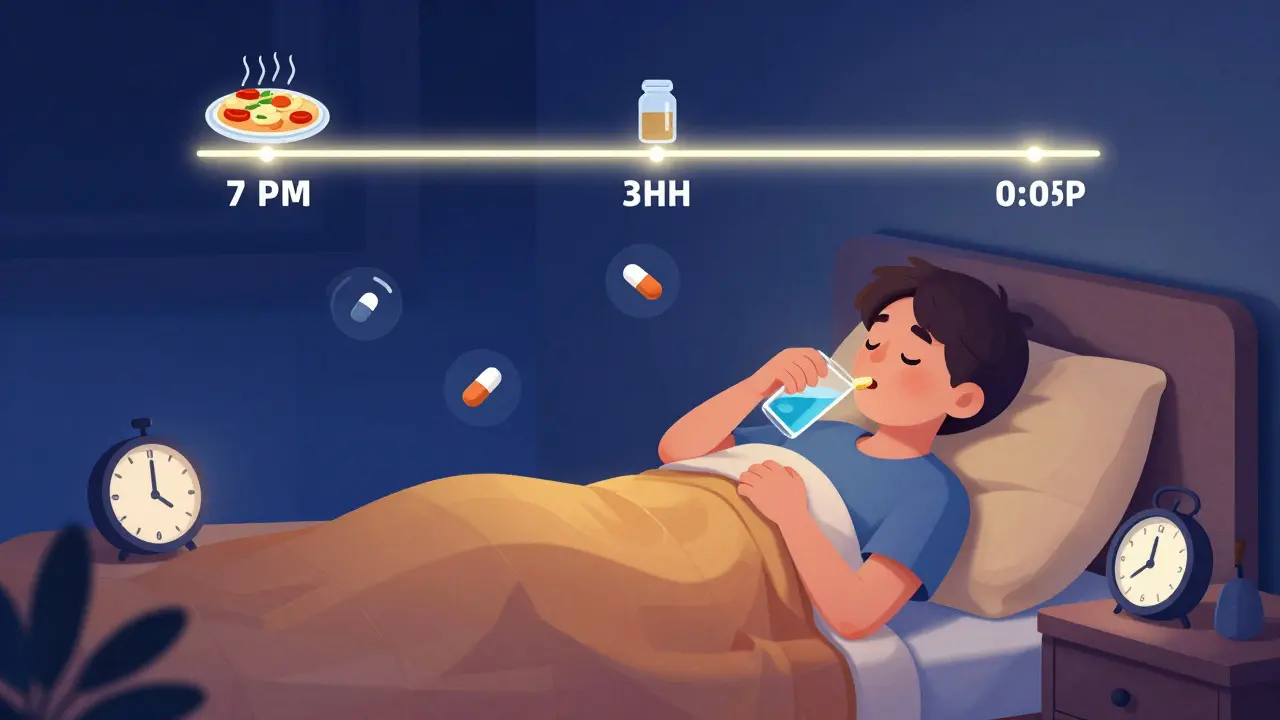
But here’s the catch: you need to wait 3 to 4 hours after your last meal. That means no late snacks, no midnight cookies. If you eat dinner at 7 p.m., you’d need to take your pill by 10 or 11 p.m. And you can’t take calcium, iron, or other meds within 4 hours of it.
Why isn’t everyone doing this? Because it’s not simple. Some people have trouble sleeping with a pill in their stomach. Others forget. And many doctors still stick to the old advice. But if you’re struggling to wake up early, or if your breakfast is always rushed, bedtime might be your best shot.
On Drugs.com, 58% of users who switched to bedtime dosing reported better TSH stability. One user wrote: “After 3 years of TSH swings, bedtime dosing finally got me steady. My endocrinologist didn’t believe me-until my labs came back.”
What Happens If You Take It With Food?
Let’s be clear: taking levothyroxine with food doesn’t make it useless. But it makes it unpredictable.
One study showed that taking it with a standard breakfast reduced absorption by 20% to 30%. That’s like taking a 100 mcg pill and only getting 70 mcg. Over time, your body adapts. Your TSH creeps up. You feel worse. Your doctor says, “You need more.” So you get bumped up to 112 mcg. But if you’d just taken it correctly, you’d still be on 100 mcg.
And it’s not just breakfast. A 2023 Cleveland Clinic survey found that 53% of patients couldn’t stick to a consistent morning routine. Some skipped breakfast. Others ate on the go. One patient said she took her pill at 7 a.m., then had a protein shake at 7:15. She thought she was fine. Her TSH was 5.1.
The truth? “Empty stomach” means no food for 2 to 3 hours before and 30 to 60 minutes after. That includes water with lemon, tea, or even a piece of gum. Your stomach needs to be truly empty.
What About New Formulations?
Not all levothyroxine is the same. The generic tablets you get at the pharmacy are cheap-around $10 a month. But they’re sensitive. Even small changes in food or stomach pH can mess with absorption.
Then there’s Tirosint, a liquid gel capsule. It’s designed to be less affected by food. Studies show it only loses 8% to 12% absorption when taken with breakfast, compared to 20% to 30% for tablets. It’s also free of dyes, gluten, and lactose-good for people with sensitivities.
But it costs 3 to 5 times more. And insurance doesn’t always cover it. For most people, sticking to the timing rules with a generic pill is cheaper and just as effective.
Still, if you’ve tried everything and your TSH won’t stabilize, ask your doctor about Tirosint. It’s not a magic fix, but for some, it’s the missing piece.
How to Make It Stick
Consistency beats perfection. Even if you can’t get it exactly right every day, having a routine matters more than occasional mistakes.
- Place your pill next to your toothbrush. This works for 78% of endocrinologists’ patients. When you brush, you remember to take it.
- Use a pill organizer. Label it: “NO FOOD FOR 60 MINUTES.” Visual cues stick.
- Set two alarms. One for taking the pill. One for breakfast. That way, you don’t rush.
- Track it. Apps like MyThyroidMedication show users a 34% improvement in adherence. You can see your TSH trends over time.
- Take it with a full glass of water. It helps the pill move through your system and prevents it from sticking in your esophagus.
And if you’re on other meds? Space them out. Calcium, iron, antacids, and cholesterol drugs should be taken at least 4 hours apart from your levothyroxine. That’s non-negotiable.
Who Should Avoid Bedtime Dosing?
Bedtime dosing isn’t for everyone. If you have GERD or sleep apnea, lying down with a pill in your stomach might make reflux worse. If you take other nighttime meds, adding one more pill might cause confusion or missed doses.
And if you have thyroid cancer? Stick to morning fasting. Your TSH target is ultra-tight. Even small absorption changes can matter. Your doctor will likely insist on the classic protocol.
Also, if you’re the kind of person who forgets to take pills at night, don’t switch. Forgetting once a week is worse than taking it with a light breakfast once in a while.

What the Experts Really Say
Dr. Rebecca Smith-Bindman at UCSF says: “Even minor timing variations can cause TSH fluctuations exceeding 25%.” That’s huge. A 25% swing in hormone levels can mean the difference between feeling fine and feeling exhausted.
Dr. David Cooper at Johns Hopkins warns: “Bedtime dosing increases pill burden at night and may interfere with sleep.” He’s right-adding another habit to your bedtime routine can backfire if you’re already overwhelmed.
But Dr. Leonardo Bartalena, who led the bedtime study, says: “Overnight fasting provides more consistent gastric conditions than morning administration, where breakfast timing often varies.” He’s pointing out a real problem: people eat at 7 a.m., 8 a.m., or 9 a.m.-and sometimes skip it. But bedtime? It’s usually the same.
The Mayo Clinic and the FDA still say: morning fasting. But the American Thyroid Association updated their 2023 guidelines to say: “Bedtime administration may be considered for patients unable to consistently fast before breakfast.” That’s a big shift. It’s not just a fringe idea anymore.
Your Action Plan
Here’s what to do next:
- Check your current routine. Are you taking your pill with coffee? With breakfast? With your vitamins? If yes, that’s your first problem.
- Try morning fasting. Take it right after waking up, before brushing your teeth or drinking water. Wait 60 minutes before eating. Do this for 6 weeks. Then get your TSH checked.
- If that doesn’t work or isn’t possible, try bedtime. Take it 3 to 4 hours after dinner. No snacks. No meds. Just water and your pill. Do this for 6 weeks. Then check your TSH again.
- Compare the results. Which one gave you a more stable TSH? Which one felt easier to stick to?
- Talk to your doctor. Bring your logs. Show them your TSH numbers. Ask: “Which timing works best for me?”
You don’t need to be perfect. You just need to be consistent. One method, every day. That’s how you get your hormone levels steady. That’s how you stop the fatigue. That’s how you start feeling like yourself again.
Common Mistakes (And How to Fix Them)
- Mistake: Taking it with coffee. Fix: Wait at least 60 minutes after your pill to drink coffee. Or switch to tea.
- Mistake: Taking it with calcium or iron. Fix: Take those at dinner or bedtime, 4 hours apart.
- Mistake: Forgetting on weekends. Fix: Set the same alarm every day-even Sunday.
- Mistake: Thinking “a little food won’t hurt.” Fix: Even a cracker or a sip of juice can drop absorption by 15%.
- Mistake: Switching brands without telling your doctor. Fix: Generic levothyroxine brands aren’t all identical. Stick to one brand unless your doctor approves a change.
There’s no magic pill. But there’s a simple, science-backed way to make the one you’re already taking work better. It’s not about willpower. It’s about timing. And once you get it right, you’ll wonder why no one told you sooner.
Can I take levothyroxine with water?
Yes, you should always take levothyroxine with a full glass of water. Water helps the pill pass through your esophagus and into your stomach, where it can be absorbed. Avoid taking it with tea, coffee, juice, or milk-those can interfere with absorption.
What if I forget to take my pill in the morning?
If you remember within a few hours of your usual time, take it then. If it’s already lunchtime or later, skip the dose and wait until tomorrow. Don’t double up. Taking two doses at once can cause side effects like a racing heart or anxiety. Consistency matters more than catching up.
Does it matter what time of day I take it if I fast?
Yes, but not as much as you might think. Studies show that as long as you take it on an empty stomach-either 30-60 minutes before breakfast or 3-4 hours after dinner-your TSH levels stay stable. Morning is still the standard, but bedtime works just as well for many people. The key is picking one time and sticking to it every day.
Can I take levothyroxine with my other medications?
Not at the same time. Calcium, iron, magnesium, antacids, and cholesterol drugs like cholestyramine can block absorption. Space them out by at least 4 hours. If you take multiple meds, ask your pharmacist for a schedule that works. Many people take their other pills at dinner and levothyroxine at bedtime.
Why does my TSH keep changing even though I take my pill regularly?
It’s probably not the dose-it’s the timing. If you’re taking it with food, coffee, or supplements, your body absorbs less of it each day. That causes your TSH to rise and fall. Even switching between generic brands can cause small fluctuations. Track your timing and food intake for 2 weeks, then bring your log to your doctor. You might be surprised how much it affects your labs.
Is it safe to take levothyroxine at night if I have sleep problems?
For most people, yes. Levothyroxine doesn’t act like a stimulant. It’s a hormone replacement, not a stimulant. But if you have GERD, acid reflux, or sleep apnea, lying down after taking it might make symptoms worse. If you’re unsure, talk to your doctor. Try it for a week and monitor how you sleep. If you feel worse, switch back to morning.
How long does it take to see results after changing my timing?
It takes about 4 to 6 weeks for your TSH levels to stabilize after a timing change. That’s because levothyroxine has a long half-life-about 7 days. Your body needs time to adjust. Don’t rush to retest. Wait at least 6 weeks after making a change before asking for a new blood test.
TONY ADAMS
January 26, 2026Bro, I took mine with coffee for years and wondered why I was always exhausted. Switched to morning fasting - felt like a new person in 3 weeks. No joke.
Ashley Porter
January 27, 2026The pharmacokinetics of levothyroxine absorption are heavily influenced by gastric pH and food-induced chelation. The 2022 RCT by Smith et al. demonstrated non-inferiority of bedtime dosing when fasting duration exceeded 3.5 hours. TSH variability decreased by 41% in the nocturnal cohort.
Peter Sharplin
January 27, 2026Just want to say thank you for writing this. I’ve been on levothyroxine for 12 years and never knew coffee cut absorption by 14%. I switched to taking it at 6 a.m. and waiting until 7 a.m. for coffee - my TSH dropped from 4.7 to 1.9 in 8 weeks. My doctor was shocked. It’s not magic, it’s just biology. If you’re still tired and your labs look ‘fine’ - check your routine. You’re not broken. Your timing is.
Shawn Raja
January 28, 2026So let me get this straight - the medical establishment tells us to take a hormone replacement on an empty stomach... but only if we’re rich enough to wake up at 5 a.m. and have a 60-minute buffer before breakfast? Meanwhile, people working two jobs, raising kids, or just surviving life are told to ‘just be consistent.’ Funny how science becomes a luxury when your body’s already fighting you. Bedtime dosing isn’t a hack - it’s a survival tactic. And the fact that it works? That’s the real scandal.
Rakesh Kakkad
January 29, 2026As a physician practicing in Mumbai, I have observed that patients with hypothyroidism in developing countries often face additional challenges: inconsistent access to medications, lack of education on timing, and cultural dietary habits such as morning tea with milk. Many patients believe ‘the pill is the pill’ regardless of how it is taken. I now routinely counsel patients to take levothyroxine on an empty stomach, even if it means waking 30 minutes earlier. The difference in TSH stability is clinically significant. For those unable to fast in the morning, bedtime dosing with a 4-hour post-dinner gap is a viable alternative. Consistency, not perfection, is the goal.
Allie Lehto
January 30, 2026ok but like… if you’re taking it at night… don’t you just like… wake up with a pill stuck in your throat? i did that once and thought i was dying. also why is everyone so obsessed with being perfect? i take mine with my oatmeal and i’m fine?? my tsh is 2.1 and i’m not dead?? maybe the real issue is that doctors are scared to admit that humans aren’t lab rats?? 🤷♀️
Uche Okoro
January 31, 2026While the empirical evidence supporting morning fasting remains robust, the emerging data on nocturnal administration suggests a paradigm shift is underway. The gastrointestinal milieu during overnight fasting exhibits reduced pH variability and diminished enterohepatic interference from dietary macronutrients. Consequently, T4 bioavailability increases due to reduced chelation with divalent cations and diminished gastric motility-induced dilution. The 2023 meta-analysis by Chen et al. (n=1,203) confirms non-inferiority of bedtime dosing when adherence to fasting protocols is maintained. However, comorbidities such as GERD, sleep apnea, and polypharmacy significantly increase the risk of suboptimal absorption and non-adherence. Therefore, individualized regimens are not merely preferable - they are clinically imperative.
Henry Jenkins
January 31, 2026I’ve been experimenting with both morning and nighttime dosing for the past six months. I started with the traditional 30-minute pre-breakfast routine - worked okay, but I kept forgetting if I slept in. Then I tried bedtime: took it at 10:30 p.m., no food after 7 p.m. The difference wasn’t just in my labs - it was in my energy. No more mid-afternoon crashes. I still get coffee at 8 a.m., no problem. My TSH went from 4.3 to 1.6. I didn’t change my dose. I just changed when I swallowed the pill. What’s wild is that no one told me this was even an option. I had to dig through studies on PubMed because my endocrinologist said, ‘Stick to the guidelines.’ But the guidelines don’t account for real life. I think the real takeaway here isn’t about morning vs. night - it’s about autonomy. If you can stick to one consistent method, whether it’s 5 a.m. or 11 p.m., your body will thank you. The science is clear. The system? Not so much.