
2 Feb 2026
- 9 Comments
Why Grapefruit Juice Can Be Dangerous With Your Medications
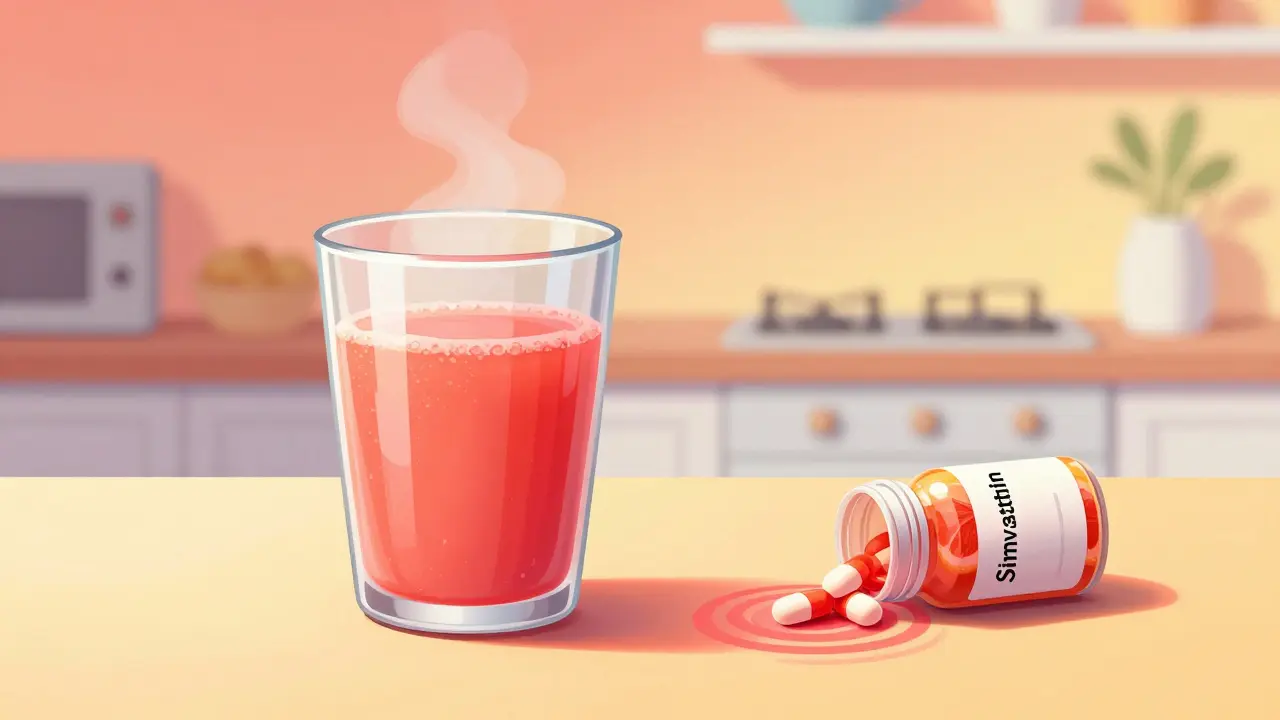
You love your morning glass of grapefruit juice. It’s tangy, refreshing, and feels like a healthy start to the day. But if you’re taking certain medications, that glass could be putting your life at risk. This isn’t a myth or a warning from an overcautious doctor-it’s science. Since the 1980s, researchers have known that grapefruit juice can dramatically change how your body handles medications, sometimes turning a safe dose into a toxic one.
The problem isn’t the sugar or the vitamin C. It’s something called furanocoumarins. These natural compounds in grapefruit (especially in white varieties) shut down an enzyme in your gut called CYP3A4. This enzyme normally breaks down about half of all oral medications before they enter your bloodstream. When it’s blocked, your body absorbs way more of the drug than it should. And once it’s turned off, it stays off for up to three days. That means even if you drink grapefruit juice at breakfast and take your pill at night, you’re still at risk.
How Much Grapefruit Juice Actually Matters?
You don’t need to drink a whole pitcher. One small glass-about 200 milliliters, or just over half a cup-is enough to cause serious changes. Studies show that this amount can block up to 47% of the CYP3A4 enzyme in your gut within four hours. And the effect doesn’t fade quickly. It takes your body 24 to 72 hours to make new enzymes to replace the ones that were destroyed. So even if you space out your juice and your pill, you’re not safe.
Not all grapefruit products are the same. Fresh-squeezed juice has the highest concentration of furanocoumarins. Pasteurized juice? Still risky. Grapefruit segments? Just as dangerous. Even grapefruit-flavored sodas or candies can contain enough of these compounds to cause trouble. The FDA says: if your medication label warns about grapefruit, avoid it completely-not just at the same time as your pill, but for the entire time you’re taking it.
Which Medications Are Most at Risk?
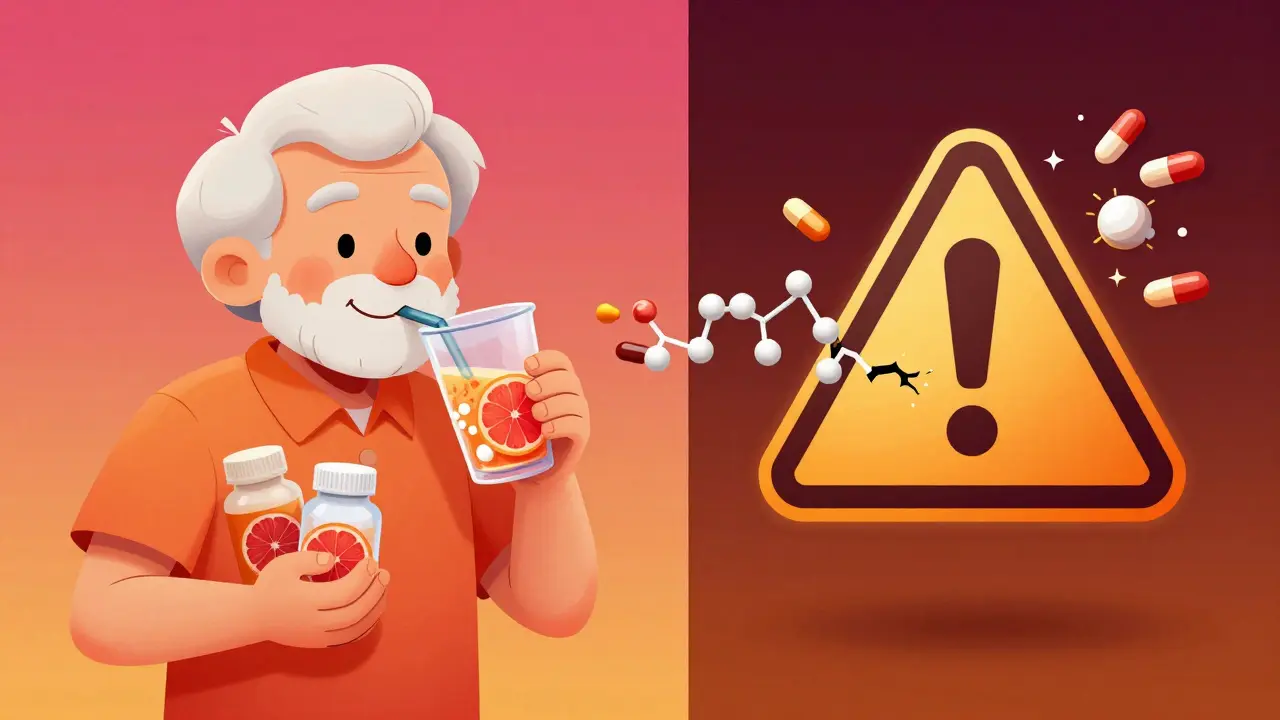
More than 85 prescription drugs are known to interact with grapefruit juice. Of those, 43 can cause life-threatening side effects. Here are the biggest red flags:
- Statins (cholesterol drugs): Simvastatin (Zocor) is the worst offender. One glass of grapefruit juice can triple your blood levels of the drug, raising your risk of rhabdomyolysis-a condition that destroys muscle tissue and can lead to kidney failure. Atorvastatin (Lipitor) is less risky, but still not safe. Pravastatin and rosuvastatin? They’re fine. If you’re on simvastatin and drink grapefruit juice, talk to your doctor about switching.
- Calcium channel blockers (blood pressure meds): Felodipine (Plendil) sees a fivefold increase in blood levels with grapefruit juice. Nifedipine (Procardia) jumps 3.3 times. Amlodipine (Norvasc)? Minimal risk. If your blood pressure drops too low, you could pass out or have a stroke.
- Immunosuppressants: Cyclosporine (Neoral), used after organ transplants, can spike 50-60% in concentration. That means kidney damage, high blood pressure, and nerve problems become much more likely.
- Antiarrhythmics: Amiodarone (Cordarone) can increase by 30-40%, raising the risk of dangerous heart rhythms.
- Some psychiatric drugs: Certain benzodiazepines and sedatives can build up to unsafe levels. But not all-trazodone and zolpidem show little to no interaction.
The key takeaway? Not every drug is affected. But if you’re on any of these, even one glass of grapefruit juice can be the difference between healing and hospitalization.
What About Other Citrus Fruits?
Not all citrus is the same. Seville oranges (the kind used in traditional marmalade) and pomelos contain the same dangerous compounds as grapefruit. Avoid them too. But sweet oranges-like navel or Valencia-and lemons? Safe. They don’t have furanocoumarins. So if you’re looking for a citrusy alternative, go for orange juice or lemon water.
Some people think that switching to orange juice is a workaround. It’s not always that simple. Some orange juices are made from Seville oranges and labeled as “bitter orange” or “marmalade orange.” Always check the label. If it doesn’t say “sweet orange,” assume it’s risky.
Who’s Most at Risk?
Older adults are the most vulnerable. People over 65 make up 40% of grapefruit juice drinkers in the U.S., according to USDA data. And they’re also the ones most likely to be taking five or more medications at once. The American Geriatrics Society specifically warns this group: if you’re on any of the high-risk drugs, skip grapefruit entirely.
Genetics also play a role. Some people naturally have more CYP3A4 enzyme in their gut than others. That means grapefruit juice might spike their drug levels 8 times, while someone else’s only doubles. There’s no test to find out which group you’re in. So if your doctor says to avoid grapefruit, don’t gamble with your health.
What Should You Do?
Here’s what works in real life:
- Check every medication label. If it says “avoid grapefruit,” take it seriously. The FDA now requires this warning on 76% of affected drug labels.
- Talk to your pharmacist. They’re trained to catch these interactions. A 2021 study found that 89% of community pharmacists screen for grapefruit juice during medication pickup. But only 38% of patients remember being told about it. Don’t rely on memory-ask.
- Make a list. Write down every pill, supplement, and over-the-counter drug you take. Bring it to every appointment. Many interactions happen because patients don’t tell their doctors about everything they’re using.
- Ask about alternatives. If you’re on simvastatin and love grapefruit, ask if pravastatin or rosuvastatin is an option. If you’re on cyclosporine, could tacrolimus work instead? These switches are common and often safer.
- Don’t assume it’s safe. Even if you’ve been drinking grapefruit juice for years with no problems, that doesn’t mean it’s safe now. Your body changes. Your meds change. Your liver changes. What was fine last year might be dangerous today.
What’s Being Done to Fix This?
Scientists are working on solutions. In October 2023, the USDA announced that CRISPR-edited grapefruit with 90% less furanocoumarin had passed early safety trials. If this becomes available, it could mean a future where you can enjoy grapefruit without the risk.
But that’s years away. Right now, the safest advice remains the same: if your medication warns about grapefruit, don’t take the chance. No amount of juice is worth a trip to the ER.
When in Doubt, Skip It
This isn’t about being extreme. It’s about being smart. You wouldn’t mix alcohol with certain painkillers. You wouldn’t take antibiotics with dairy if your doctor said no. Grapefruit juice is the same. It’s not a food that’s “sometimes okay.” For many medications, it’s a silent, unpredictable danger.
There’s no test to know if you’re sensitive. No way to measure your enzyme levels before you drink. And the consequences can be fatal-heart attacks, kidney failure, muscle breakdown, sudden death.
So if you’re unsure, skip the juice. Drink orange juice instead. Or water. Or tea. Your body will thank you.
Can I drink grapefruit juice if I take my medication at night and juice in the morning?
No. The enzyme-blocking effect of grapefruit juice lasts 24 to 72 hours. Even if you drink it in the morning and take your pill at night, the enzyme is still suppressed. The FDA says you must avoid grapefruit juice for the entire time you’re on the medication-not just around the time you take your dose.
Is it safe to eat grapefruit instead of drinking the juice?
No. The same compounds that block the enzyme are in the fruit’s pulp and peel. Whether you drink it, eat it, or chew the rind, the risk is the same. The interaction isn’t about liquid vs. solid-it’s about the furanocoumarins.
Do all statins interact with grapefruit juice?
No. Simvastatin and lovastatin have the strongest interaction. Atorvastatin has a moderate one. But pravastatin and rosuvastatin don’t interact significantly. If you’re on a statin and want to drink grapefruit juice, ask your doctor which one you’re taking and whether it’s safe.
What if I accidentally drank grapefruit juice with my medication?
Don’t panic. One time won’t always cause harm-but it can. Watch for unusual symptoms: unexplained muscle pain, weakness, dark urine, dizziness, irregular heartbeat, or extreme fatigue. If you notice any of these, call your doctor or go to the emergency room. In the future, avoid grapefruit completely if your medication has this warning.
Can I drink grapefruit juice if I’m not on any medications?
Yes. Grapefruit juice is perfectly safe if you’re not taking any drugs that interact with it. Many people drink it daily without issue. The risk only exists when you’re on medications that are broken down by the CYP3A4 enzyme. If you’re unsure, check with your doctor or pharmacist.
Justin Fauth
February 3, 2026This is why America's getting weaker. People drink their grapefruit juice like it's water while popping pills like candy. No wonder we've got a healthcare crisis. You think your 'natural remedy' is harmless? Nah. It's a slow-motion suicide pact with your own liver. Wake up, folks.
Meenal Khurana
February 4, 2026I avoid grapefruit juice with my blood pressure meds. Simple. Safe.
Jesse Naidoo
February 6, 2026Wait wait wait... so you're telling me my morning ritual is secretly trying to kill me? I've been drinking this since college. My grandma drank it. My dad drank it. And now you're saying it's a silent assassin? I need to sit down. This is too much.
Sherman Lee
February 7, 2026They don't want you to know the truth. The FDA, Big Pharma, and the citrus lobby? All in cahoots. Why? Because if people knew grapefruit juice could save them from overmedicated zombies, they'd stop buying $200 pills. CRISPR-edited grapefruit? That's just a distraction. They're not fixing the problem-they're monetizing the fear. 🍊💀
Lorena Druetta
February 7, 2026Thank you for sharing this vital information. I have shared it with my elderly mother who takes multiple medications daily. Please continue to educate others with such clarity and care. Your work matters deeply.
With sincere gratitude,
Lorena
Zachary French
February 9, 2026Okay so I just found out that my ‘healthy’ grapefruit smoothie is basically a chemical weapon when paired with my statin. I’ve been doing this for 7 years. SEVEN YEARS. I’m basically a walking science experiment gone wrong. My doctor never mentioned it. My pharmacist? Didn’t say a word. Now I’m paranoid as hell. Is my kidney okay? Is my heart gonna explode? I’m gonna go cry in the shower now. 🍊😭
Kunal Kaushik
February 9, 2026I drink grapefruit juice every day and take my meds at night. Didn't know this. Thanks for the heads up. I'll switch to orange juice now. Peace out. 🍊➡️🍊
Nathan King
February 10, 2026The biochemical mechanism elucidated herein-namely, the irreversible inhibition of CYP3A4 by furanocoumarins-is both elegant and alarming. One is compelled to question the adequacy of current pharmacovigilance protocols when such a ubiquitous dietary component remains underemphasized in public health messaging. The regulatory lacuna is, frankly, indefensible.
Susheel Sharma
February 12, 2026This article is basically fearmongering dressed up as science. 85 drugs? Big whoop. Most people don’t even take them. And you’re acting like grapefruit juice is poison? It’s a fruit. You think your body can’t handle it? You’re weak. Also, CRISPR grapefruit? That’s just GMO fear 2.0. 🤡🍊