
17 Jan 2026
- 13 Comments
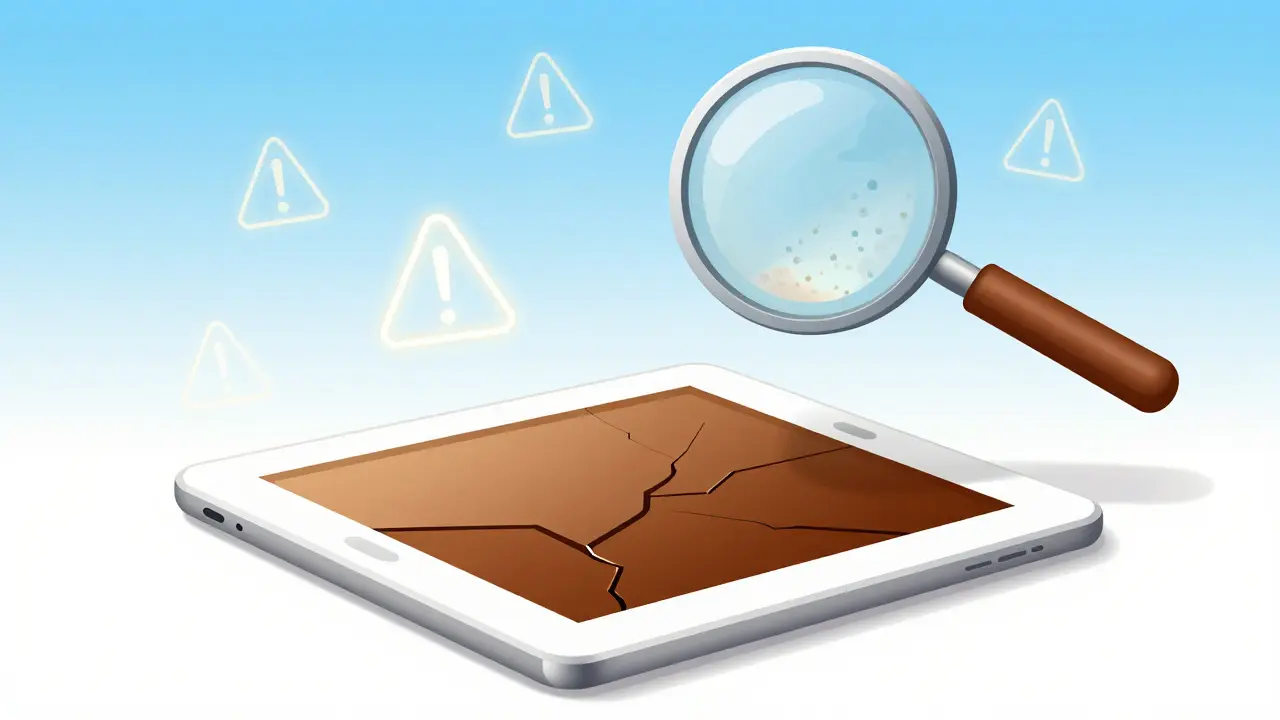
When a pill turns brown, a cream separates into oily layers, or a liquid medicine smells like vinegar, it’s not just old-it’s potentially dangerous. Expired drugs don’t always lose potency overnight. Sometimes, they change physically long before the date on the label, and those changes can signal real health risks. You don’t need a lab to spot them. With a little knowledge and careful observation, you can catch warning signs before someone takes a compromised medication.
What Changes to Look For
Expired medications often show three clear signs of degradation: color, odor, and texture. These aren’t random quirks-they’re clues rooted in chemistry and physics. The U.S. Food and Drug Administration (FDA) and World Health Organization (WHO) both confirm that physical changes are among the most common indicators of instability in drugs past their expiration date.
Color shifts are the most frequent. A white tablet turning yellow or brown? That’s not normal aging. Tetracycline antibiotics, for example, commonly darken due to chemical breakdown. Nitroglycerin tablets, which should stay clear or pale yellow, turn deep brown when they degrade. Even clear liquids like eye drops can cloud over or develop a yellow tint. In NASA’s 2011 stability study, 68.3% of expired solid drugs showed visible discoloration.
Odor changes are harder to ignore. If your antibiotic smells rancid, sour, or like wet cardboard, it’s gone bad. Amoxicillin capsules, especially if stored in humid areas, absorb moisture and start to smell musty. Liquid suspensions can develop a fermented odor as bacteria grow. Don’t assume the smell is just from the filler-medications are formulated to be odorless or mildly scented. A strong, off-putting smell means chemical or microbial degradation has occurred.
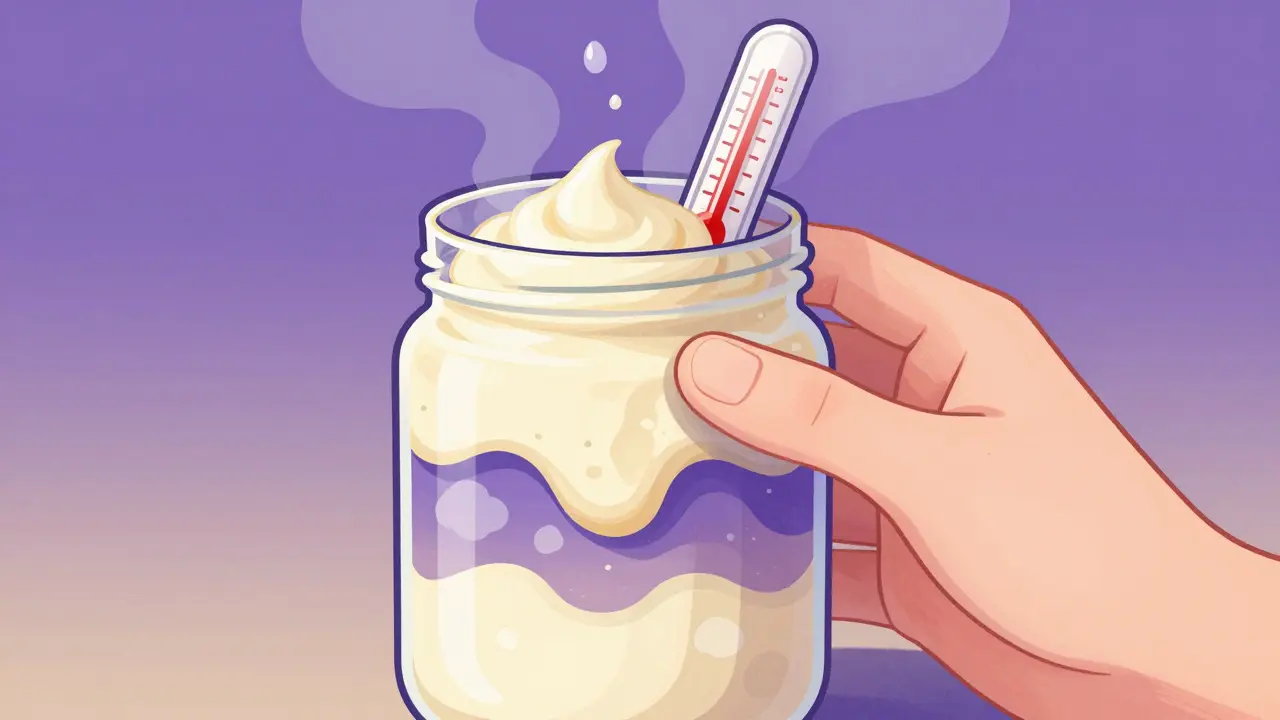
Texture is the most overlooked sign. A tablet that crumbles when you touch it? That’s friability-too much moisture or heat has broken down the binder. Capsules that feel sticky, clumpy, or swollen? That’s moisture absorption. Creams and ointments that separate into oily and watery layers? That’s phase separation. If you shake a bottle of liquid medicine and particles don’t fully dissolve, or if you see floating specks, that’s particulate formation. These aren’t cosmetic issues-they affect how the drug is absorbed and can cause harm.
How Different Medications Degrade
Not all drugs degrade the same way. The form matters. Solid tablets, liquids, creams, and injectables each follow different breakdown patterns.
Solid oral dosage forms like tablets and capsules are the most common. Tablets may develop dark spots, especially around the edges, or become brittle. Capsules often swell, leak, or harden. Hygroscopic drugs-those that soak up moisture like amoxicillin or aspirin-are especially vulnerable. In one study, amoxicillin capsules stored at high humidity absorbed moisture from 2% to over 15%, causing caking and clumping inside the shell.
Semisolid formulations like hydrocortisone cream, mupirocin ointment, or antifungal gels are prone to phase separation. You’ll see oil rising to the top or water pooling at the bottom. Some creams develop a grainy texture or harden into a waxy lump. Ciprofloxacin ointment, tested in NASA’s space missions, liquefied after 880 days past expiration-even under controlled conditions.
Liquid medications like cough syrups, eye drops, or injectables are the most sensitive. Particles may form, the liquid may cloud, or it may change color. The FDA’s USP <788> standard says non-sterile liquids should have fewer than 6,000 particles per container larger than 10 microns. Once you see visible specks, it’s over the limit. Microbial growth can also occur-especially in multi-dose vials or suspensions without preservatives. If the liquid smells off or looks cloudy, don’t use it.
Why Physical Changes Matter More Than You Think
Some people think if a pill still looks like a pill, it’s fine. That’s dangerous thinking. The National Institute of Justice found that human visual assessment of drug color is only 65.2% accurate compared to instruments. You can miss subtle changes.
Even worse, physical changes don’t always match chemical degradation. Some drugs, like PMZ (phenylbutazone) tablets, lost potency before any color or texture shift occurred. Others, like certain antibiotics, changed color but remained safe and effective. That’s why physical inspection is a screening tool-not a final verdict.
But here’s the key: if you see a physical change, you don’t need to wait for a lab test. The risk isn’t worth it. The WHO estimates that 10.5% of expired drugs show physical changes that affect safety. That’s more than 1 in 10. In hospital settings, 37.6% of expired drug incidents involved overlooked discoloration in light-sensitive meds like nitroglycerin. One hospital kept using expired morphine sulfate with fine crystals-mistaking them for normal sediment-and caused 14 patient adverse events.
How to Inspect Medications Properly
You don’t need special tools, but you do need a system.
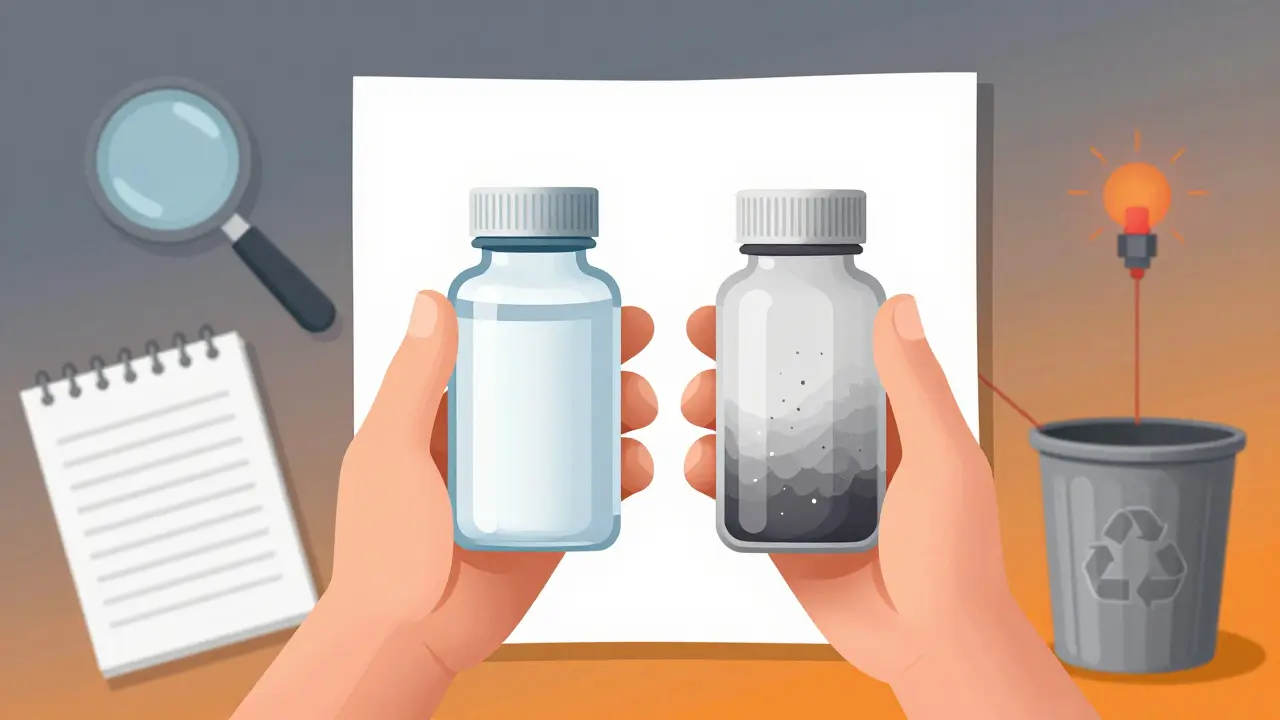
- Use good lighting. Inspect under natural daylight or a 500-lux lamp. Avoid dim or yellow lights.
- Use a white background. Place pills or creams on a clean white paper or plate. This makes color shifts easier to spot.
- Compare to new ones. If you have an unexpired bottle of the same drug, compare side by side. Look for differences in shade, texture, or clarity.
- Smell everything. Open capsules and sniff. Smell liquids before shaking. If it smells wrong, it is wrong.
- Check texture. Gently press a tablet between your fingers. Does it crumble? Does a cream feel grainy or oily? Does a liquid leave residue when shaken?
- Document anything odd. Write down what you saw: “light brown discoloration on tablet edges,” “cream separated into two layers,” “liquid smells like vinegar.” Photos help, especially if you’re unsure.
Many pharmacies and research labs use the Colored Dot System-color-coded stickers on expiration dates-to remind staff to check monthly. You can do something similar at home. Use a permanent marker to write the expiration date on the outside of the bottle. Check it every 3 months.
What to Do When You Spot a Problem
If you see any of these changes, stop using the medication immediately. Don’t flush it down the toilet or toss it in the trash. Take it to a pharmacy with a drug take-back program. Many pharmacies accept expired or unwanted medications for safe disposal.
If you’re unsure, call your pharmacist. They can look up the drug’s stability profile and tell you whether the change is common or alarming. For example, some antibiotics naturally darken slightly over time-but only within a specific range. A pharmacist can tell you if it’s within normal limits.
Never take a drug that looks, smells, or feels off-even if it’s just a few days past the expiration date. The risk of reduced effectiveness or harmful reactions isn’t worth it.
What Doesn’t Count as Degradation
Not every change means the drug is bad. Some drugs are designed to look different.
- White tablets with faint lines or specks? Those are often harmless excipients (fillers) that settle.
- Some liquids are cloudy by design, like suspensions of antibiotics for children.
- Creams may thicken slightly in cold weather but return to normal at room temperature.
When in doubt, compare to the manufacturer’s reference images. The FDA’s Drug Expiration Database includes photos of common degradation patterns. If you’re still unsure, consult a pharmacist.
Storage Matters More Than You Realize
Most people store medicines in the bathroom-hot, humid, and full of steam. That’s the worst place. Heat and moisture speed up degradation. Studies show that temperatures above 25°C (77°F) can accelerate physical changes by 2.3 times.
Store medications in a cool, dry place-like a bedroom drawer or kitchen cabinet away from the stove. Avoid leaving pills in the car or in direct sunlight. Keep them in their original bottles with the child-resistant cap on. Don’t transfer them to pill organizers unless you’re using them within a week.
Future Trends: Technology Is Changing the Game
While visual inspection remains the most accessible method, especially in low-resource areas, technology is catching up. Portable Raman spectrometers and smartphone-based color analyzers are becoming affordable. Pfizer’s Visual Stability AI, currently in trials, can predict drug degradation from microscopic texture images with 94.3% accuracy.
By 2025, the European Medicines Agency may require spectrophotometric verification for injectables. But for now, your eyes, nose, and fingers are your best tools. No app replaces a careful look.
Final Rule: When in Doubt, Throw It Out
Medications aren’t like food. You can’t taste them to check if they’re spoiled. There’s no second chance if a degraded drug causes an allergic reaction, reduces effectiveness, or triggers side effects. The cost of a new bottle is nothing compared to the cost of a bad reaction.
If you see a color change, an odd smell, or a strange texture-don’t hesitate. Dispose of it safely and get a new one. Your body doesn’t care if the expiration date was yesterday or last year. It only cares if the medicine works-and if it’s safe to take.
Can expired drugs still be effective if they look normal?
Yes, some expired drugs retain potency even after the date on the label, especially if stored properly. But appearance alone doesn’t guarantee safety. Some medications degrade chemically without changing color or texture. The FDA says expiration dates are the last guaranteed date of full potency and safety. If a drug is expired, don’t assume it’s safe-even if it looks fine.
Is it safe to use a pill that changed color but is still within the expiration date?
No. If a pill changes color before the expiration date, it likely experienced improper storage-heat, moisture, or light exposure. That can cause degradation regardless of the label date. Don’t use it. Contact your pharmacist and report the issue. The manufacturer may need to investigate.
Can I tell if a liquid medicine is contaminated just by looking at it?
You can spot signs of contamination: cloudiness, floating particles, unusual sediment, or a foul odor. But not all microbial growth is visible. The FDA allows up to 100 colony-forming units per milliliter in non-sterile liquids. You can’t see that. If a liquid smells off, looks cloudy, or has been left open too long, throw it out. Don’t risk infection.
Why do some creams separate into layers?
Creams and ointments are emulsions-oil and water held together by stabilizers. Over time, especially after expiration or exposure to heat, those stabilizers break down. The oil rises to the top, and water sinks. This is called phase separation. It means the formula is no longer stable. Even if you stir it back together, the drug may not distribute evenly. Don’t use it.
What’s the safest way to dispose of expired medications?
Take them to a pharmacy with a drug take-back program. Many pharmacies, hospitals, and police stations offer free disposal. If that’s not available, mix pills with an unappealing substance like coffee grounds or cat litter, seal them in a plastic bag, and throw them in the trash. Never flush them unless the label says to. This prevents accidental ingestion and environmental contamination.
kenneth pillet
January 18, 2026Been using my dad's old blood pressure pills after the date and never had an issue. Maybe i got lucky. But if it looks weird now i'm tossing it. Better safe than sorry.
Andrew Qu
January 18, 2026This is gold. I work in a rural clinic and we see people take expired meds all the time because they can't afford new ones. The color changes in tetracycline? Yeah, we've seen it turn black. No one should risk it. Always check the texture too - if it's crumbling, it's not just old, it's broken down.
Pro tip: Keep meds in a sealed container with silica packs in a drawer. Bathroom = death zone.
Dayanara Villafuerte
January 19, 2026I used to store my insulin in the car because i thought 'it's just medicine, it's fine'... until it turned into syrup and smelled like fermented grapes 🤢. Now it lives in my fridge with a sticky note that says 'DO NOT TOUCH THIS OR I WILL END YOU'.
rachel bellet
January 21, 2026The notion that physical changes are reliable indicators is fundamentally flawed. Degradation kinetics are nonlinear and compound-specific. You're conflating macroscopic manifestations with molecular instability. A tablet may appear pristine while its active moiety has hydrolyzed by 40%. Relying on visual inspection is a heuristic fallacy with potentially lethal consequences.
Naomi Keyes
January 21, 2026I just checked my medicine cabinet - three bottles had changed color. One was a 3-year-old antibiotic that looked like it had been dipped in espresso. I called my pharmacist immediately. She said, 'Good job. Most people just shrug and take it.' I felt like a superhero. 🦸♀️
Jodi Harding
January 22, 2026Smell is the real tell. If it smells like regret, it’s expired.
Chuck Dickson
January 23, 2026Look, I know it’s tempting to think 'it’s just a few days past' - but that’s how people end up in the ER. I had a cousin who took expired amoxicillin because the bottle looked fine. Got a full-blown C. diff infection. Now he’s on probiotics for life. Don’t be that person. When in doubt, toss it. Your body will thank you.
Robert Cassidy
January 24, 2026This is why America’s healthcare system is a joke. You can’t even trust your own medicine anymore. The FDA lets this happen. Big Pharma doesn’t want you to know how fast these things rot. They profit off you buying new ones. I’m not taking anything past the date - even if it looks perfect. I’m not their lab rat.
Pat Dean
January 24, 2026You think you’re being careful? You’re not. Half the people who read this will still take expired meds because they’re lazy. And then they wonder why they get sick. It’s not the drug’s fault. It’s yours. You didn’t check. You didn’t care. Now you’re blaming the system. Pathetic.
Selina Warren
January 25, 2026We treat our bodies like disposable machines. We eat garbage, sleep poorly, then pop pills like candy. And when those pills go bad? We’re shocked. But we never ask: why did we let it get to this? The real expiration date isn’t on the bottle - it’s the day we stopped respecting our own health.
Jay Clarke
January 25, 2026I saw a guy in the pharmacy today take a bottle of expired insulin and put it in his cart. I almost yelled at him. He looked at me like I was crazy. I said, 'That stuff turns into poison after 6 months.' He shrugged. I left. But I swear, if he uses that and ends up in the ER, I’m posting this article on his Facebook wall.
Stacey Marsengill
January 26, 2026I used to keep my thyroid meds in the bathroom because I forgot to move them. Then I noticed the pills had tiny white specks - like frost. I thought it was humidity. Turns out, the binder had broken down. I took one anyway because I was out of refills. Felt like I was being slowly poisoned for 3 days. Never again. Now I store mine in a locked box in the closet. Like a secret treasure. Or a time bomb.
christian Espinola
January 27, 2026The FDA’s expiration dates are a scam. Most drugs are still potent for years after. The real danger is the pharmaceutical industry pushing you to repurchase. They don’t care if you die - they care if you buy more. This article is propaganda. Trust your own eyes - not some bureaucrat’s label.