
2 Dec 2025
- 9 Comments
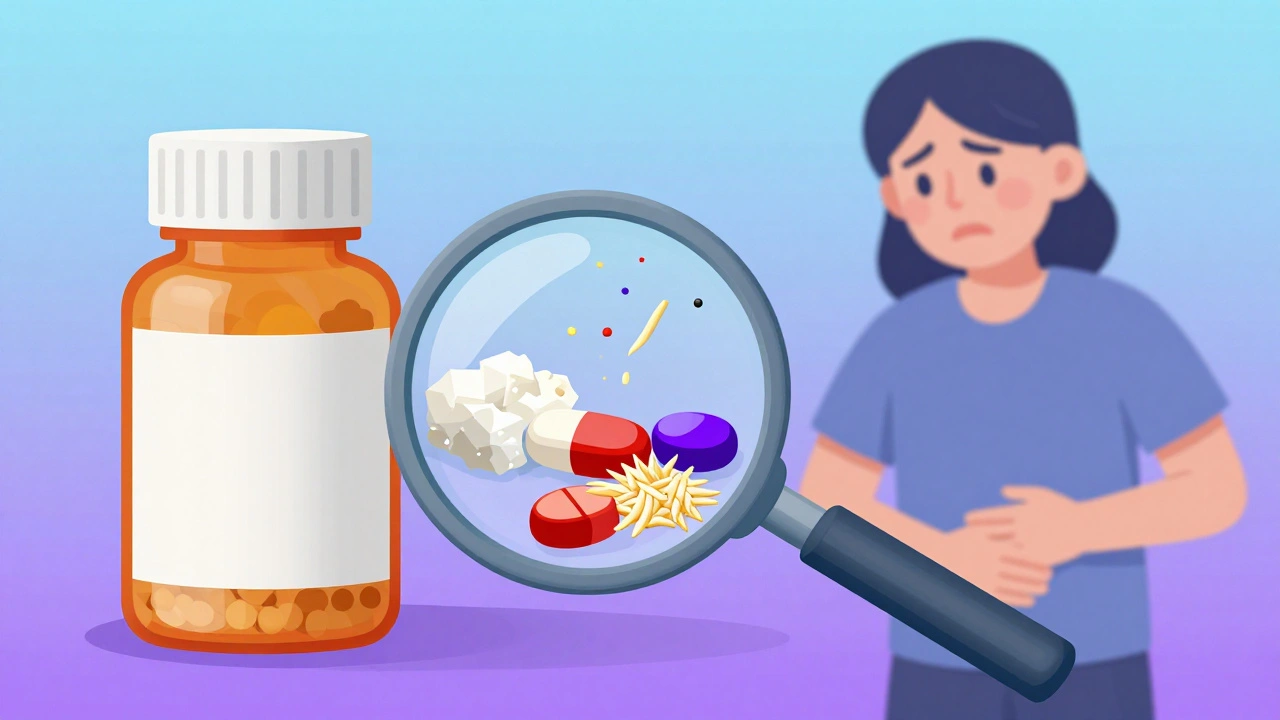
When you pick up a generic pill at the pharmacy, you’re told it’s the same as the brand-name version. And technically, that’s true - the active ingredient is identical. But what you don’t see are the inactive ingredients. These are the fillers, dyes, preservatives, and binders that make up most of the pill. For most people, they’re harmless. For others, they’re the reason they feel worse after switching.
What Exactly Are Inactive Ingredients?
Inactive ingredients - also called excipients - aren’t meant to treat your condition. They’re there to help the medicine work properly. They hold the pill together, make it easier to swallow, improve shelf life, or even make it taste less awful. But here’s the catch: they’re not regulated the same way as the active drug.
While the FDA requires generic drugs to match brand-name drugs in strength, purity, and how quickly they enter your bloodstream, there’s no rule forcing them to use the same fillers. A generic version of your blood pressure pill might use lactose as a binder. The brand version might use cornstarch. Both are approved. But if you’re lactose intolerant, that small change can cause bloating, cramps, or worse.
Studies show that over half the weight of most pills comes from these inactive ingredients. In some cases, it’s as high as 99%. That means you’re swallowing mostly stuff that isn’t medicine - and you have no idea what’s in it unless you dig deep.
Why This Matters More Than You Think
Most people assume that if the active ingredient is the same, the whole pill is the same. That’s not true. And it’s not just about allergies.
Research from MIT and Brigham and Women’s Hospital found that 93% of medications contain at least one common allergen - like lactose, gluten, peanut oil, or artificial dyes. About 55% contain FODMAP sugars, which can trigger IBS symptoms in sensitive people. And here’s the kicker: most of these aren’t labeled.
Manufacturers must list bisulfites (which can trigger asthma attacks) on the label. But if your pill contains lactose, gluten, or a dye like Red 40? You won’t know unless you look up the ingredient list online or ask your pharmacist. And even then, it’s not always easy to find.
Patients with chronic conditions - especially older adults taking five or more pills a day - are at higher risk. Each pill adds another potential trigger. Over time, these hidden ingredients can pile up. One person might react to lactose in their thyroid med, gluten in their statin, and dye in their antidepressant. Suddenly, they’re dealing with rashes, stomach pain, or fatigue - and no doctor can connect the dots because no one’s asking about the fillers.

Real Stories: When the Pill Stops Working
It’s not theoretical. People report real problems after switching to generics.
One patient on Reddit switched from Synthroid to generic levothyroxine and developed severe stomach cramps. The symptoms vanished when they went back to the brand. Another person reported constant headaches after switching to a generic version of losartan - a blood pressure drug. Their doctor dismissed it as coincidence. They didn’t know that a 2017 Harvard study found adverse event rates jumped by 8-14% for several generic blood pressure medications after they hit the market.
A survey by MedShadow found that 27% of people who switched to generics reported new side effects. Of those, 68% blamed the inactive ingredients. These aren’t rare cases. They’re underreported because most doctors don’t think to ask. And most patients don’t know to say anything.
The FDA’s own adverse event database has hundreds of reports linking reactions to fillers in generic drugs. But proving causation is hard. The system isn’t built to track what’s in the pill - only whether the drug worked or caused harm.
Are Generic Drugs Safe?
Yes - for most people, absolutely. Generic drugs are safe, effective, and save billions in healthcare costs. About 90% of prescriptions in the U.S. are filled with generics. That’s not a flaw - it’s a win.
The FDA requires generics to prove they deliver the same amount of active ingredient into your bloodstream as the brand name. The difference in absorption is usually less than 4%, well within safe limits. So if you’re taking a generic for high cholesterol or diabetes and feel fine? You’re likely doing great.
The problem isn’t quality control. It’s transparency. There’s no requirement for manufacturers to list all inactive ingredients on the packaging. No standard for allergen warnings. No easy way for patients to compare formulations across brands.
That’s why some people do better on one generic version than another - even if both are labeled the same. One might use magnesium stearate. Another might use stearic acid. They sound similar. But for someone with a rare sensitivity, one could cause inflammation while the other doesn’t.
What Should You Do?
If you’ve noticed new symptoms after switching to a generic - stomach upset, skin rashes, fatigue, headaches - don’t ignore it. Here’s what to do:
- Check the pill’s ingredients. Look up the National Drug Code (NDC) on the pill bottle. Search it on the FDA’s Inactive Ingredient Database (IID). You’ll see every filler used in that specific version.
- Talk to your pharmacist. Ask: “Is there a version of this generic that doesn’t contain lactose, gluten, or Red 40?” Pharmacists have access to formulation databases and can often find alternatives.
- Ask your doctor to write “Dispense as Written” or “Do Not Substitute” on the prescription. This forces the pharmacy to give you the exact brand or generic they’re supposed to. It’s legal. It’s your right.
- Keep a symptom log. Note when you switch medications and what changes you feel. Bring it to your next appointment. Patterns matter.
- Consider specialty generics. Some manufacturers now make “hypoallergenic” versions - free from common irritants. They’re not always cheaper, but they exist.
If you’re on multiple medications - especially if you’re over 65 - this becomes even more important. Each pill adds another potential trigger. You might not react to one filler alone, but combine lactose, gluten, and a dye? That’s when symptoms show up.
The Bigger Picture
This isn’t just about you. It’s about a system that treats pills like interchangeable parts - when they’re not. For most people, it works. For a growing number, it doesn’t.
Researchers at MIT are building a public database to map inactive ingredients across all FDA-approved drugs. That’s a step forward. But until labels clearly warn about gluten, lactose, and dyes - and until doctors routinely ask about them - patients will keep suffering in silence.
Generic drugs are a vital part of modern healthcare. But they’re not magic. They’re chemistry. And chemistry has side effects - even when the active ingredient is perfect.
If you’ve ever felt off after switching to a generic - you’re not imagining it. You’re not crazy. You’re just one of the people the system forgot to protect.
Joanne Rencher
December 4, 2025Wow, finally someone says it. I’ve been telling my doctor for years that my generic thyroid med makes me feel like a zombie with a side of bloating. She just shrugged and said ‘it’s the same chemical.’ Yeah, right. Like my stomach doesn’t know the difference between lactose and cornstarch. Thanks for validating what I’ve been too tired to fight about.
Erik van Hees
December 5, 2025You’re all missing the real issue. The FDA doesn’t regulate excipients because they’re not *active* - not because they don’t matter. But here’s the kicker: the same manufacturers often make both brand and generic versions. They just swap out the filler to cut costs. Lactose? Cheap. Cornstarch? Slightly more expensive. So guess which one gets used in the $2 generic? Also, Red 40 isn’t even FDA-approved for all uses - yet it’s in pills like it’s candy. Wake up.
Cristy Magdalena
December 5, 2025I can’t believe how many people are still in denial. I had a rash for six months. Six. Months. My dermatologist blamed stress. My allergist blamed my laundry detergent. My GP blamed ‘hormonal imbalance.’ Then I looked up the NDC code for my generic fluoxetine - and there it was: FD&C Yellow No. 6. I stopped taking it. The rash vanished in 36 hours. No one asked. No one cares. But now I know. And I’m never going back. This isn’t ‘anecdotal.’ It’s medical negligence wrapped in a pill.
Josh Bilskemper
December 7, 2025Stop crying about fillers. If you can’t handle a few milligrams of lactose or dye you shouldn’t be taking pills at all. The system works. 90% of people are fine. The rest are just hypersensitive or lazy. Just buy the brand if you’re that delicate. No one’s forcing you to save money.
Storz Vonderheide
December 7, 2025Hey everyone - I work in pharmacy tech and I see this every day. A lot of you are right to be concerned. But here’s the good news: pharmacists have access to a whole database of generic formulations. If you ask for a version without lactose or gluten, we can usually find one. It might cost a little more, but it’s not impossible. Also - if you’re on five meds? Ask for a med sync. We can flag potential filler conflicts across all your prescriptions. You’re not alone. We’re here to help. Just speak up.
dan koz
December 7, 2025Bro in Nigeria here. We don’t even have generics here - just fake pills sold in markets. But I read this and I’m like… same problem everywhere. People don’t know what’s in their medicine. I had a cousin who got sick after switching to a ‘cheap’ blood pressure pill. Turned out it had talc in it. Talc. Like baby powder. No one checked. This is global. We need labels like food. Simple. Clear. No excuses.
Ethan McIvor
December 9, 2025It’s wild how something so small - a few milligrams of filler - can throw off someone’s entire life. I used to think medicine was just chemistry. Now I see it’s also personal. Like, your body isn’t a test tube. It remembers. It reacts. And no algorithm or FDA form can capture that. We need more empathy in pharmacology. Not just data.
Mindy Bilotta
December 11, 2025OMG I just looked up my generic metformin and it’s got lactose 😭 I’ve had IBS for years and never connected it. I’m calling my pharmacist tomorrow. Thank you for this post. Seriously. I feel seen.
Michael Bene
December 12, 2025Let me get this straight - we’ve got a multi-billion-dollar industry that can put a man on the moon, send a rover to Mars, and engineer CRISPR to edit genes… but can’t print ‘THIS PILL CONTAINS LACTOSE’ on the bottle? Are we in 1923? This isn’t ‘regulatory oversight’ - it’s corporate laziness dressed up as bureaucracy. And if you’re still defending this? You’re part of the problem. Wake. Up. The pill you’re swallowing isn’t medicine. It’s a Russian roulette cartridge with a side of corporate indifference.